Peninsula Building Materials Mountain View: Stone & Masonry Comparison
Compare natural stone, manufactured veneer, and porcelain pavers at Peninsula Building Materials Mountain View. 2026 pricing and seismic specs.

The Mountain View Showroom: Bay Area Masonry & Hardscape Trends
Peninsula Building Materials, located on Old Middlefield Way in Mountain View, operates as the primary masonry, stone, and hardscape supply hub for Silicon Valley contractors, landscape architects, and custom home builders. As we navigate 2026, the Bay Area construction market is heavily influenced by two competing forces: strict seismic structural requirements and a surge in biophilic, drought-resilient exterior designs. Selecting the right cladding or paving material from this specific yard requires balancing aesthetic demands with dead-load limitations and local Title 24 compliance.
This comparison review evaluates the three dominant exterior material categories stocked at the Mountain View facility: Natural Thin Stone Veneer, Manufactured Stone Veneer (MSV), and Architectural Porcelain Pavers. We break down exact material costs, structural weights, installation parameters, and long-term performance metrics specific to Northern California's microclimates.
Material Comparison Matrix: At-a-Glance Specifications
| Material Category | Avg. Weight (psf) | 2026 Material Cost (sq. ft.) | Installation Complexity | Primary Application |
|---|---|---|---|---|
| Natural Thin Stone Veneer | 12 - 18 lbs | $16.00 - $28.00 | High (Requires scratch coat) | Feature walls, high-end facades |
| Manufactured Stone Veneer (MSV) | 7 - 10 lbs | $9.50 - $15.00 | Medium (Standard masonry prep) | Full-home exteriors, retrofits |
| 20mm Porcelain Hardscape Pavers | 9 - 11 lbs | $14.00 - $24.00 | Low/Medium (Pedestal or sand set) | Plazas, pool decks, roof decks |
Category 1: Natural Thin Stone Veneer
Real-World Performance, Sourcing, and Pricing
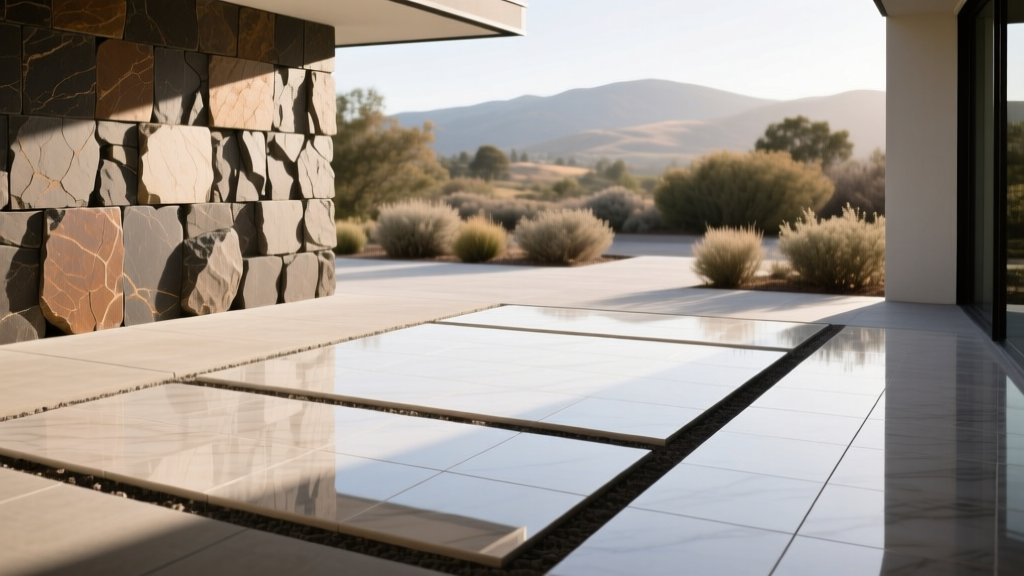
The Mountain View yard maintains a robust inventory of natural thin veneers, ranging from regional Sierra granite blends to imported quartzites and basalts. Unlike full-bed dimensional stone, thin veneer is sawn to a 1-inch to 1.5-inch profile, significantly reducing weight while retaining the authentic mineral variation and thermal mass of solid rock.
For exterior applications in the Bay Area, absorption rates are critical. Materials stocked here generally comply with Masonry Institute of America guidelines for exterior cladding in freeze-thaw or high-moisture zones. When specifying natural stone from this yard, request the ASTM C97 absorption test data. Stones with an absorption rate above 3% require a high-quality penetrating siloxane sealer to prevent efflorescence and spalling during Northern California's wet winter cycles.
Category 2: Manufactured Stone Veneer (MSV)
The Seismic Advantage for Silicon Valley Retrofits
Manufactured Stone Veneer (MSV), primarily sourced from brands like Eldorado Stone and Cultured Stone available at the facility, is a Portland cement-based architectural product cast in molds taken from real stone. The primary advantage of MSV in Mountain View is structural: it weighs roughly 40% less than natural thin veneer.
In a high seismic risk zone adjacent to the San Andreas and Hayward fault systems, reducing the dead load on shear walls and elevated floor diaphragms is a primary engineering objective. According to structural guidelines referenced by the National Concrete Masonry Association (NCMA), lighter cladding materials reduce the lateral inertial forces a building must resist during a seismic event. MSV allows architects to achieve the visual weight of a masonry facade without triggering the need for heavily reinforced (and expensive) steel moment frames in wood-framed residential builds.
All quality MSV products stocked at the Mountain View location meet ASTM C1670 standards, which dictate strict limits on freeze-thaw durability, density, and flexural strength. When purchasing MSV, ensure you also acquire the manufacturer-specified bonding mortar and weep screed; using standard brick mortar can lead to premature delamination due to the differing porosity of the concrete veneer.
Category 3: 20mm Architectural Porcelain Pavers
Hardscaping for Drought-Resilient & Elevated Decks
As Santa Clara County continues to enforce strict water conservation ordinances, the shift away from natural turf toward high-end hardscaping has accelerated. The Mountain View showroom features a growing selection of 20mm (3/4-inch) thick porcelain pavers designed for exterior use. These are not standard interior tiles; they are extruded and pressed to withstand point loads of up to 2,200 lbs, making them suitable for driveways, commercial plazas, and elevated pedestal roof decks.
Porcelain pavers offer a distinct advantage in slip resistance and stain immunity. Look for products with a Dynamic Coefficient of Friction (DCOF) of 0.60 or higher, measured via ANSI A137.1 testing protocols. Unlike natural flagstone or cast concrete pavers, porcelain is virtually impervious to water (absorption rate < 0.5%), meaning it will not harbor algae, resist oil stains from outdoor kitchens, and requires zero chemical sealing.
When installing 20mm porcelain pavers over a pedestal system on a rooftop or waterproofed balcony, the substrate slope must be precisely calibrated. Porcelain does not flex. If the pedestors are not laser-leveled to within 1/16th of an inch, the pavers will rock underfoot and eventually micro-fracture at the corners under concentrated point loads.
Decision Framework: Selecting the Right Material
Choosing between these materials at the Peninsula Building Materials yard should be driven by structural constraints, budget, and site-specific environmental factors. Use the following framework to finalize your specification:
- Choose Natural Thin Stone Veneer if: The project is a high-budget custom build where authentic mineral variation is paramount, the structural framing has been engineered to support 15+ psf dead loads, and the client is committed to periodic sealing maintenance.
- Choose Manufactured Stone Veneer (MSV) if: You are executing a seismic retrofit, building a multi-story wood-framed structure where dead load reduction is critical, or working with a mid-tier budget that requires a masonry aesthetic without the premium cost of natural quarry stone.
- Choose 20mm Porcelain Pavers if: The scope involves horizontal hardscaping, elevated roof decks requiring lightweight pedestal systems, or areas surrounding outdoor kitchens where high stain resistance and zero water absorption are non-negotiable.
Logistics and Delivery Considerations
When ordering from the Mountain View facility, factor in local logistical constraints. Delivery trucks carrying palletized stone (which routinely weigh 3,500 to 4,500 lbs per pallet) require stable, paved staging areas. For residential infill projects in dense Mountain View neighborhoods with narrow setbacks, coordinate with the yard's dispatch team to specify a smaller flatbed or a truck equipped with a Moffett forklift to navigate tight curb-side drops without damaging existing landscaping or sidewalks.
Written by
Marcus ChenMarcus Chen is a licensed structural engineer (PE) and building materials analyst with over 12 years of experience across residential, commercial, and industrial construction. He holds a Master of Science in Civil Engineering from UC Berkeley and spent six years at Thornton Tomasetti before transitioning to independent consulting and technical writing. Marcus specializes in material selection for seismic-prone regions, concrete reinforcement strategies, and lifecycle cost analysis. His work has been cited by the American Concrete Institute (ACI) and the Structural Engineers Association of California (SEAOC). When he is not on a job site or at his desk, you will find him hiking the Sierra Nevada or restoring a 1920s craftsman bungalow in Oakland, CA.
More from Marcus Chen
View all
Construction Cost
How Much Did the Eiffel Tower Cost to Build?
How much did the Eiffel Tower cost to build in 1889? We adjust for inflation and compare its budget to modern skyscraper construction.
Aug 4, 2026

Fire Resistance
What Is a Fire Resistant Material? Testing & Certification Guide
Discover what is a fire resistant material through ASTM and UL testing. Learn how fire ratings, certifications, and assemblies work in construction.
Aug 4, 2026

Construction Cost
How Much Did the Burj Khalifa Cost to Build?
How much did the Burj Khalifa cost to build? We break down the $1.5B project and extract 5 money-saving strategies for your next build.
Jul 30, 2026