Prime Building Materials Oxnard California: 2026 Cost Analysis
Analyze 2026 costs for prime building materials in Oxnard, California. Compare coastal-grade pricing, Title 24 compliance, and lifecycle ROI.

Defining 'Prime' in the Oxnard Coastal Microclimate
Sourcing construction supplies in Ventura County requires navigating a unique intersection of strict environmental regulations, aggressive coastal weathering, and complex logistics. When contractors and developers search for prime building materials Oxnard California markets offer, they are not simply looking for luxury finishes. In this specific zip code, 'prime' denotes materials engineered to survive the Pacific marine layer, resist seismic lateral forces, and comply with the rigorous 2026 updates to California's Title 24 Energy Code.
Oxnard's proximity to the Port of Hueneme and the Pacific coastline means structures are constantly battered by salt-laden fog and high-velocity coastal winds. Standard-grade materials that perform adequately in the inland San Fernando Valley will suffer premature failure here. According to the California Coastal Commission's Local Coastal Programs, developments within the coastal zone must utilize materials that resist corrosion and minimize maintenance runoff. This mandate fundamentally shifts the cost analysis from upfront procurement to total lifecycle expenditure.
Any prime material specified for Oxnard properties west of Highway 101 must pass ASTM B117 salt spray testing standards. Galvanized steel and standard aluminum cladding are highly discouraged in favor of Type 316 stainless steel and fiber-cement composites to prevent oxidization and structural degradation.
2026 Material Cost Matrix: Standard vs. Prime Grades
To accurately budget a 2026 residential or light-commercial project in Oxnard, builders must evaluate the cost delta between builder-grade supplies and prime, coastal-rated alternatives. The table below outlines current market rates for the Ventura County corridor, factoring in regional distributor markups and Q1 2026 freight adjustments.
| Material Category | Standard Grade (2026 Cost) | Prime Coastal Grade (2026 Cost) | Oxnard Lifecycle ROI |
|---|---|---|---|
| Exterior Cladding Vinyl vs. Fiber Cement |
$4.50 - $6.00 / sq ft (Standard Vinyl) |
$13.50 - $17.00 / sq ft (James Hardie Artisan) |
High. Vinyl becomes brittle in UV/salt; fiber cement offers a 30-year coastal warranty. |
| Structural Fasteners Galvanized vs. Stainless |
$0.04 - $0.06 / unit (Hot-Dipped Galvanized) |
$0.22 - $0.28 / unit (Type 316 Stainless Steel) |
Critical. Galvanized rusts in 5-7 years near the strand; 316 SS prevents shear failure. |
| Fenestration Standard Dual-Pane vs. Low-E3 |
$45.00 - $55.00 / sq ft (Vinyl Dual-Pane) |
$95.00 - $120.00 / sq ft (Fiberglass Low-E3 Argon) |
High. Fiberglass frames (e.g., Pella Impervia) do not warp in coastal heat spikes. |
| Roofing Systems Asphalt vs. Cool Metal |
$5.50 - $7.50 / sq ft (Architectural Asphalt) |
$16.00 - $21.00 / sq ft (CRRC-Rated Standing Seam) |
Moderate. Metal reflects solar gain, reducing HVAC loads and meeting Title 24 cool roof mandates. |
The True Cost of Fastener Downgrading
A common value-engineering mistake in Oxnard construction is pairing prime cladding with standard fasteners to save on line-item costs. If a contractor installs $15,000 worth of premium fiber cement siding using standard galvanized nails, the fasteners will oxidize and bleed rust stains through the primer within 36 months. Re-driving and replacing 4,000 fasteners on a two-story coastal home will cost upwards of $8,500 in scaffolding and labor. The $600 upfront savings on Type 316 stainless steel fasteners is mathematically indefensible in this microclimate.
Local Supply Chain Dynamics and Freight Surcharges
Procuring prime building materials Oxnard California suppliers stock locally comes with distinct logistical premiums. Unlike inland markets where big-box stores maintain massive regional distribution hubs, Oxnard relies on a fragmented network of specialized lumber yards and direct-to-site freight from the Inland Empire or Central Valley.
- Highway 101 Freight Surcharges: Heavy materials like concrete tiles, steel beams, and masonry shipped from Riverside or San Bernardino counties incur a 12% to 15% fuel and congestion surcharge due to the Conejo Grade and 101 corridor bottlenecks. Expect an added $450 to $600 per flatbed load.
- Local Staging and Storage: Coastal lots in Oxnard Shores or Hollywood Beach are notoriously tight. If materials cannot be immediately craned onto the site, local Ventura County supply yards charge premium daily staging fees, typically ranging from $150 to $250 per day for secure, weather-protected storage.
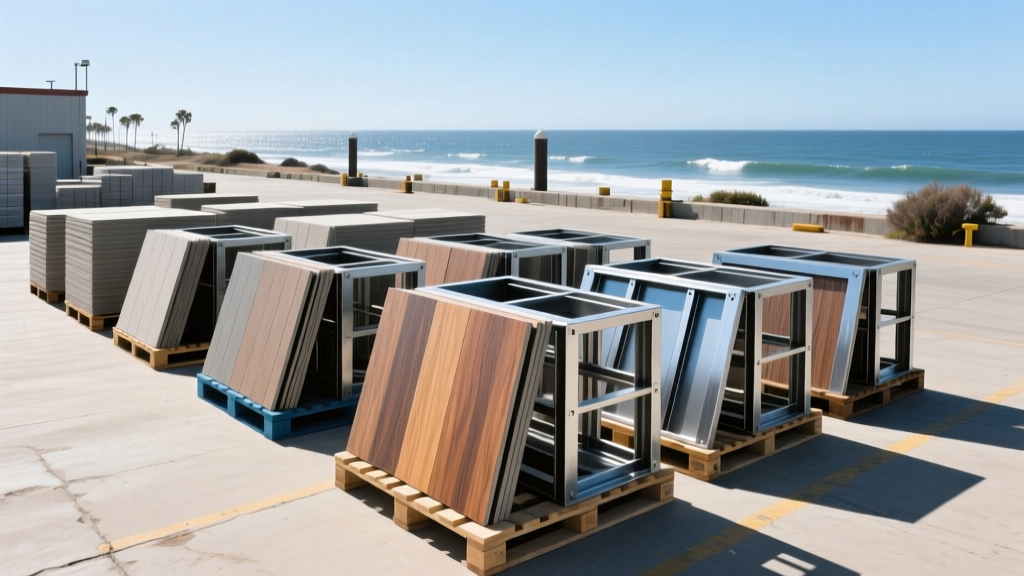
- Crane Rentals for Strand Proximity: For multi-story builds near the coastline where material staging on the street is prohibited by the city, utilizing a 90-ton mobile crane to lift pre-fabricated trusses and pallets of siding costs approximately $2,800 to $3,500 per day, including the operator and rigging crew.
Navigating California Title 24 (2026 Updates) on a Budget
The 2026 iteration of the California Energy Commission's Title 24 Building Energy Efficiency Standards has tightened the envelope requirements for all new construction and major retrofits. According to the California Energy Commission, the focus has shifted heavily toward electrification readiness, advanced thermal envelopes, and mandatory solar photovoltaic integration.
For Oxnard builders, this means prime materials must also be energy-compliant materials. Upgrading from standard R-19 batt insulation to closed-cell spray foam (R-7 per inch) in 2x6 wall cavities adds roughly $2.10 per square foot to the framing budget. However, this prime material choice allows builders to downsize the HVAC tonnage required for the home. In a coastal environment where the marine layer keeps ambient temperatures moderate but humidity high, a smaller, highly efficient heat pump paired with a superior thermal envelope yields a net-zero cost impact over the first five years of operation.
Title 24 requires structural readiness for future solar arrays. If you opt for prime standing-seam metal roofing, ensure the structural engineer specifies purlin spacing that can handle an additional 4.5 lbs/sq ft dead load. Failing to reinforce the trusses during the initial material procurement phase will require a $12,000+ structural retrofit before solar panels can be legally permitted.
Strategic Procurement Framework for Ventura County Builders
To maximize ROI when sourcing prime materials in the Oxnard market, general contractors and custom home builders should adopt the following decision framework:
- Spend on the Envelope, Save on the Interior: Allocate the premium budget to the exterior shell (Type 316 hardware, fiber cement, Low-E3 fiberglass windows, and closed-cell foam). The coastal environment destroys weak envelopes. Interior finishes (e.g., standard MDF cabinetry vs. marine-grade plywood) can be value-engineered without risking structural failure.
- Consolidate Freight via Local Pro-Desks: Instead of ordering prime materials from five different specialized online vendors, establish a commercial account with a major regional supplier (e.g., Ganahl Lumber or a specialized Ventura County distributor). Consolidating orders into weekly flatbed deliveries eliminates redundant $500+ freight drops.
- Specify CRRC-Approved Roofing Early: The Cool Roof Rating Council (CRRC) maintains a strict database of approved reflective roofing. Ensure your selected metal or tile profile is actively listed in the 2026 CRRC directory before issuing the purchase order. If a material loses its rating or is discontinued, Title 24 compliance software will flag the build, halting final inspections.
Ultimately, evaluating the cost of prime building materials in Oxnard requires looking past the initial invoice. By aligning material specifications with the realities of the Pacific marine layer, local freight constraints, and California's aggressive energy codes, builders can deliver structures that maintain their structural integrity and market value for decades. For further guidance on wind and coastal load resistance, contractors should consult the FEMA Building Science publications regarding coastal construction best practices.
Written by
Elena RodriguezElena Rodriguez is a civil engineer and technical writer specializing in concrete technology, masonry systems, and ASTM/ACI compliance. She earned her B.S. in Civil Engineering from Texas A&M University and spent a decade at a materials testing laboratory, performing over 2,000 concrete compressive strength tests and masonry prism evaluations. Elena is an ACI-certified Field Testing Technician (Grade I) and a member of ASTM Committee C12 on Natural Building Stone. She currently consults on forensic engineering cases involving concrete failures and moisture intrusion. Based in San Antonio, TX, Elena is a proud member of the Society of Women Engineers (SWE) and coaches her daughter's FIRST Robotics team.
More from Elena Rodriguez
View all
Walls & Panels
Cost Analysis: Light Gauge Steel Framing Advantages and Disadvantages
Evaluate light gauge steel framing advantages and disadvantages through a strict cost analysis lens, comparing material, labor, and lifecycle expenses.
Aug 4, 2026

Walls & Panels
Gypsum Board Types: Exact Specifications, Thickness & Dimensions
Compare standard, Type X, and moisture-resistant gypsum board types. Get exact specifications, thicknesses, dimensions, and ASTM standards for your project.
Aug 4, 2026

Fire Resistance
Best Fire-Resistant Outdoor Decking Materials: 2026 Buyer Guide
Discover the best fire-resistant outdoor decking materials for 2026. Compare Class A PVC, aluminum, and hardwood options for WUI compliance and safety.
Aug 4, 2026