Smart Sourcing for Construction and Building Materials (2026)
Discover how to source construction and building materials in 2026. Compare costs, evaluate sustainable options, and navigate modern supply chains.

The 2026 Procurement Landscape
Sourcing construction and building materials in 2026 requires navigating a market defined by localized supply chain stabilization, aggressive decarbonization mandates, and shifting tariff environments. The era of blanket global purchasing is over; general contractors and developers now rely on nearshored manufacturing, BIM-integrated material tracking, and strict embodied carbon limits to keep projects viable. According to the U.S. Bureau of Labor Statistics Producer Price Index, while aggregate material costs have stabilized compared to the extreme volatility of the early 2020s, specialized low-carbon and high-performance materials continue to experience localized premiums and extended lead times.
Core Material Categories and Pricing Baselines
Accurate budgeting requires moving beyond historical square-foot heuristics. The matrix below outlines current baseline costs, lead times, and volatility risks for primary structural and envelope materials in the North American market.
| Material Category | Specification / Grade | 2026 Avg. Cost | Lead Time | Volatility Risk |
|---|---|---|---|---|
| Structural Steel | W-Shapes, ASTM A992 | $1,050 - $1,150 / ton | 8 - 12 weeks | Medium |
| Ready-Mix Concrete | 4000 PSI, Standard Mix | $155 - $175 / cu. yd. | 1 - 2 weeks | Low |
| Cross-Laminated Timber | 5-Ply, APA PRG 320 | $55 - $68 / sq. ft. | 14 - 20 weeks | High |
| Architectural Glass | Low-E IGU, Aluminum Clad | $42 - $55 / sq. ft. | 16 - 24 weeks | High |
Evaluating Low-Carbon and Sustainable Alternatives
With municipal building codes increasingly adopting embodied carbon limits, sourcing construction and building materials now requires rigorous Environmental Product Declaration (EPD) verification. Under LEED v4.1 and the Living Building Challenge, specifying high-clinker cement or virgin aluminum can jeopardize certification and trigger local carbon taxes.
Limestone Calcined Clay Cement (LC3)
Traditional Portland cement (ASTM C150) is being rapidly displaced by LC3 blends. By substituting up to 50% of the energy-intensive clinker with calcined clay and limestone, LC3 reduces the carbon footprint of concrete by up to 40% without sacrificing compressive strength. For structural elements requiring 4000+ PSI at 28 days, specify LC3-50 blends conforming to ASTM C595 (Standard Specification for Blended Hydraulic Cements). The primary sourcing challenge is the regional availability of high-grade metakaolin; contractors in the Southeastern U.S. currently benefit from proximity to kaolin mining operations, while Northern regions face a 10-15% premium due to freight costs.
Cross-Laminated Timber (CLT) vs. Structural Steel
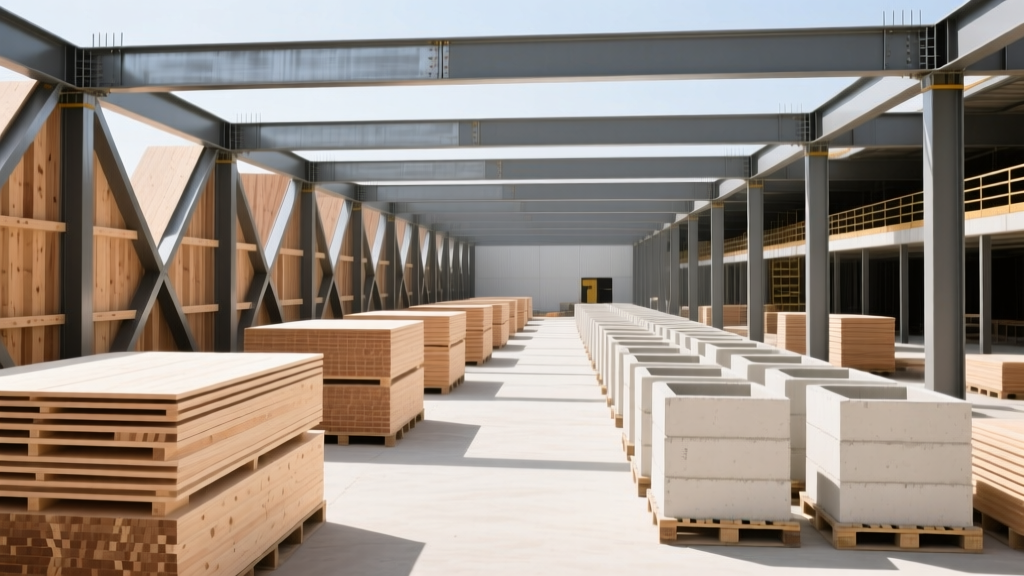
Mass timber has transitioned from a niche architectural statement to a viable structural alternative for mid-rise commercial builds (up to 18 stories under the 2021/2024 IBC). When evaluating CLT against steel, the material cost per square foot is often comparable, but the financial advantage lies in schedule compression. A CLT floor system can be erected and made weather-tight in a fraction of the time required for steel decking and concrete pouring.
"The decision between CLT and steel in 2026 rarely comes down to raw material cost. It is driven by the crane time, the speed of enclosure, and the reduction in wet trades on site. However, acoustic detailing and MEP routing through mass timber require BIM coordination at LOD 400 before fabrication begins." — WoodWorks Innovation Network Structural Guidelines
For fire resistance, specify CLT panels with an integrated sacrificial char layer to meet the 2-hour fire rating required by ASTM E119 for Type I and II construction, eliminating the need for secondary gypsum encapsulation in exposed-ceiling designs.
Strategic Procurement Framework for General Contractors
To mitigate delays and cost overruns, procurement teams must implement a structured decision framework before the design development (DD) phase concludes.
- Extract and Aggregate BIM Data: Utilize Revit or Tekla plugins to generate automated, real-time material takeoffs. Do not rely on 2D PDF scales for structural steel or rebar quantification, as design changes during the CD phase will render manual takeoffs obsolete.
- Lock Long-Lead Items Early: Identify items with lead times exceeding 16 weeks (e.g., custom curtain wall extrusions, mass timber, electrical switchgear). Issue early release packages to fabricators, even if the architectural envelope is not 100% finalized, using performance-based specifications.
- Negotiate Price Escalation Clauses: For contracts spanning more than 12 months, tie material costs to recognized indices like the ENR Construction Cost Index (CCI) or the BLS PPI. Cap the owner's risk at 5-8% and require the contractor to absorb the first 2% of material inflation.
- Mandate EPD Submittals: Include a specification division (e.g., Division 01 81 13) requiring contractors to submit Type III EPDs for concrete, steel, and insulation prior to shop drawing approval. Reject submittals that rely on industry-average data rather than facility-specific manufacturing data.
Navigating Tariffs and Regional Supply Constraints
The geopolitical landscape continues to heavily influence the cost of imported construction and building materials. Section 232 tariffs on imported steel and aluminum remain a factor, but the more pressing issue in 2026 is the enforcement of 'Buy America' provisions on federally funded infrastructure and commercial projects receiving specific tax credits (such as those tied to domestic manufacturing hubs).
Regionally, the availability of natural sand for concrete production is becoming a critical bottleneck in fast-growing Sunbelt markets. The depletion of local river sand has forced batch plants to transition to manufactured sand (M-sand) produced from crushed granite or basalt. While M-sand meets ASTM C33 standards, its angular particle shape increases water demand. Procurement teams must ensure their concrete suppliers are utilizing polycarboxylate ether (PCE) superplasticizers to maintain workability without increasing the water-cement ratio, which would compromise structural integrity and durability.
Frequently Asked Questions
How far in advance should I order structural steel in 2026?
For standard W-shapes and HSS tubing, initiate procurement 12 to 16 weeks before the required erection date. For complex, custom-fabricated connections or heavy plate girders, extend this window to 20 weeks to account for detailing approvals and specialized welding inspections.
Is it cost-effective to source reclaimed brick for commercial facades?
While reclaimed brick offers unmatched aesthetic value and zero embodied manufacturing carbon, the labor cost for cleaning, testing (ASTM C67 for compressive strength), and sorting typically pushes the installed cost 40% to 60% higher than new, extruded face brick. It is best reserved for high-visibility pedestrian zones rather than entire envelope cladding.
What is the best strategy for managing drywall supply shortages?
Diversify your supplier base across national manufacturers (e.g., USG, CertainTeed, National Gypsum) and regional producers. Specify synthetic gypsum (FGD gypsum) sourced from power plant scrubbers, which is chemically identical to mined gypsum but often features more stable regional pricing and lower transportation emissions.
Written by
Priya KapoorPriya Kapoor is a real estate market analyst and construction economics researcher with expertise in housing affordability, development feasibility, and infrastructure investment. She holds a Master of Regional Planning from Cornell University and previously worked as a senior analyst at CBRE's Investment Properties group, where she modeled returns for $4B in mixed-use development pipelines. Priya now runs an independent research practice advising developers, municipalities, and REITs on construction cost forecasting and market timing. She publishes the quarterly "BuildMat Market Pulse" report tracking material price indices across 12 commodity categories. Based in Austin, TX, Priya serves on the board of Habitat for Humanity Austin and is a marathon runner.
More from Priya Kapoor
View all
Construction Cost
Cost to Build a 1600 Sq Ft Home in 2026: Full Breakdown
Accurate 2026 cost to build a 1600 sq ft home—material, labor, and regional pricing breakdowns included. Plan your budget with real-time estimates.
Aug 11, 2026

Wood & Lumber
Name the Types of Wood for Pressure Treatment and Preservation
Learn how to name the types of wood best suited for pressure treatment. Compare species treatability, chemical retention levels, and 2026 preservation costs.
Aug 4, 2026

Stone & Masonry
Stone Veneer Suppliers Lindenhurst: 2026 Cost Analysis
Analyze 2026 stone veneer costs in Lindenhurst, NY. Compare local supplier pricing, delivery fees, and Suffolk County installation labor rates.
Aug 4, 2026