Smarter Building Materials Marketing via Lifecycle Cost Analysis
Discover how smarter building materials marketing leverages lifecycle cost analysis and TCO frameworks to win over commercial contractors in 2026.
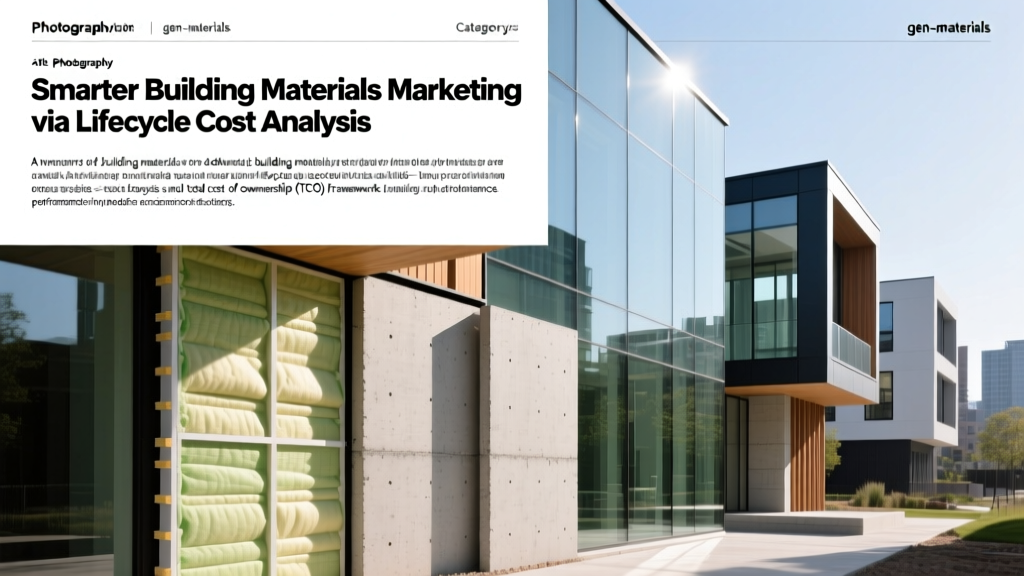
Building material manufacturers and distributors operate in a saturated market where procurement teams default to the lowest upfront bid. In 2026, with commercial construction labor rates averaging $95 to $130 per burdened hour and material volatility remaining a persistent threat, competing on unit price is a race to the bottom. Smarter building materials marketing requires a fundamental pivot: shifting the narrative from initial purchase price to Total Cost of Ownership (TCO) and lifecycle cost analysis (LCCA). By embedding rigorous cost-analysis data directly into marketing collateral, suppliers can bypass commoditized bidding wars and appeal directly to the financial stakeholders—developers, architects, and asset managers—who actually control project specifications.
The Fallacy of Upfront Unit Pricing in Modern Procurement
Traditional building materials marketing focuses heavily on product features, aesthetics, and unit cost. However, according to the Whole Building Design Guide (WBDG), upfront material costs typically represent only 20% to 30% of a building component's true economic impact over a 30-year lifecycle. When marketing teams fail to address the remaining 70%—which includes installation labor, maintenance, energy consumption, and end-of-life disposal—they leave the value proposition incomplete.
In 2026, general contractors are facing severe skilled labor shortages. A material that costs 15% more per unit but installs 40% faster is mathematically superior on the job site. Smarter building materials marketing translates these field realities into C-suite financial metrics, utilizing Net Present Value (NPV) and Internal Rate of Return (IRR) calculations to prove that premium materials are actually the lowest-cost option over time.
The 4-Pillar TCO Marketing Framework
To implement smarter building materials marketing, product managers and marketing directors must build collateral around four distinct cost-analysis pillars. Each pillar requires specific, quantifiable data points rather than vague claims of "efficiency" or "durability."
1. Installation Labor Velocity
Labor is the most volatile cost in construction. Marketing materials must quantify exactly how many man-hours a product saves. For example, when marketing integrated structural insulated sheathing (like the ZIP System R-sheathing) versus traditional OSB plus housewrap, do not just claim "faster installation." Provide the math: A standard 5,000 sq. ft. commercial envelope requires roughly 32 man-hours to wrap and tape with traditional materials. At a 2026 burdened labor rate of $115/hour for a three-person carpentry crew, eliminating the housewrap step saves $3,680 in direct labor, instantly offsetting the $2,100 material premium of the integrated panels.
2. Waste and Yield Optimization
Material waste directly impacts project margins and sustainability mandates. Marketing campaigns for precision-cut or modular materials (such as cold-formed steel framing or prefabricated bathroom pods) should highlight the NIST Building for Environmental and Economic Sustainability (BEES) metrics. If a proprietary fiber-cement siding profile features a specialized interlocking joint that reduces off-cuts by 12% compared to standard lap siding, marketing collateral should feature a "Yield Calculator" showing the exact dollar savings per 10,000 square feet based on current landfill tipping fees and material replacement costs.
3. Lifecycle Maintenance and Downtime
For commercial and multi-family developers, maintenance downtime equals lost revenue. Smarter marketing for high-performance roofing membranes (e.g., TPO vs. EPDM) or commercial sealants (e.g., Tremco high-performance silicones) must include a 20-year maintenance schedule. Detail the exact cost of scaffolding, mobilization, and labor required to re-seal or patch inferior products at years 5, 10, and 15, contrasting it with the zero-maintenance profile of the premium product.
4. Warranty and Risk Transfer
In construction, risk has a calculable cost. Marketing collateral should frame extended, no-dollar-limit (NDL) warranties as financial instruments. By transferring the risk of water intrusion or structural failure to the manufacturer, the developer reduces their contingency reserves and insurance premiums. Quantify the typical builder's risk insurance premium reduction when specifying materials with third-party validated performance data.
Cost Analysis Matrix: Traditional vs. TCO-Optimized Marketing
The table below illustrates the structural differences between legacy marketing approaches and smarter, cost-analysis-driven strategies.
| Marketing Element | Traditional Approach (Unit-Centric) | Smarter TCO Approach (Lifecycle-Centric) |
|---|---|---|
| Primary Metric | Cost per square foot / Cost per unit | Net Present Value (NPV) over 30 years / Cost per installed hour |
| Collateral Format | Glossy brochures, aesthetic renders, feature lists | Interactive ROI calculators, BIM-integrated cost schedules, case-study P&L sheets |
| Labor Narrative | "Easy to install" or "Contractor friendly" | "Reduces envelope crew time by 14 hours per 1,000 sq. ft., saving $1,610 at current rates" |
| Target Audience | Purchasing agents, field superintendents | Developers, asset managers, lead architects, CFOs |
| Objection Handling | Discounting, volume rebates | Demonstrating long-term OPEX reduction and risk mitigation |
Real-World Financial Modeling: Fiber Cement vs. Engineered Wood
To see smarter building materials marketing in action, consider the commercial multi-family siding market. A marketing team selling premium fiber cement siding must justify a 22% upfront premium over engineered wood lap siding. Instead of arguing about "curb appeal," the marketing collateral presents a rigorous 30-year LCCA model.
- Initial Material & Install (Year 0): Fiber cement costs $14.50/sq. ft. installed; engineered wood costs $11.80/sq. ft. For a 40,000 sq. ft. facade, the premium is $108,000.
- Maintenance Intervals: Engineered wood requires repainting and caulking every 7 years. In 2026, commercial scaffolding mobilization and painting labor cost roughly $4.25/sq. ft. Over 30 years, that is four maintenance cycles, totaling $680,000 in undiscounted OPEX.
- Replacement Factor: Engineered wood in high-moisture zones requires a 15% board replacement rate by year 20. Fiber cement requires zero painting and carries a 50-year substrate warranty.
- The NPV Conclusion: Applying a standard 6% commercial discount rate, the NPV of the engineered wood option over 30 years is $412,000 higher than the fiber cement option. The marketing one-pager highlights this $412,000 savings in bold, effectively neutralizing the initial $108,000 premium.
Deploying Interactive Cost Collateral in the Sales Cycle
Static PDFs are no longer sufficient for complex B2B construction sales. Smarter building materials marketing leverages digital tools that allow prospects to input their own project variables. According to McKinsey's research on construction productivity, digitization and data transparency are primary drivers of margin improvement for modern contractors.
Strategic Collateral Deliverables for 2026
- BIM-Integrated TCO Plugins: Develop Revit or ArchiCAD plugins that allow architects to swap generic material blocks with your proprietary products, automatically updating the project's estimated lifecycle cost schedule in the software's native dashboard.
- Dynamic ROI Dashboards: Provide sales reps with tablet-optimized dashboards where they can adjust variables (local energy costs, HVAC sizing reductions due to better insulation) in real-time during client pitches.
- Post-Occupancy Validation Reports: Publish verified case studies from 5-year-old buildings that track actual utility and maintenance data against the projected LCCA models, proving the accuracy of your marketing claims.

Conclusion: Marketing as a Financial Advisory Tool
The era of selling building materials based solely on technical data sheets and aesthetic samples is over. Smarter building materials marketing positions the supplier as a financial partner. By mastering lifecycle cost analysis, quantifying labor velocity, and providing interactive, data-rich collateral, material manufacturers can successfully defend premium pricing, secure early-stage specifications, and build unshakeable loyalty with the developers and contractors who drive the industry forward.
Written by
Elena RodriguezElena Rodriguez is a civil engineer and technical writer specializing in concrete technology, masonry systems, and ASTM/ACI compliance. She earned her B.S. in Civil Engineering from Texas A&M University and spent a decade at a materials testing laboratory, performing over 2,000 concrete compressive strength tests and masonry prism evaluations. Elena is an ACI-certified Field Testing Technician (Grade I) and a member of ASTM Committee C12 on Natural Building Stone. She currently consults on forensic engineering cases involving concrete failures and moisture intrusion. Based in San Antonio, TX, Elena is a proud member of the Society of Women Engineers (SWE) and coaches her daughter's FIRST Robotics team.
More from Elena Rodriguez
View all
Walls & Panels
Cost Analysis: Light Gauge Steel Framing Advantages and Disadvantages
Evaluate light gauge steel framing advantages and disadvantages through a strict cost analysis lens, comparing material, labor, and lifecycle expenses.
Aug 4, 2026

Walls & Panels
Gypsum Board Types: Exact Specifications, Thickness & Dimensions
Compare standard, Type X, and moisture-resistant gypsum board types. Get exact specifications, thicknesses, dimensions, and ASTM standards for your project.
Aug 4, 2026

Fire Resistance
Best Fire-Resistant Outdoor Decking Materials: 2026 Buyer Guide
Discover the best fire-resistant outdoor decking materials for 2026. Compare Class A PVC, aluminum, and hardwood options for WUI compliance and safety.
Aug 4, 2026