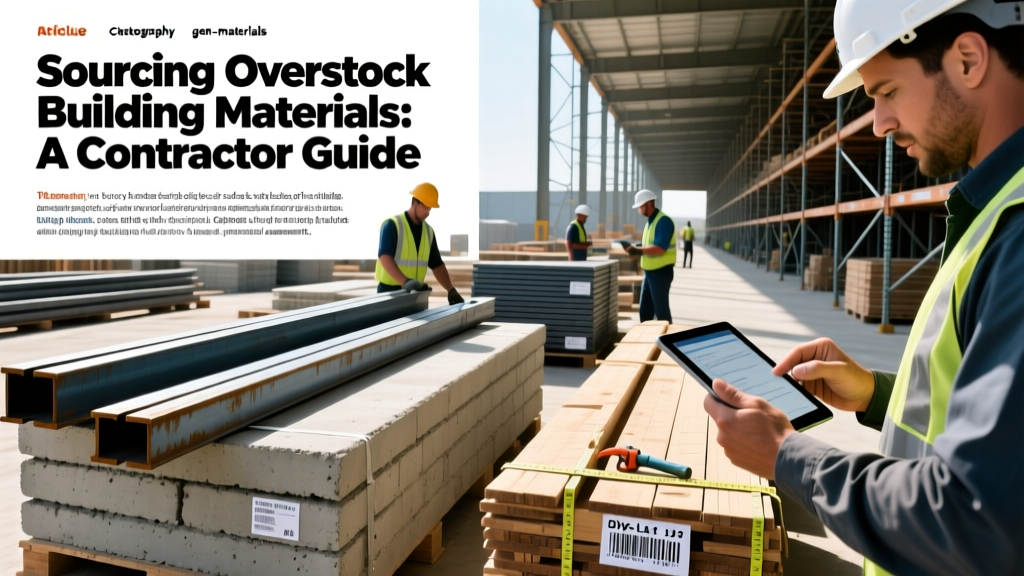
Sourcing Overstock Building Materials: A Contractor Guide
Learn how contractors source overstock building materials, calculate true freight costs, inspect dye-lots, and avoid liquidation margin traps.
The Economics of Overstock: Margin vs. Risk
Procuring overstock building materials offers general contractors, flippers, and custom home builders a 40% to 75% gross margin advantage over retail distribution channels. However, the liquidation market operates on an as-is, where-is basis, shifting the entire burden of quality assurance, logistics, and defect mitigation onto the buyer. In 2026, with LTL (Less Than Truckload) freight rates stabilizing but remaining historically elevated compared to pre-pandemic baselines, the gap between the listed pallet price and the true landed cost is where most amateur buyers lose their projected profit.
Tiered Sourcing Matrix: Where the Inventory Lives
The secondary market for construction supplies is highly fragmented. Sourcing the right overstock building materials requires matching your project's risk tolerance and volume requirements to the correct liquidation tier. Below is a comparison of the primary channels available to commercial buyers.
| Sourcing Channel | Best Suited For | Minimum Order | Risk & Variance Profile |
|---|---|---|---|
| B-Stock (Big Box Portals) | High-volume GCs, flooring installers, multi-family developers | Full truckload (FTL) or 5+ pallets | Low to Medium. Manifests are usually accurate; direct from retailer distribution centers. |
| Liquidation.com | Handyman services, small-scale flippers, eBay resellers | Single pallet or mixed lot | High. High incidence of salvage, returns, and broken packaging. Requires physical sorting. |
| Habitat ReStore | Architectural salvage, custom cabinetry, boutique remodels | Single item to box truck loads | Low risk if inspected in person. Zero warranty. Hyper-local inventory limits scaling. |
| Direct Mill Closeouts | Production builders, large roofing contractors | Truckload only (e.g., 40,000 lbs) | Very Low. First-quality goods, usually end-of-run colors or discontinued SKUs. |
For contractors looking to integrate B-Stock into their supply chain, registering for specific retailer portals (like those operated by major home improvement chains) is mandatory. These portals auction off seasonal overstock, discontinued SKUs, and truckload returns. According to the EPA's guidelines on construction and demolition material management, diverting surplus and overstock materials from landfills through secondary markets is a critical component of modern sustainable building practices, adding a layer of LEED compliance value to your procurement strategy.
Material-Specific Inspection Protocols
When you take delivery of overstock building materials, the clock starts ticking. You have a narrow window to file freight claims or liquidation disputes. Implementing strict, material-specific inspection protocols is non-negotiable.
Hard Surface Flooring & Tile: The Dye-Lot Trap
Porcelain and ceramic tile, as well as luxury vinyl plank (LVP), are manufactured in specific dye-lots and caliper runs. If you purchase 50 boxes of overstock LVP, and 10 boxes are from a different production run, the color variance and thickness differences (even as small as 1mm) will cause severe lippage and visible shading shifts in open-concept layouts.
- Action Step: Unbox one carton from every single pallet upon delivery.
- Verification: Cross-reference the lot/batch number printed on the short side of the box. If they do not match, isolate the mismatched boxes immediately for liquidation or use in secondary spaces (closets, garages).
- Moisture Testing: For engineered hardwood, use a pin-type moisture meter. Readings above 9% indicate improper warehouse storage, which will result in cupping post-installation.
Gypsum Board & Drywall: Edge Crush and Delamination
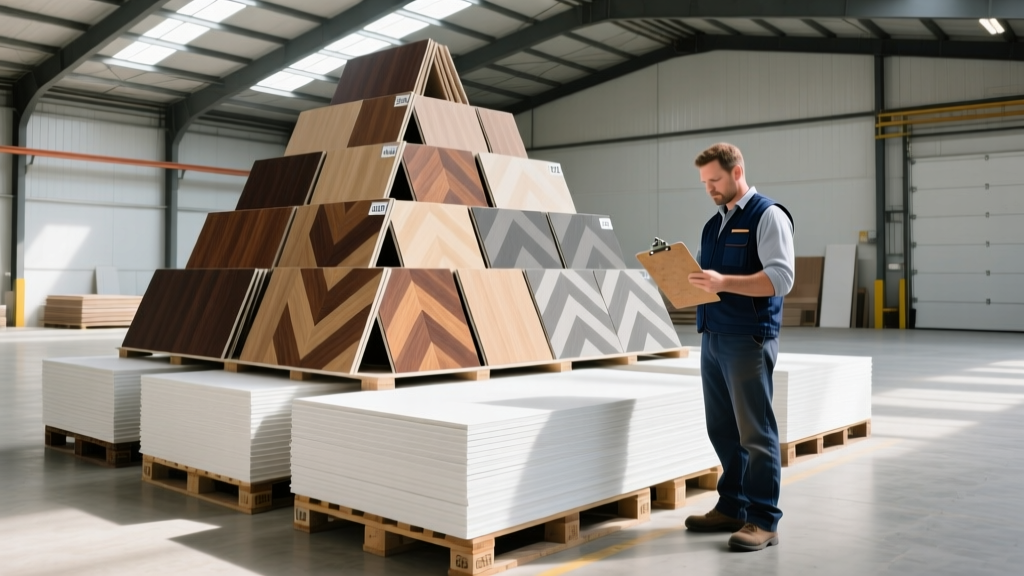
Drywall is notoriously fragile when subjected to poor supply chain handling. Overstock drywall is often stored in non-climate-controlled liquidation warehouses or stacked improperly on edge rather than flat.
- Edge Inspection: Check the tapered edges. If the paper face is crushed or separated from the gypsum core (delamination), the board will not finish properly with standard joint compound.
- Storage Compliance: Always verify that the supplier stored the material flat and off the ground. For comprehensive handling standards, reference the local salvage and reuse guidelines or manufacturer specifications which dictate that gypsum board must be kept dry and supported evenly to prevent sagging and structural compromise.
Architectural Shingles: The Thermal Sealant Issue
Asphalt roofing shingles feature a thermoplastic sealant strip designed to activate under solar heat. If overstock shingles are stored in a corrugated metal warehouse where ambient temperatures exceed 110°F for months, the sealant strips can prematurely activate, fusing the bundles together into solid blocks (known in the industry as 'bricking').
- Field Test: Open a random bundle. If you have to forcefully tear the shingles apart, damaging the fiberglass mat or granule surface, the entire pallet is compromised and will result in massive installation delays and roof failures.
Logistics & Freight: Navigating NMFC Codes
The biggest margin killer in the overstock market is freight misclassification. Carriers price shipments based on the National Motor Freight Classification (NMFC) system. If you do not know the exact NMFC code for your overstock building materials, the carrier will default to a higher, more expensive class.
- Identify the NMFC Code: Dimensional lumber and ceramic tile typically fall under Class 50 (dense, easy to handle). However, plumbing fixtures, vanities, and lighting jump to Class 85, 100, or even 125+ due to their fragility and packaging volume.
- Dimensional Weight vs. Actual Weight: Carriers charge based on whichever is greater. A pallet of rigid foam insulation is incredibly light but takes up massive volume. Always calculate the DIM weight (Length x Width x Height / 139) before accepting a freight quote.
- Accessorial Fees: Liquidation warehouses rarely have dock staff to load your truck. You must pre-pay for 'Driver Assist' at the pickup. At the delivery end, if you do not have a commercial loading dock or a forklift, you must add a 'Liftgate' and 'Residential/Limited Access' fee to your budget, which can add $150 to $300 to the final invoice.
Warranty & Code Compliance Red Flags
It is vital to understand the legal and structural implications of utilizing liquidated inventory. Manufacturer warranties are almost universally voided on overstock building materials sold through unauthorized secondary channels. If an overstock PVC plumbing fitting fails and floods a custom home, the manufacturer will deny the claim based on the unauthorized point of purchase.
"Contractors must ensure that overstock structural components, fire-rated doors, and specialized insulation still carry legible UL or ASTM certification stamps. Building inspectors have the authority to reject materials that lack traceable origin or visible compliance markings, regardless of the purchase price."
To mitigate this, restrict your overstock purchases to cosmetic and non-structural finishes: flooring, cabinetry, interior trim, paint, and landscaping materials. Leave structural framing, electrical panels, and pressure-rated plumbing to primary, authorized distributors where chain-of-custody and warranty protection are guaranteed. By applying these rigorous sourcing and inspection frameworks, contractors can reliably harness the secondary market to drastically reduce project overhead without sacrificing build quality.
Written by
Priya KapoorPriya Kapoor is a real estate market analyst and construction economics researcher with expertise in housing affordability, development feasibility, and infrastructure investment. She holds a Master of Regional Planning from Cornell University and previously worked as a senior analyst at CBRE's Investment Properties group, where she modeled returns for $4B in mixed-use development pipelines. Priya now runs an independent research practice advising developers, municipalities, and REITs on construction cost forecasting and market timing. She publishes the quarterly "BuildMat Market Pulse" report tracking material price indices across 12 commodity categories. Based in Austin, TX, Priya serves on the board of Habitat for Humanity Austin and is a marathon runner.
More from Priya Kapoor
View all
Construction Cost
Cost to Build a 1600 Sq Ft Home in 2026: Full Breakdown
Accurate 2026 cost to build a 1600 sq ft home—material, labor, and regional pricing breakdowns included. Plan your budget with real-time estimates.
Aug 11, 2026

Wood & Lumber
Name the Types of Wood for Pressure Treatment and Preservation
Learn how to name the types of wood best suited for pressure treatment. Compare species treatability, chemical retention levels, and 2026 preservation costs.
Aug 4, 2026

Stone & Masonry
Stone Veneer Suppliers Lindenhurst: 2026 Cost Analysis
Analyze 2026 stone veneer costs in Lindenhurst, NY. Compare local supplier pricing, delivery fees, and Suffolk County installation labor rates.
Aug 4, 2026