Glesby Building Materials: Inventory & Sourcing Guide
Explore the Glesby Building Materials inventory, supply chain logistics, and technical specifications for lumber, masonry, and insulation.

The Strategic Value of Regional Material Distributors
Sourcing construction materials requires balancing unit cost, lead time, and technical compliance. While national big-box retailers offer convenience for small residential repairs, commercial and custom residential projects demand the specialized inventory and logistical support provided by regional distributors like Glesby Building Materials. Evaluating a full-service supplier involves scrutinizing their stock depth, handling capabilities for oversized engineered components, and adherence to current ASTM and ANSI standards. This overview breaks down the core material categories, technical specifications, and supply chain metrics essential for contractors and procurement managers operating in the 2026 construction landscape.
Core Inventory Breakdown and Technical Specifications
A comprehensive material supplier must stock beyond basic dimensional lumber, providing engineered solutions and specialized masonry components that meet rigorous structural and environmental codes.
Structural Lumber and Engineered Wood Products
Standard SPF (Spruce-Pine-Fir) #2 dimensional lumber remains the baseline for interior framing, but modern load paths increasingly rely on engineered wood. According to APA - The Engineered Wood Association, the use of LVL (Laminated Veneer Lumber) and I-joists has become mandatory for long-span applications where solid sawn lumber is prone to warping and shrinkage. Regional distributors typically stock LVL beams graded 2.0E or 2.2E. For example, a 1-3/4" x 14" 2.0E LVL beam can span up to 26 feet under standard residential roof loads. However, procurement managers must note that deflection limits (typically L/360 for live loads) often govern the design before shear or bending capacities are reached. I-joists, commonly available in depths ranging from 9-1/2" to 16", feature OSB webs and LVL or solid sawn flanges, providing superior dimensional stability for floor assemblies.
Masonry and Hardscape Components
Masonry inventory extends far beyond standard face brick. Structural concrete masonry units (CMUs) must comply with ASTM C90, which mandates a minimum average net area compressive strength of 2,000 psi for load-bearing applications. When sourcing from specialized yards, contractors should verify the availability of lightweight CMUs, which utilize expanded shale or clay aggregates to reduce dead load by up to 30% while maintaining fire ratings. Mortar selection is equally critical; Type S mortar (1,800 psi compressive strength) is required for below-grade foundations and high-load retaining walls due to its high tensile bond strength, whereas Type N (750 psi) is the standard for above-grade, non-load-bearing veneers.
Building Envelope and Thermal Insulation
The building envelope dictates long-term energy performance. As outlined by the National Institute of Building Sciences (WBDG), continuous insulation (ci) is now a baseline requirement to prevent thermal bridging through wood or steel studs. Polyisocyanurate (polyiso) rigid board is the industry standard for exterior ci, offering a nominal R-value of R-6.5 per inch. However, expert procurement requires understanding thermal drift: at mean temperatures of 25°F, the blowing agents in polyiso can condense, temporarily reducing the effective R-value to approximately R-5.6 per inch. For below-grade applications and inverted roof assemblies, extruded polystyrene (XPS) or expanded polystyrene (EPS) must be specified due to their moisture resistance and stable R-values in cold, damp conditions.
2026 Supply Chain Metrics and Lead Time Matrix
Material availability fluctuates based on mill production schedules, resin costs for engineered products, and regional freight capacities. The following matrix outlines standard lead times and volatility factors for core inventory categories when sourcing through established regional networks.
| Material Category | Standard Specification | Typical Lead Time (2026) | Price Volatility Factor |
|---|---|---|---|
| Dimensional Lumber (SPF #2) | ASTM D1990 | 3 - 7 Days | High (Seasonal/Weather) |
| LVL Beams (2.0E / 2.2E) | ASTM D5456 | 10 - 14 Days | Medium (Resin Dependent) |
| Load-Bearing CMUs | ASTM C90 (2000 psi) | 5 - 10 Days | Low (Regional Production) |
| Polyiso Rigid Insulation | ASTM C1289 | 7 - 14 Days | High (Petrochemical Tied) |
| Structural Steel (W-Shapes) | ASTM A992 (50 ksi) | 4 - 8 Weeks | Medium (Global Tariffs) |
Logistics, Staging, and Site Delivery Protocols
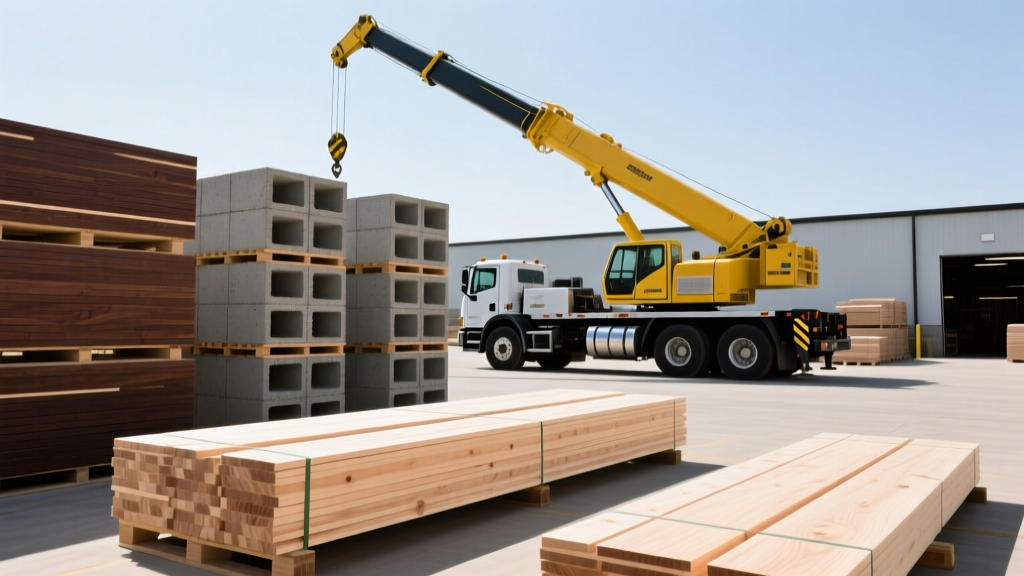
Procuring materials is only half the equation; site logistics dictate whether those materials are installed efficiently or damaged in the staging area. Specialized distributors utilize specific equipment for delivery that general freight carriers lack.
- Boom Truck Delivery: Essential for placing LVL beams, steel I-beams, and roof trusses directly onto the second-story deck or into tight urban lots. Standard reach is 40 to 60 feet, requiring a minimum 12-foot wide staging pad with a compacted sub-base to support outrigger point loads exceeding 25,000 lbs.
- Moffett Forklifts: Truck-mounted, all-terrain forklifts allow drivers to offload pallets of CMUs, pavers, and roofing bundles directly to the point of installation on uneven or muddy terrain, eliminating double-handling by the framing or masonry crews.
- Weather Protection: Engineered wood products and OSB sheathing must be delivered with intact poly-wrapping. If staging is required for more than 48 hours, contractors must elevate bundles on 4x4 dunnage and cover them with breathable tarps to prevent edge swelling and fungal decay.
Quality Assurance: Certifications and Compliance
Regional material suppliers act as the first line of defense against substandard or non-compliant building products. When evaluating inventory from distributors like Glesby Building Materials, procurement teams should verify the following certifications:
- FSC and SFI Certification: For projects targeting LEED v4.1 or Green Globes certification, structural lumber and wood panels must carry chain-of-custody documentation from the Forest Stewardship Council (FSC) or Sustainable Forestry Initiative (SFI).
- UL Fire-Rated Assemblies: Fire-rated drywall (Type X and Type C), fireblocking materials, and intumescent coatings must carry active Underwriters Laboratories (UL) design numbers. Substituting unverified materials voids the assembly's fire rating and creates severe liability exposure.
- ENERGY STAR and NFRC Ratings: For fenestration and building envelope components, ensuring that windows, doors, and continuous insulation meet the specific climate zone requirements outlined by the NFRC (National Fenestration Rating Council) is critical for passing final municipal energy inspections.
Decision Framework: Regional Distributor vs. National Big-Box
Choosing where to source materials impacts project margins and scheduling. Use this framework to determine the optimal supply channel for your specific project phase.
When to Use a Regional Distributor (e.g., Glesby Building Materials)
- Complex Structural Packages: Projects requiring custom LVL schedules, metal connector hardware (Simpson Strong-Tie bulk orders), and specialized masonry units.
- Volume and Credit: Commercial builds requiring 30-to-60-day net payment terms, volume tier pricing, and dedicated account management for change orders.
- Specialized Logistics: Sites requiring boom truck placement, Moffett offloading, or phased just-in-time (JIT) deliveries to accommodate zero-lot-line constraints.
When to Use a National Big-Box Retailer
- Punch-List and Trim-Out: Sourcing miscellaneous fasteners, touch-up paint, caulk, and replacement hardware during the final weeks of construction.
- Emergency Replacements: Immediate, same-day needs for small quantities of dimensional lumber, drywall, or plumbing fittings when a local distributor's delivery schedule cannot accommodate a single-item drop.
- DIY and Small Remodels: Projects under 1,500 square feet where the logistical overhead of opening a commercial credit account and scheduling freight deliveries outweighs the marginal unit-cost savings of wholesale pricing.
By aligning material specifications with the logistical capabilities of specialized suppliers, contractors can mitigate supply chain delays, ensure strict code compliance, and maintain tight control over project margins throughout the 2026 building season.
Written by
Sarah WhitfieldSarah Whitfield is a chartered quantity surveyor (MRICS) and construction cost analyst with 15 years of experience in material pricing, procurement strategy, and project budgeting. She earned her degree in Construction Management from the University of Reading (UK) and has worked on projects ranging from $2M custom homes to $180M mixed-use developments across North America and Europe. Sarah currently leads cost estimating for BuildMat Insight, maintaining a proprietary database of 4,000+ material price points updated quarterly. She is a frequent contributor to RSMeans cost data panels and has presented at the International Cost Engineering Council (ICEC) congress. Based in Denver, CO, Sarah is an avid trail runner and volunteer mentor for Women in Construction.
More from Sarah Whitfield
View all
Wood & Lumber
What Are the Different Types of Wood? A Builder's Guide
Compare structural softwoods, finish hardwoods, and engineered lumber. Analyze Janka ratings, MOE values, and 2026 pricing for construction.
Aug 4, 2026

Walls & Panels
Steel Framing vs Wood Framing: Corrosion and Moisture Defense
Compare steel framing vs wood framing for moisture resistance. Learn about galvanized coatings, condensation risks, and corrosion protection strategies.
Jul 21, 2026

Stone & Masonry
How to Cut Stone Veneer: Wet Saw vs Grinder Comparison
Compare the best tools for cutting stone veneer. We review wet saws, angle grinders, and chop saws to help you achieve clean, chip-free cuts.
Jul 21, 2026