Best Salvage Building Materials Winston-Salem Yards Compared (2026)
Compare top sources for salvage building materials in Winston-Salem. We review ReStores, architectural yards, and direct demo pricing for 2026.

The Winston-Salem Salvage Landscape
Sourcing reclaimed and salvaged building materials in the Piedmont Triad requires navigating a unique intersection of industrial history and residential preservation. Winston-Salem’s architectural heritage—ranging from the 18th-century Moravian structures in Old Salem to the massive early-20th-century tobacco warehouses and 1920s Craftsman bungalows—yields highly specific salvage inventory. When contractors and homeowners search for salvage building materials Winston-Salem locals rely on, they are typically looking for three distinct categories: reclaimed longleaf heart pine, historic soft brick, and architectural millwork.
Unlike buying new stock from big-box retailers, procuring salvaged materials involves evaluating yield rates, deconstruction methods, and lead-paint remediation. This comparison review evaluates the primary avenues for sourcing architectural salvage in and around Forsyth County, breaking down retail salvage yards, nonprofit ReStores, and direct-from-demolition contractor networks to help you decide which route fits your 2026 renovation budget and timeline.
Head-to-Head: Retail Yards vs. ReStores vs. Direct Demo
Not all salvage supply chains are created equal. A high-end architectural antique store operates on a completely different pricing and grading model than a nonprofit clearinghouse. Below is a structural comparison of the three primary sourcing methods available to Winston-Salem builders.
| Sourcing Method | Best For | Pricing Tier | Inventory Consistency | Prep & Milling Included? |
|---|---|---|---|---|
| Regional Architectural Salvage Yards | Historic millwork, stained glass, high-grade heart pine, period hardware | Premium ($$$) | Curated, graded, and categorized | Yes (often kiln-dried and planed) |
| Habitat ReStore (Forsyth County) | Cabinetry, solid core doors, appliances, basic dimensional lumber | Budget ($) | Highly volatile, daily turnover | No (sold as-is, buyer must prep) |
| Direct Demo / Deconstruction Contractors | Whole-house framing timber, brick lots, flooring from teardowns | Wholesale/Negotiable ($$) | Bulk, project-specific | No (requires buyer to process) |
Deep Dive: Sourcing Historic Piedmont Materials
When working on restorations in neighborhoods like Ardmore, Buena Vista, or West End, material authenticity is paramount. Here is how the local salvage market handles the region's most sought-after materials.
Reclaimed Longleaf Heart Pine
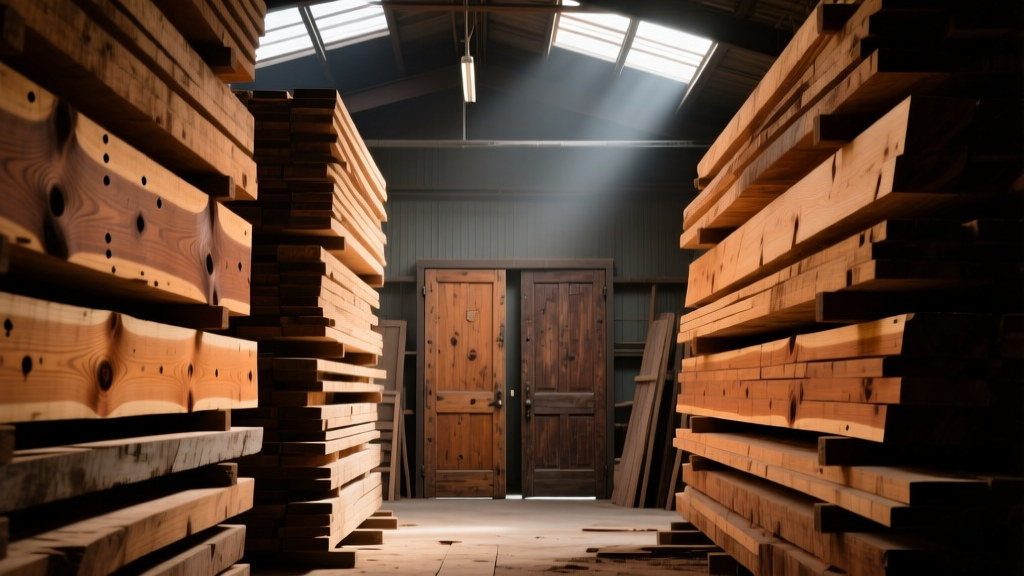
Longleaf heart pine is the crown jewel of North Carolina salvage. Milled from old-growth forests that no longer exist, this timber was used extensively in the framing and flooring of Winston-Salem’s early industrial buildings. Retail salvage yards in the broader Triad region grade this wood meticulously. Select Grade (clear, tight grain) typically runs $11 to $15 per square foot for flooring, while Character Grade (featuring nail holes, checking, and occasional knots) ranges from $7 to $10 per square foot. If you source directly from a local demolition contractor tearing down a 1920s warehouse, you can acquire raw beams for $2 to $4 per board foot, but you will absorb the $3,000–$5,000 cost of having a local mill kiln-dry, de-nail, and plane the timber.
Moravian & Industrial Brick
Salvaging brick in this region requires an understanding of historic mortar compatibility. Bricks pulled from pre-1900 structures in the area are significantly softer than modern extruded clay bricks. They were designed to be laid with lime-based mortar, which allows the wall to breathe and flex. If you purchase salvaged historic brick from a local yard, expect to pay $0.65 to $1.10 per brick (cleaned and palletized). Crucial specification: Never use modern Portland cement mortar with salvaged soft brick; the rigid cement will cause the historic brick faces to spall and crack during winter freeze-thaw cycles.
Winston-Salem has a massive stock of pre-1978 housing. When salvaging painted millwork, windows, or siding, assume lead paint is present. According to the EPA's Renovation, Repair and Painting (RRP) Rule, disturbing lead paint requires certified containment and disposal protocols. If you are buying salvaged painted trim from a ReStore or direct demo site, factor in the cost of chemical stripping (e.g., SoyGel or Peel Away 1) or media blasting. Never dry-sand or heat-gun salvaged trim without an EPA-recognized lead test kit confirming it is lead-free.
Cost Breakdown: Salvaged vs. New in the Triad
To understand the true ROI of salvage building materials Winston-Salem contractors utilize, we must compare the fully prepped salvage cost against premium new equivalents. The data below reflects 2026 regional pricing for the Piedmont Triad market.
- Solid Core Wood Doors (6-Panel): Salvaged (stripped and sanded) = $140–$220 | New Premium Wood = $450–$700
- Heart Pine Flooring (3.25" plank): Salvaged Character Grade = $8.50/sq ft | New Engineered Heart Pine = $11.00/sq ft
- Cast Iron Clawfoot Tubs (5ft): Salvaged (refinished interior) = $600–$950 | New Reproduction = $1,400–$2,200
- Dimensional Lumber (2x10 Framing): Salvaged De-nailed = $3.50/linear ft | New SPF #2 = $2.10/linear ft
Analysis: Salvage offers massive savings on finish-grade architectural elements (doors, tubs, hardware) but can actually be more expensive than new lumber for basic structural framing due to the labor-intensive de-nailing and straightening process. Use salvage for aesthetics and history; use new materials for hidden structural framing.
The Verdict: How to Choose Your Supplier
Your choice of supplier should be dictated by your project phase and your tolerance for processing labor. The Building Materials Reuse Association (BMRA) notes that deconstruction and salvage divert up to 90% of building waste from landfills, but the logistical burden shifts to the buyer when utilizing non-retail sources.
Decision Framework
- Choose a Retail Architectural Salvage Yard if: You are a homeowner or finish carpenter needing specific, ready-to-install period pieces (e.g., a matched set of 1920s mortise locksets or pre-finished heart pine mantels) and lack the workshop space to process raw materials.
- Choose the Forsyth County Habitat ReStore if: You are outfitting a rental property, building a workshop, or need high-quality, modern-era cabinetry and appliances at a steep discount, and you have the flexibility to adapt your design to whatever inventory is available that week.
- Choose Direct Demo Contractors if: You are a general contractor managing a full-gut renovation or new build and need bulk quantities of a specific material (like 2,000 sq ft of oak flooring or 5,000 historic bricks) and possess the crew and equipment to clean and prep the materials on-site.
Frequently Asked Questions
Can I salvage materials from my own Winston-Salem demolition site?
Yes, but you must instruct your demo crew to perform a "soft strip" before the heavy machinery arrives. This involves manually removing doors, trim, flooring, and fixtures. Standard demolition will crush these materials, rendering them useless and sending them to the Forsyth County landfill.
Do local salvage yards buy materials from the public?
Most high-end architectural salvage yards in the region operate on a consignment or direct-purchase model for high-value items (stained glass, antique mantels, copper roofing). However, they will not buy standard dimensional lumber or modern contractor-grade fixtures. For those, donating to the local ReStore for a tax write-off is the most financially viable route.
How do I verify the structural integrity of salvaged framing lumber?
Reclaimed framing timber must be visually graded for checking (splits), rot, and insect damage. In North Carolina, subterranean termites are prevalent. Any salvaged lumber pulled from ground-level sills or porch structures in the Winston-Salem area should be treated with a borate-based wood preservative (like Bora-Care) before being reinstalled in an enclosed wall cavity.
Written by
David NakamuraDavid Nakamura is a licensed architect (AIA) and construction technology writer focused on sustainable building methods, mass timber engineering, and high-performance building envelopes. He holds a Master of Architecture from the University of Washington and is a certified Passive House Consultant (CPHC). David spent eight years at the Seattle firm Mithun, where he led the design of three LEED Platinum projects, before founding his own practice specializing in net-zero residential design. He serves on the editorial advisory board of GreenBuilder Magazine and has authored peer-reviewed papers on cross-laminated timber (CLT) connections for the Journal of Structural Engineering. In his spare time, David teaches woodworking at Pratt Fine Arts Center and kayaks the Puget Sound.
More from David Nakamura
View all
Construction Cost
Labor Cost to Build a Deck Per Sq Ft: 2026 Installation Guide
Discover the exact labor cost to build a deck per sq ft in 2026. This installation guide breaks down contractor rates, complexity factors, and hidden fees.
Aug 4, 2026

Construction Cost
How Much Does It Cost to Build a 3 Bedroom House? Financing Guide
Learn exactly how much it costs to build a 3 bedroom house and explore 2026 financing options, construction loan types, and budget frameworks for your build.
Aug 4, 2026

Construction Cost
Cost to Build a Tennis Court: 2026 Guide
How much does it cost to build a tennis court in 2026? Breakdowns for asphalt, concrete, and synthetic surfaces plus fencing and lighting.
Jul 30, 2026