Tarver Building Materials vs Big Box: Pro Contractor Review
Comparing Tarver Building Materials against big box stores for 2026 residential projects. Analyze lumber grades, delivery logistics, and pro pricing.

The Sourcing Dilemma: Specialized Lumberyard vs. Retail Hybrid
Sourcing materials for residential and light commercial projects in the Southeast requires balancing unit cost, material grade, and job-site logistics. For general contractors and custom home builders operating in Alabama, Georgia, and the broader Gulf Coast region, the decision often narrows down to utilizing a specialized regional supplier like Tarver Building Materials versus relying on the pro desks of national big box home improvement chains. While big box stores offer unmatched convenience for last-minute hardware and small-volume purchases, evaluating them head-to-head against a dedicated lumberyard reveals distinct operational advantages and limitations for full-shell material packages in the 2026 construction market.
Tarver Building Materials operates as a traditional, full-service lumberyard and millwork supplier. Their business model is built around high-volume contractor accounts, custom window and door schedules, and direct mill relationships. Big box stores, conversely, operate on a retail-first model where the pro contractor is a secondary revenue stream. This fundamental difference dictates everything from the moisture content of their framing lumber to the type of trucks that deliver it to your job site.
Lumber Grades, Moisture Content, and Mill Direct Relationships
The most critical divergence between Tarver and national retail chains lies in framing lumber quality and handling. Tarver specializes in #2 and Better Southern Yellow Pine (SYP) framing lumber, often sourcing directly from regional mills. According to the grading standards outlined by the Southern Pine Council, #2 grade SYP provides the necessary structural values for residential floor joists, rafters, and load-bearing walls. However, the physical condition of that lumber upon delivery varies wildly by supplier.
The Moisture and Storage Factor
Big box stores typically store lumber in open-air, partially covered garden centers. In the humid Southeast, this exposes dimensional lumber to repeated wetting and drying cycles, leading to warping, twisting, and elevated moisture content (often exceeding 19% MC). When you frame with wet lumber and immediately seal it behind drywall and vapor barriers, you risk mold growth and drywall nail pops as the wood acclimates and shrinks.
Head-to-Head Comparison Matrix
The following matrix breaks down the operational differences between Tarver Building Materials, Big Box Pro Desks, and National Roofing/Siding Distributors for a standard 2,500 sq. ft. single-family residential build.
| Feature | Tarver Building Materials | Big Box Pro Desk | National Distributor (e.g., ABC) |
|---|---|---|---|
| Primary Focus | Full-shell residential & custom millwork | Retail DIY & light contractor repair | Roofing, siding, and commercial envelope |
| Lumber Storage | Enclosed / Mill-wrapped | Open-air / Partial cover | N/A (Focus on engineered wood/siding) |
| Delivery Equipment | Knuckleboom (articulating) trucks | Flatbed with piggyback forklift | Flatbed / Truss-boom |
| Custom Millwork | Full-service (Doors, Windows, Stairs) | Stock sizes only, long lead times | Limited to exterior trim/fascia |
| Account Terms | Net-30 / Volume rebates / Draw billing | Net-30 (via third-party credit) | Net-30 / Project-based bidding |
Exterior Envelope: Siding and Trim Specifics
When spec'ing exterior cladding, the difference in inventory depth becomes apparent. Big box stores primarily stock pre-primed fiber cement (like James Hardie) or basic vinyl siding in a limited color palette. If a project requires James Hardie ColorPlus® Technology finishes or LP® SmartSide® ExpertFinish® pre-finished siding, big box stores must special order these through corporate channels, often resulting in 4-to-6 week lead times and minimum order surcharges.
Tarver maintains deep inventory of regional favorites, including pre-finished LP SmartSide and specialized cedar shakes. More importantly, their estimators can perform accurate takeoffs using digital plans, ensuring that soffit, fascia, and corner trim lengths are optimized to reduce waste. A big box pro desk will typically just hand you a raw material list generated by basic software, leaving the contractor to figure out the waste factor for complex architectural details like board-and-batten transitions or rake overhangs.
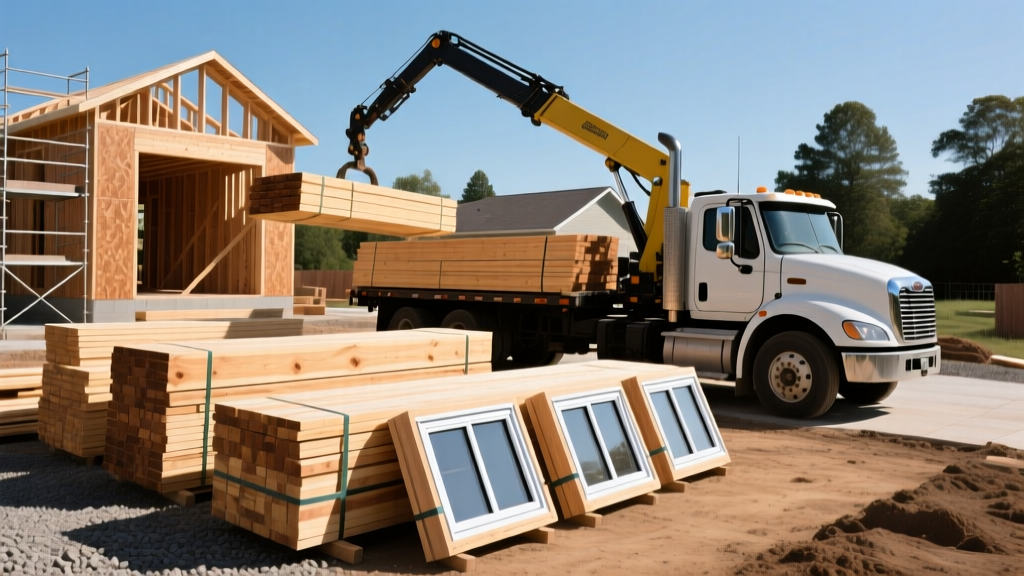
Job Site Logistics: The Knuckleboom Advantage
Material delivery is where specialized lumberyards justify their existence. National retail chains rely on third-party flatbed trucks equipped with piggyback (Moffett) forklifts. While effective for dropping pallets of shingles on a flat driveway, forklifts cannot lift a 2,000 lb. bundle of floor joists or a package of JELD-WEN® windows onto a second-story deck.
Tarver utilizes knuckleboom (articulating boom) trucks. These vehicles can reach over obstacles, place roof trusses directly onto the top plates, and stack siding packages precisely where the installers need them. This targeted staging reduces material damage from site-moving and cuts framing labor hours by up to 15% on complex custom builds.
Pricing Dynamics and Pro Credit Terms
A common misconception is that big box stores are always cheaper due to their massive national purchasing power. While they may win on commodity items like boxes of screws or rolls of Tyvek, they lose on bundled structural packages. In the 2026 framing lumber market, price volatility requires agile purchasing. Tarver's buyers negotiate directly with SYP mills and engineered wood manufacturers (like Weyerhaeuser or Boise Cascade) on a regional basis.
For a 2,500 sq. ft. shell package, Tarver will typically bid the entire takeoff as a single unit, absorbing minor fluctuations in hardware or hanger pricing to win the primary lumber and sheathing contract. Furthermore, their pro accounts offer draw-based billing. As the National Association of Home Builders frequently notes regarding builder cash flow, managing supply chain credit is vital. Tarver allows builders to break a single master invoice into multiple draws tied to construction loan disbursements (e.g., foundation, framing, dry-in), whereas big box corporate credit cards often demand payment within 30 days regardless of the builder's draw schedule.
Decision Framework: Which Supplier Fits Your Project?
Choosing between Tarver Building Materials and a big box pro desk should not be an either/or decision for a professional contractor. The most efficient operations use a hybrid approach based on the following framework:
- Choose Tarver Building Materials When: You are bidding a full structural shell, require custom millwork (pre-hung doors, custom stair parts, specific window schedules), need second-story knuckleboom delivery, or are building a custom home where lumber grade and moisture content are critical to the finishing schedule.
- Choose Big Box Pro Desks When: You need same-day emergency restocking of miscellaneous hardware, framing anchors, or fasteners. They are also ideal for small-scale renovation projects (under 1,000 sq. ft.) where the overhead of setting up a formal lumberyard bid and delivery schedule is not cost-effective.
- Choose National Distributors When: You are executing large-scale multi-family or commercial roofing and siding projects that require massive volume discounts on asphalt shingles, TPO membranes, or commercial-grade metal panels.
By aligning your material sourcing strategy with the specific logistical and grading strengths of regional suppliers like Tarver, contractors can protect their profit margins, reduce framing callbacks, and maintain tighter construction schedules throughout 2026 and beyond.
Written by
David NakamuraDavid Nakamura is a licensed architect (AIA) and construction technology writer focused on sustainable building methods, mass timber engineering, and high-performance building envelopes. He holds a Master of Architecture from the University of Washington and is a certified Passive House Consultant (CPHC). David spent eight years at the Seattle firm Mithun, where he led the design of three LEED Platinum projects, before founding his own practice specializing in net-zero residential design. He serves on the editorial advisory board of GreenBuilder Magazine and has authored peer-reviewed papers on cross-laminated timber (CLT) connections for the Journal of Structural Engineering. In his spare time, David teaches woodworking at Pratt Fine Arts Center and kayaks the Puget Sound.
More from David Nakamura
View all
Construction Cost
Labor Cost to Build a Deck Per Sq Ft: 2026 Installation Guide
Discover the exact labor cost to build a deck per sq ft in 2026. This installation guide breaks down contractor rates, complexity factors, and hidden fees.
Aug 4, 2026

Construction Cost
How Much Does It Cost to Build a 3 Bedroom House? Financing Guide
Learn exactly how much it costs to build a 3 bedroom house and explore 2026 financing options, construction loan types, and budget frameworks for your build.
Aug 4, 2026

Construction Cost
Cost to Build a Tennis Court: 2026 Guide
How much does it cost to build a tennis court in 2026? Breakdowns for asphalt, concrete, and synthetic surfaces plus fencing and lighting.
Jul 30, 2026