Technical Building Materials Guide: Decoding ASTM & ISO Specs
Master the technical building materials guide for ASTM and ISO specs. Learn to decode mill test reports, structural metrics, and environmental ratings.
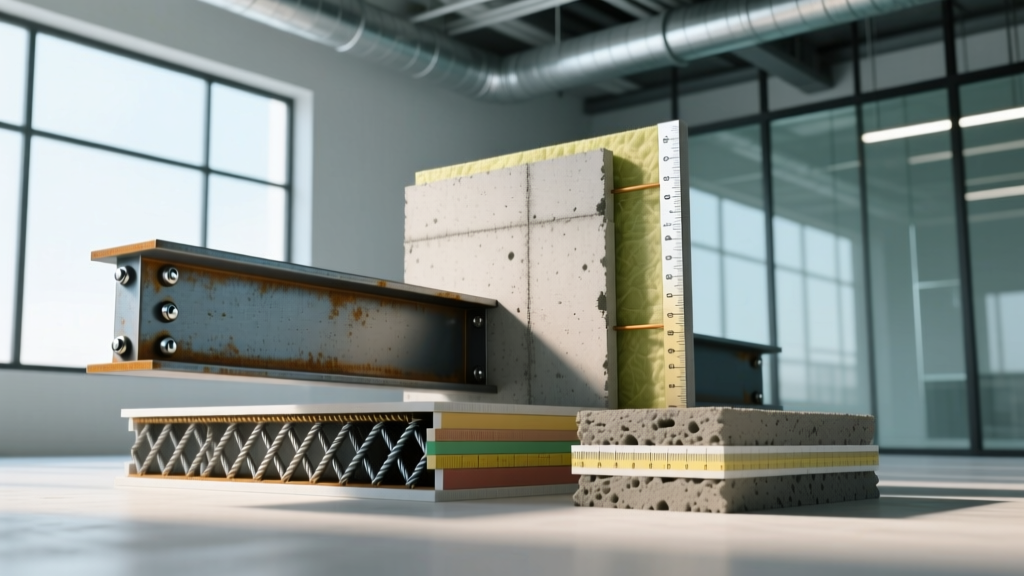
The Anatomy of a Material Specification Sheet
Procuring construction materials based solely on supplier marketing brochures introduces severe liability and structural risks. A rigorous technical building materials guide must anchor on standardized specification sheets—primarily governed by ASTM International, ISO, and EN frameworks. These documents strip away marketing terminology and define exact chemical, physical, and dimensional tolerances.
Standard ASTM specifications follow a strict chronological structure. Understanding this anatomy allows project engineers to rapidly locate critical failure thresholds:
- Scope & Referenced Documents: Defines the exact boundaries of the standard and lists mandatory secondary testing protocols.
- Terminology & Classification: Establishes the precise nomenclature to prevent substitution errors (e.g., distinguishing between 'cement' and 'concrete').
- Materials & Manufacture: Dictates the allowable raw material sources and processing methods, such as kiln temperature profiles for clinker.
- Chemical & Physical Properties: The core data matrix detailing elemental compositions, tensile strengths, and thermal limits.
- Dimensions & Permissible Variations: Outlines the exact tolerances for thickness, length, and camber.
- Workmanship, Finish, & Appearance: Defines acceptable surface defects, such as maximum allowable mill scale depth on structural beams.
Suppliers frequently offer 'equivalent' materials when specified products are out of stock. Never accept an equivalent without verifying the governing standard. A manufacturer's proprietary 'equivalent' structural sheathing may match the nominal thickness of ASTM C1396 Type X gypsum board but fail entirely in fire-resistance or moisture-absorption metrics. Always demand the specific ASTM/ISO certification for the substituted batch.
Critical Performance Metrics by Material Class
When evaluating materials, general descriptions like 'high-strength' or 'water-resistant' are technically meaningless. Procurement specifications must cite exact baseline metrics. The following matrix outlines the governing standards and critical failure thresholds for primary structural and envelope materials.
| Material Class | Governing Standard | Critical Metric | Standard Baseline | Failure / Rejection Threshold |
|---|---|---|---|---|
| Structural Steel (W-Shapes) | ASTM A992 / A992M | Yield Strength (Fy) | 50 ksi (345 MPa) min | < 48 ksi or > 70 ksi (over-strengthening disrupts seismic yielding) |
| Portland Cement (Sulfate Resisting) | ASTM C150 Type V | Tricalcium Aluminate (C3A) | Max 5.0% | > 6.0% (High vulnerability to sulfate attack in soil) |
| Extruded Polystyrene (XPS) Insulation | ASTM C578 Type IV | Compressive Strength | 25 psi (170 kPa) min | < 22 psi under sustained dead loads |
| Fire-Rated Gypsum Board | ASTM C1396 Type X | Core Reinforcement / Fire Endurance | 1-hour rating (5/8 in. thickness) | Fails hose-stream test or core crumbles < 45 mins |
| Hot-Applied Rubberized Asphalt Waterproofing | ASTM D6153 | Low-Temperature Flexibility | Passes at -15°F (-26°C) | Cracking or loss of adhesion at -10°F |
For comprehensive standard lookups and updates, project teams should regularly consult the ASTM Standards Resources portal to ensure they are not specifying retired or superseded document versions.
Environmental Exposure & Specification Adjustments
Baseline material specifications must be dynamically adjusted based on the project's microclimate and exposure conditions. Applying standard interior specifications to exterior or aggressive environments guarantees premature degradation.
Coastal and High-Salinity Zones
In marine environments, chloride ion penetration is the primary driver of rebar corrosion and concrete spalling. Standard concrete mixes are insufficient. Specifications must mandate:
- Water-to-Cementitious Materials Ratio (w/cm): Strictly limited to 0.40 or lower to reduce capillary porosity.
- Supplementary Cementitious Materials (SCMs): Incorporate 20% to 30% Class F fly ash or slag cement by mass. This refines the pore structure and binds free chlorides.
- Concrete Cover: Increase minimum clear cover over reinforcing steel from the standard 1.5 inches to a minimum of 3.0 inches for elements exposed to salt spray.
Freeze-Thaw and Seismic Regions
Materials in northern latitudes must withstand cyclic freezing and thawing while saturated. According to research from the NIST Engineering Laboratory, specifying air-entrained concrete is non-negotiable in these zones. The specification must require an air content of 5% to 8% (depending on aggregate size), creating microscopic voids that accommodate the 9% volumetric expansion of freezing water. Furthermore, in high seismic design categories (SDC D, E, F), structural steel specifications must include Charpy V-Notch (CVN) toughness testing to ensure the steel absorbs energy without brittle fracture at ambient temperatures.
When specifying vapor retarders for building envelopes, do not rely on generic terms like 'vapor barrier.' Specify the exact perm rating tested via ASTM E96. A Class I vapor retarder (e.g., polyethylene sheeting) must have a permeance of ≤ 0.1 perms. Using a Class II retarder (0.1 to 1.0 perms) in a cold climate heating-dominated building can lead to catastrophic interstitial condensation within the wall cavity.

Verifying Mill Test Reports (MTRs) and Certifications
A specification is only as strong as its verification. For structural metals, the Mill Test Report (MTR) is the legal document proving the material meets the specified ASTM standard. Procurement agents and site engineers must verify the following data points on every MTR before installation:
- Heat Number Traceability: Ensure the physical heat number stamped on the steel beam matches the MTR exactly. If the stamping is illegible, the material must be rejected or re-tested.
- Chemical Composition Limits: Check the Carbon Equivalent (CE) formula. For structural steel intended for field welding, a CE exceeding 0.45% (per the IIW formula) requires specialized pre-heating protocols to prevent hydrogen-induced cracking in the heat-affected zone.
- Actual vs. Minimum Yield: While exceeding the minimum yield strength seems beneficial, in seismic moment frames, steel that is too strong (e.g., actual yield of 75 ksi on a 50 ksi specification) will shift the plastic hinge away from the beam and into the column, causing catastrophic structural collapse during an earthquake. Verify the upper limit.
The American Institute of Steel Construction (AISC) provides exhaustive guidelines on MTR verification and the handling of certified structural materials.
Galvanic and Thermal Incompatibility Edge Cases
Technical specifications often evaluate materials in isolation, ignoring the chemical and physical reactions that occur when dissimilar materials interface. Two critical edge cases must be addressed in the project specifications:
Galvanic Corrosion at Material Junctions
When two dissimilar metals are in electrical contact in the presence of an electrolyte (rainwater, condensation), the less noble metal (anode) corrodes rapidly. Specifications must mandate physical separation using non-conductive gaskets, neoprene pads, or specialized isolation coatings. For example, never specify direct contact between aluminum window frames (anodic) and copper flashing (cathodic). The galvanic potential difference will cause severe pitting of the aluminum within months. If proximity is unavoidable, specify a minimum 10-mil dielectric coating on the copper and a continuous EPDM separation membrane.
Coefficient of Thermal Expansion (CTE) Mismatches
Differential movement between bonded materials causes shear failures and delamination. A common failure mode occurs when rigid cementitious stucco (ASTM C926) is applied directly over structural elements with high thermal expansion rates without proper slip planes or expansion joints. The specification must detail the exact placement of ASTM E2550 compliant expansion joints, typically requiring a joint every 18 feet in horizontal runs and at every floor line in vertical runs, to absorb the delta in thermal expansion between the steel framing and the cementitious matrix.
Expert Insight: 'The most frequent envelope failures I investigate are not due to the primary material failing its own ASTM test, but due to the specification ignoring the transition details between materials. A perfect window installed with an incompatible, high-VOC sealant that degrades the PVC frame is a failed system. Specifications must govern the interfaces, not just the components.' — Senior Forensic Building Envelope Engineer
Summary: Building a Specification-First Procurement Strategy
Transitioning from a catalog-based procurement model to a specification-driven strategy eliminates ambiguity. By mandating exact ASTM/ISO standards, defining strict environmental adjustments for w/cm ratios and SCMs, enforcing rigorous MTR verification, and detailing interface compatibilities, project teams protect structural integrity, ensure code compliance, and drastically reduce long-term maintenance liabilities. Always treat the technical specification as the primary legal and engineering baseline for all material acquisitions.
Written by
Elena RodriguezElena Rodriguez is a civil engineer and technical writer specializing in concrete technology, masonry systems, and ASTM/ACI compliance. She earned her B.S. in Civil Engineering from Texas A&M University and spent a decade at a materials testing laboratory, performing over 2,000 concrete compressive strength tests and masonry prism evaluations. Elena is an ACI-certified Field Testing Technician (Grade I) and a member of ASTM Committee C12 on Natural Building Stone. She currently consults on forensic engineering cases involving concrete failures and moisture intrusion. Based in San Antonio, TX, Elena is a proud member of the Society of Women Engineers (SWE) and coaches her daughter's FIRST Robotics team.
More from Elena Rodriguez
View all
Walls & Panels
Cost Analysis: Light Gauge Steel Framing Advantages and Disadvantages
Evaluate light gauge steel framing advantages and disadvantages through a strict cost analysis lens, comparing material, labor, and lifecycle expenses.
Aug 4, 2026

Walls & Panels
Gypsum Board Types: Exact Specifications, Thickness & Dimensions
Compare standard, Type X, and moisture-resistant gypsum board types. Get exact specifications, thicknesses, dimensions, and ASTM standards for your project.
Aug 4, 2026

Fire Resistance
Best Fire-Resistant Outdoor Decking Materials: 2026 Buyer Guide
Discover the best fire-resistant outdoor decking materials for 2026. Compare Class A PVC, aluminum, and hardwood options for WUI compliance and safety.
Aug 4, 2026