How to Verify Technical Claims in a Building Materials Advertisement
Learn how to verify ASTM and ISO technical specifications hidden in building materials advertisement claims to ensure code compliance and performance.
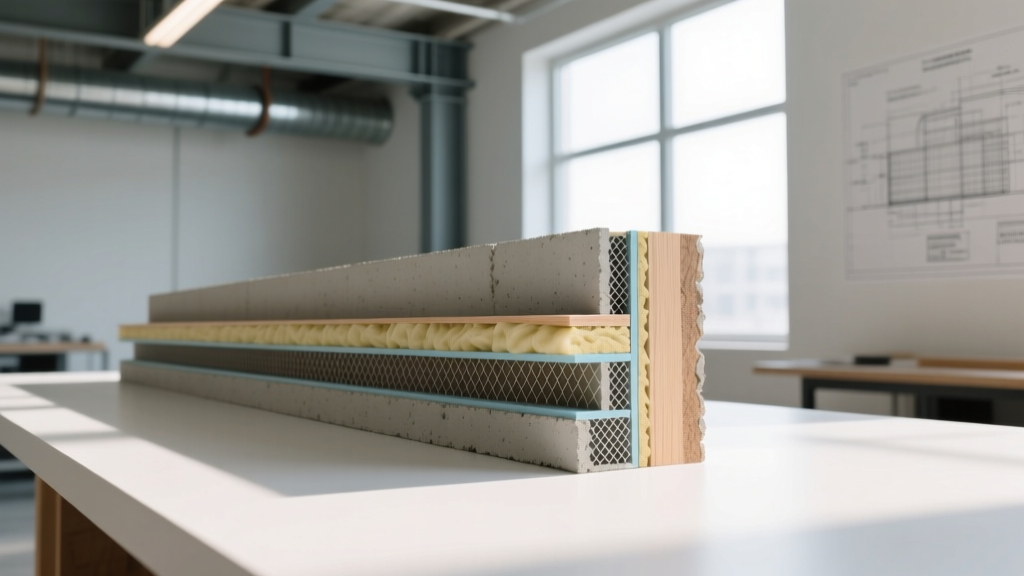
The Gap Between Marketing Copy and Material Science
Marketing copy in construction supply catalogs frequently compresses complex material science into simplified bullet points. While a building materials advertisement might highlight a '5000 PSI mix' or an 'R-19 thermal barrier,' these claims often omit the boundary conditions, testing methodologies, and assembly requirements necessary for actual code compliance. For general contractors, architects, and specifiers, relying on advertised headlines rather than verified technical data sheets (TDS) introduces severe liability and performance risks.
Under the 2024 and 2026 International Energy Conservation Code (IECC) updates and evolving structural mandates, the delta between an advertised claim and an installed reality can result in failed inspections, envelope condensation, or structural deflection. This guide dissects the most common technical specifications found in construction marketing and provides a framework for verifying them against established ASTM, ISO, and FTC standards.
Decoding Structural Claims: Compressive and Tensile Strength
Concrete and masonry advertisements heavily feature compressive strength metrics, typically expressed in pounds per square inch (PSI) or megapascals (MPa). A common advertisement will boldly state: 'High-Strength 5000 PSI Concrete Mix.' However, this figure is technically meaningless without the accompanying time and testing parameters.
The 7-Day vs. 28-Day Curing Trap
Standard structural engineering specifications require compressive strength to be measured at 28 days of curing, per ASTM C39 (Standard Test Method for Compressive Strength of Cylindrical Concrete Specimens). Many admixtures and high-early-strength cements (Type III) can achieve 5000 PSI at 7 days, but their 28-day ultimate strength may plateau or even experience retrogression due to microcracking from rapid heat of hydration.
- Specification Requirement: Always cross-reference the advertisement's PSI claim with the TDS to ensure it specifies '28-day cylinder break strength.'
- Core vs. Cylinder: Advertised strengths are based on laboratory-cured cylinders. Field-cured cores typically yield 10% to 15% lower results. If an ad claims exactly 4000 PSI, anticipate field cores testing around 3400 PSI to 3600 PSI.
Thermal Performance: R-Value vs. U-Factor in Insulation Ads
Insulation manufacturers are heavily regulated by the Federal Trade Commission (FTC) R-Value Rule (16 CFR Part 460), which mandates that advertised R-values reflect the material's performance under specific laboratory conditions. However, advertisements for building envelopes often blur the line between material R-value and whole-assembly U-factor.
An advertisement for fiberglass batts may prominently display 'R-19'. However, according to the U.S. Department of Energy, compressing an R-19 batt (designed for a 6.25-inch 2x6 cavity) into a standard 3.5-inch 2x4 cavity does not yield R-19. The compression increases thermal conductivity, dropping the effective installed R-value to approximately R-15. Always specify based on cavity depth, not just the uncompressed label.
Marketing Claim vs. Technical Reality Matrix
| Advertised Claim | Technical Reality (ASTM/FTC) | Specifier Action |
|---|---|---|
| 'R-19 Fiberglass Batt' | Compressing an R-19 batt into a 2x4 cavity drops performance to ~R-15. | Specify R-15 for 2x4, R-19 for 2x6 per 16 CFR Part 460. |
| 'R-6.5 per inch Spray Foam' | Applies only to closed-cell (ccspf). Open-cell is typically R-3.5 to R-3.8. | Verify ASTM C518 test data and confirm cell structure (open vs. closed). |
| 'Eliminates Thermal Bridging' | Continuous insulation (ci) reduces but does not 'eliminate' bridging at fasteners. | Calculate effective R-value using ASHRAE 90.1 Appendix A methodology. |
Fire Resistance Ratings: The 'Non-Combustible' Trap
Fire performance is arguably the most misrepresented category in building product marketing. Advertisements frequently use terms like 'fireproof,' 'fire-resistant,' and 'non-combustible' interchangeably, despite these having vastly different technical definitions under building codes.
Surface Burning (ASTM E84) vs. Assembly Endurance (ASTM E119)
When an advertisement claims a 'Class A Fire Rating,' it is referencing ASTM E84 (the Steiner Tunnel test). This test measures surface flame spread and smoke development. A Class A rating simply means the Flame Spread Index (FSI) is 0-25 and the Smoke Developed Index (SDI) is 0-450. It does not mean the material will protect a structural assembly during a building fire.
Conversely, a '1-Hour Fire Rating' refers to ASTM E119 (or UL 263), which tests an entire wall or floor/ceiling assembly's ability to contain a fire, maintain structural integrity, and limit heat transmission. Crucially, ASTM E119 includes a hose-stream test to simulate the thermal shock of firefighting efforts—a grueling test that many advertised 'fire-resistant' boards fail when not installed in a highly specific, tested assembly.
Marketing copy frequently labels materials as 'non-combustible' based on localized testing. Under ASTM E136, a material must not exhibit flaming for more than 10 seconds and must meet strict weight loss criteria to earn this classification. Always request the third-party lab report verifying E136 compliance. For specific drywall and panel assemblies, consult the Gypsum Association's fire resistance manuals to verify the exact UL Design Number required for your code-mandated assembly.
Moisture and Permeability: Reading the Fine Print
Waterproofing and weather-resistive barrier (WRB) advertisements often rely on the colloquial term '100% Waterproof.' In material science, the correct metric is water vapor permeance, measured in perms via ASTM E96.
Understanding Perm Classifications
Building codes categorize vapor retarders into three distinct classes. An advertisement claiming a product is a 'vapor barrier' is technically incorrect unless it meets Class I criteria.
- Class I Vapor Retarder (0.1 perm or less): True vapor barriers (e.g., polyethylene sheeting, glass, sheet metal). Required in specific climate zones to prevent interstitial condensation.
- Class II Vapor Retarder (0.1 to 1.0 perm): Semi-impermeable materials (e.g., kraft-faced fiberglass batts, certain smart membranes).
- Class III Vapor Retarder (1.0 to 10 perms): Semi-permeable materials (e.g., latex paint, standard housewraps).
If a liquid-applied flashing advertisement claims to 'stop all moisture,' verify its hydrostatic pressure resistance via ASTM D5385. A product might pass a standard water-resistance test but fail when subjected to 3 feet of continuous hydrostatic head pressure, which is common in below-grade foundation applications.

Verification Framework: 4 Steps to Audit Ad Specifications
To protect your firm from liability and ensure project longevity, implement this four-step audit process whenever evaluating a new product based on its marketing materials.
- Demand the TDS and SDS: Never write a product into a specification based solely on a brochure. Require the Technical Data Sheet (TDS) and Safety Data Sheet (SDS). The TDS will list the actual ASTM testing standards the product was subjected to.
- Check the Testing Date and Lab: Ensure the ASTM test reports are from an independent, ISO 17025-accredited third-party laboratory (e.g., UL, Intertek, SGS) and were conducted within the last five years. Formulations change; a 2018 test report may not reflect the 2026 manufacturing formula.
- Verify Assembly vs. Material: Determine if the advertised rating (especially for fire and acoustics/STC) applies to the raw material or a specific multi-layer assembly. If it is assembly-dependent, you must replicate the exact fastener type, spacing, and stud gauge used in the test.
- Cross-Reference Local Code Amendments: Compare the product's verified ASTM metrics against your local jurisdiction's specific code amendments. A product that meets the baseline International Building Code (IBC) may fail to meet the stricter wildfire (WUI) or coastal wind-load requirements of your specific municipality.
Frequently Asked Questions: Advertisement Red Flags
What does 'meets or exceeds ASTM standards' actually mean?
This phrase is a common marketing shield. It often means the product meets the absolute minimum threshold of a specific ASTM standard, but not necessarily the threshold required by your local building code. Always ask for the exact numerical result achieved during testing, not just a pass/fail badge.
Can I trust the STC (Sound Transmission Class) ratings in acoustic panel ads?
Only if the rating is for the entire wall assembly (tested per ASTM E90), not just the isolated panel material. An advertisement claiming an acoustic mat provides 'STC 55' is misleading if that number requires a specific double-stud wall with resilient channels and dual layers of 5/8-inch Type X gypsum to achieve.
Written by
Priya KapoorPriya Kapoor is a real estate market analyst and construction economics researcher with expertise in housing affordability, development feasibility, and infrastructure investment. She holds a Master of Regional Planning from Cornell University and previously worked as a senior analyst at CBRE's Investment Properties group, where she modeled returns for $4B in mixed-use development pipelines. Priya now runs an independent research practice advising developers, municipalities, and REITs on construction cost forecasting and market timing. She publishes the quarterly "BuildMat Market Pulse" report tracking material price indices across 12 commodity categories. Based in Austin, TX, Priya serves on the board of Habitat for Humanity Austin and is a marathon runner.
More from Priya Kapoor
View all
Construction Cost
Cost to Build a 1600 Sq Ft Home in 2026: Full Breakdown
Accurate 2026 cost to build a 1600 sq ft home—material, labor, and regional pricing breakdowns included. Plan your budget with real-time estimates.
Aug 11, 2026

Wood & Lumber
Name the Types of Wood for Pressure Treatment and Preservation
Learn how to name the types of wood best suited for pressure treatment. Compare species treatability, chemical retention levels, and 2026 preservation costs.
Aug 4, 2026

Stone & Masonry
Stone Veneer Suppliers Lindenhurst: 2026 Cost Analysis
Analyze 2026 stone veneer costs in Lindenhurst, NY. Compare local supplier pricing, delivery fees, and Suffolk County installation labor rates.
Aug 4, 2026