When Was Asbestos Outlawed in Building Materials? US vs Global Bans
Discover when asbestos was outlawed in building materials. Compare US vs global ban timelines, modern alternatives, and safe renovation protocols.

The Short Answer: When Was Asbestos Outlawed?
The timeline for when asbestos was outlawed in building materials depends heavily on geography and specific regulatory loopholes. In the United States, the EPA issued a comprehensive ban in 1989, but it was largely overturned by the Fifth Circuit Court of Appeals in 1991, leaving many asbestos-containing materials (ACMs) legal for decades. It was not until March 18, 2024, that the EPA finalized a landmark rule under the Toxic Substances Control Act (TSCA) to prohibit the ongoing use of chrysotile asbestos, the only remaining type of asbestos actively imported and used in the US. Globally, the phase-out happened much earlier; over 60 countries have enacted full bans, with the UK leading major industrialized nations in 1999 and the European Union implementing a union-wide ban in 2005.
Regulatory Comparison: US vs. Global Asbestos Bans
Understanding the global disparity in asbestos regulation is critical for contractors sourcing international materials or renovating mid-century structures built with imported goods. According to the World Health Organization, all types of asbestos are classified as known human carcinogens, yet regulatory responses have varied wildly.
| Region | Year of Full Ban | Last Major Loophole Closed | Current Legacy Status |
|---|---|---|---|
| United States | 2024 (Chrysotile) | EPA TSCA Final Rule (March 2024) | Regulated via NESHAP during demolition |
| United Kingdom | 1999 | Amosite and Crocidolite banned earlier (1985) | Strict HSE licensing required for removal |
| European Union | 2005 | Directive 1999/77/EC fully enacted | Mandatory registers for public buildings |
| Australia | 2003 | Total ban on import and use | Aggressive national eradication program |
Material Comparison: Pre-Ban Asbestos Products vs. Modern Alternatives
When renovating pre-1990 structures, contractors must replace hazardous legacy materials with modern, code-compliant alternatives. Below is a technical comparison of the most common ACMs encountered in the field and their 2026 standard replacements.
1. Exterior Siding: Transite vs. Fiber Cement
Asbestos cement siding (often branded as Transite) was ubiquitous from the 1940s through the 1970s due to its fire resistance and low cost. Today, it is replaced by Portland cement-based fiber cement.
- Legacy ACM: 12" x 24" Asbestos Cement Shingles (approx. 10-15% chrysotile content). Highly brittle; releases fibers when snapped or pressure-washed.
- Modern Alternative: James Hardie HardiePlank® Lap Siding (Select Cedarmill). Composed of cellulose fiber, Portland cement, and sand.
- Cost & Labor Impact: Asbestos siding abatement and disposal costs between $8.00 and $15.00 per square foot. Installing modern fiber cement ranges from $10.00 to $14.00 per square foot installed. Modern fiber cement requires a fiber-cement scoring knife or specialized diamond-tipped polycrystalline diamond (PCD) saw blade to prevent silica dust exposure.
2. Flooring: 9x9 VAT vs. Luxury Vinyl Plank (LVP)
Vinyl Asbestos Tile (VAT), specifically the 9-inch by 9-inch format, is a primary indicator of mid-century construction. The danger lies not just in the tile, but in the black asphalt-based cutback adhesive (mastic) used to bind it to the subfloor.
- Legacy ACM: 9x9 VAT and Black Mastic. Often intact and non-friable unless mechanically scraped or sanded.
- Modern Alternative: Rigid Core Luxury Vinyl Plank (LVP) with attached cork underlayment (e.g., Shaw Floorte Pro).
- Abatement Strategy: Instead of scraping the black mastic (which violates OSHA permissible exposure limits), contractors should encapsulate the existing VAT using a self-leveling cementitious underlayment (like Ardex K 15) before floating the new LVP above it.
3. Thermal Insulation: Zonolite Vermiculite vs. Blown-In Cellulose
Vermiculite insulation, famously sold under the brand name Zonolite, was sourced primarily from a mine in Libby, Montana, which was heavily contaminated with tremolite-actinolite asbestos.
- Legacy ACM: Zonolite loose-fill vermiculite (pebble-like, accordion-shaped granules). Highly friable; settles into wall cavities and ceiling joists.
- Modern Alternative: Dense-pack cellulose or blown-in fiberglass (e.g., Owens Corning AttiCat).
- Removal Protocol: Zonolite removal requires critical barriers, negative air pressure machines (NAMs) with HEPA filtration, and specialized vacuum trucks. Expect to pay $12.00 to $18.00 per square foot for professional attic remediation.
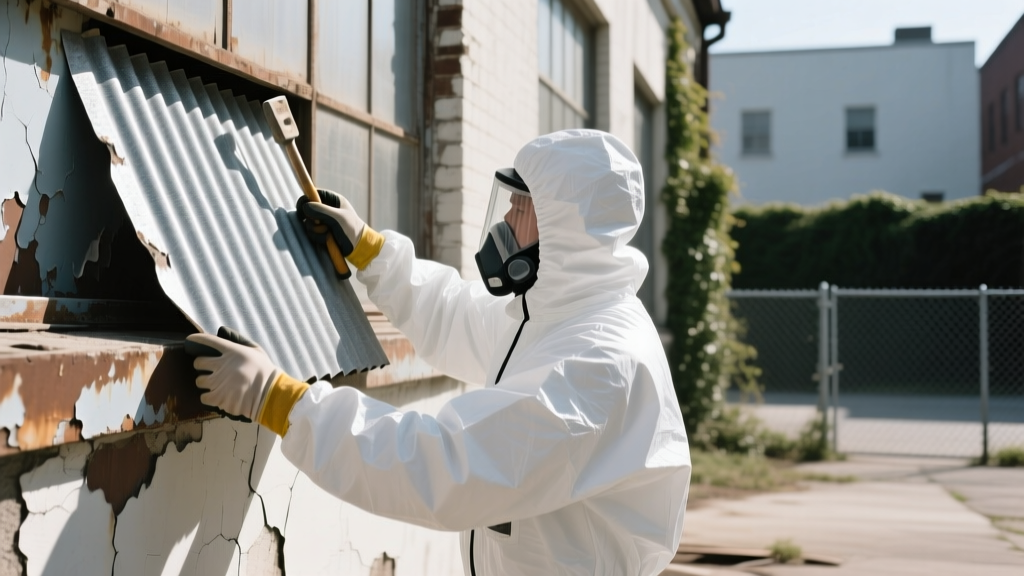
Testing Matrix: Identifying ACMs Before Demolition
Relying on visual identification is a critical failure point in renovation planning. Laboratory analysis is legally required before disturbing suspected materials in commercial buildings, and highly recommended for residential projects. The EPA and AHERA (Asbestos Hazard Emergency Response Act) protocols dictate specific microscopy methods.
| Testing Method | Resolution / Accuracy | Average Cost per Sample | Best Use Case |
|---|---|---|---|
| PLM (Polarized Light Microscopy) | Detects fibers >1.0 micrometers | $30 - $50 | Initial bulk material screening (drywall, siding) |
| TEM (Transmission Electron Microscopy) | Detects fibers down to 0.005 micrometers | $75 - $120 | Mandatory for final air clearance post-abatement |
| PCM (Phase Contrast Microscopy) | Counts total fibers (cannot differentiate asbestos) | $25 - $40 | Real-time worker exposure monitoring (OSHA PEL) |
Actionable Framework for Renovating Pre-1990 Structures
If you are managing a renovation on a structure built before 1990, follow this sequential framework to ensure regulatory compliance and mitigate liability.
- Commission an AHERA-Standard Survey: Before any demolition permits are pulled, hire a third-party environmental consultant to conduct a destructive survey. They will core-cut drywall, scrape mastic, and pull pipe insulation samples. Budget $400 to $800 for a standard 2,000 sq ft residential survey.
- File the NESHAP Notification: Under the National Emission Standards for Hazardous Air Pollutants (NESHAP), you must notify your state environmental agency at least 10 working days before demolishing or renovating a commercial or multi-family structure, regardless of whether asbestos is found.
- Establish Negative Air Pressure: If abatement is required, the containment zone must maintain a minimum of -0.02 inches of water column (w.c.) negative pressure relative to the outside environment. Verify this daily using a calibrated manometer.
- Wet Methods and Encapsulation: OSHA mandates the use of amended water (water mixed with a surfactant) to suppress dust during ACM removal. If removal is structurally unfeasible, use a penetrating encapsulant (like Foster 32-80) that binds fibers at the substrate level, rather than a bridging encapsulant that merely coats the surface.
- Secure TEM Air Clearance: Do not dismantle containment barriers until an independent third party passes the area using TEM air monitoring. The clearance threshold is strictly less than 0.01 fibers per cubic centimeter (f/cc).
Frequently Asked Questions
Is it legal to sell a house with asbestos materials in 2026?
Yes, it is generally legal to sell a residential property containing intact, undisturbed asbestos materials in the US. However, most states mandate strict seller disclosure laws requiring you to formally document the presence and location of known ACMs on a standardized property condition form. Encapsulated or non-friable asbestos (like intact floor tiles or siding) does not require removal prior to sale.
Does homeowners insurance cover asbestos abatement?
Standard HO-3 homeowners insurance policies explicitly exclude pollution and asbestos abatement under standard liability and property damage clauses. Abatement is considered a maintenance and renovation expense. However, if a covered peril (such as a tree falling through an asbestos-insulated roof) causes sudden damage that releases fibers, the insurance may cover the specialized cleanup and disposal costs required to restore the home to a safe condition, though not the wholesale upgrade of the material.
What is the OSHA Permissible Exposure Limit (PEL) for asbestos?
The OSHA PEL for asbestos is 0.1 fibers per cubic centimeter (f/cc) of air as an 8-hour time-weighted average (TWA), and an excursion limit of 1.0 f/cc over a 30-minute period. Contractors performing Class I and Class II asbestos work must utilize half-facepiece air-purifying respirators (APRs) equipped with P100 filters, and conduct daily fit testing.
Written by
Elena RodriguezElena Rodriguez is a civil engineer and technical writer specializing in concrete technology, masonry systems, and ASTM/ACI compliance. She earned her B.S. in Civil Engineering from Texas A&M University and spent a decade at a materials testing laboratory, performing over 2,000 concrete compressive strength tests and masonry prism evaluations. Elena is an ACI-certified Field Testing Technician (Grade I) and a member of ASTM Committee C12 on Natural Building Stone. She currently consults on forensic engineering cases involving concrete failures and moisture intrusion. Based in San Antonio, TX, Elena is a proud member of the Society of Women Engineers (SWE) and coaches her daughter's FIRST Robotics team.
More from Elena Rodriguez
View all
Walls & Panels
Cost Analysis: Light Gauge Steel Framing Advantages and Disadvantages
Evaluate light gauge steel framing advantages and disadvantages through a strict cost analysis lens, comparing material, labor, and lifecycle expenses.
Aug 4, 2026

Walls & Panels
Gypsum Board Types: Exact Specifications, Thickness & Dimensions
Compare standard, Type X, and moisture-resistant gypsum board types. Get exact specifications, thicknesses, dimensions, and ASTM standards for your project.
Aug 4, 2026

Fire Resistance
Best Fire-Resistant Outdoor Decking Materials: 2026 Buyer Guide
Discover the best fire-resistant outdoor decking materials for 2026. Compare Class A PVC, aluminum, and hardwood options for WUI compliance and safety.
Aug 4, 2026