Disneyland Building Materials Reaction: GFRC and Polyurea Specs
Analyze the chemical and physical Disneyland building materials reaction to UV, moisture, and thermal stress in themed GFRC, EPS, and polyurea composites.

The Science of Themed Entertainment Construction
Constructing immersive theme park environments requires materials that defy standard architectural conventions. When structural engineers and material scientists analyze the Disneyland building materials reaction to extreme environmental stressors, they are not evaluating standard commercial drywall or structural steel. Instead, they are testing highly specialized composites—specifically Glass Fiber Reinforced Concrete (GFRC), Expanded Polystyrene (EPS) foams, and elastomeric polyurea—against intense UV radiation, continuous moisture immersion, and aggressive thermal cycling. As of 2026, Imagineering and themed entertainment specifications demand rigorous chemical stability and precise mechanical tolerances to prevent catastrophic aesthetic and structural failures in high-traffic attractions.
GFRC and the Alkali-Silica Reaction (ASR) Mitigation
Themed rockwork, castle facades, and sculpted architectural elements rely heavily on GFRC due to its high strength-to-weight ratio. However, standard glass fibers undergo a destructive chemical reaction when embedded in a Portland cement matrix. The calcium hydroxide (Ca(OH)2) generated during cement hydration attacks the silica in standard E-glass fibers, leading to severe embrittlement and loss of flexural strength over time.
To mitigate this Alkali-Silica Reaction (ASR), themed entertainment specifications mandate the use of Alkali-Resistant (AR) glass fibers. These fibers are doped with zirconium dioxide (ZrO2). The zirconia acts as a chemical shield, preventing the alkaline pore solution from etching the glass surface.
- AR-Glass Fiber Content: 4.5% to 6.0% by weight of the total composite.
- Zirconia (ZrO2) Content: Minimum 16.5% to ensure long-term alkaline resistance.
- Cement Matrix: Type I/II Portland cement with a water-to-cement ratio strictly limited to 0.30–0.35 to minimize capillary porosity and moisture ingress.
- Silica Sand: AFS 50-70 gradation, washed and dried to <0.5% moisture content.
- Compressive Strength: >6,000 psi at 28 days (ASTM C39).
- Flexural Strength: >1,800 psi Modulus of Rupture (MOR) at 28 days.
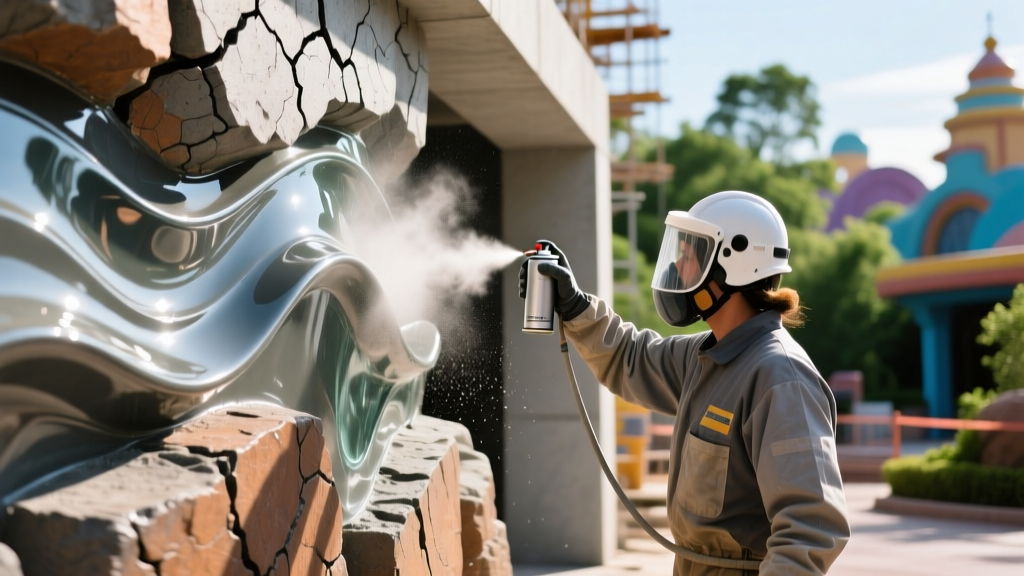
Thermal Reaction Dynamics in EPS and Polyurea Composites
For massive, lightweight set pieces and interior mountain structures, builders utilize EPS foam cores coated with a polyurea hard-shell. The primary engineering challenge here is the differential thermal reaction between the core and the shell. EPS foam and polyurea elastomers possess vastly different Coefficients of Thermal Expansion (CTE). When exposed to direct solar radiation, the outer polyurea shell can reach surface temperatures exceeding 160°F (71°C), while the EPS core remains relatively insulated.
If the polyurea formulation is too rigid, the thermal expansion of the foam core will cause the shell to crack or delaminate. Conversely, if the shell is too soft, it will lack the impact resistance required for guest interaction. Engineers must specify a polyurea with a high elongation modulus to absorb these differential thermal reactions without tearing.
| Material Component | CTE (x 10^-6 /°F) | Thermal Reaction Behavior |
|---|---|---|
| EPS Foam Core (Type II) | 35.0 - 40.0 | Expands significantly under heat; low thermal conductivity traps heat at the shell interface. |
| Polyurea Elastomer Shell | 80.0 - 100.0 | High expansion rate; requires >400% elongation to prevent stress cracking. |
| Steel Armature (Internal) | 6.5 - 7.0 | Highly stable; acts as a rigid anchor, requiring flexible tie-in joints to the EPS. |
| GFRC (Exterior Rockwork) | 5.0 - 6.0 | Matches steel armatures closely, minimizing shear stress at mechanical connection points. |
UV Degradation and Aliphatic Topcoat Specifications
The final aesthetic layer of any themed facade is the protective topcoat. A common and costly failure in early theme park construction was the use of aromatic polyurethanes and standard polyureas as final color coats. Aromatic polymers contain benzene rings that react rapidly with ultraviolet (UV) radiation. This photochemical reaction breaks the polymer chains, resulting in severe chalking, loss of gloss, and a yellowing shift that destroys carefully calibrated thematic color palettes within 12 to 18 months.
Never specify an aromatic polyurea or polyurethane as a final topcoat in exterior environments. While aromatic base coats provide excellent tensile strength and adhesion for under polyurea development standards, they must be shielded. As of 2026, all exterior themed entertainment specifications require an aliphatic polyurethane or aliphatic polyurea topcoat. Aliphatic polymers utilize linear carbon chains that do not absorb UV radiation in the same destructive spectrum, ensuring color stability and gloss retention for 10+ years.
For exterior facades, the required specification is a two-component, aliphatic polyurethane topcoat applied at a Dry Film Thickness (DFT) of 3.0 to 5.0 mils. This specific thickness ensures adequate UV absorption without inducing solvent entrapment or micro-cracking during the curing reaction.
Submerged Attractions: Osmotic Blistering and MVTR Limits
Water-based dark rides and flume attractions present the most aggressive chemical environment for building materials. The ride water is continuously treated with biocides, algaecides, and chlorine-based oxidizers to maintain hygiene. When structural concrete or steel in these attractions is coated with protective elastomers, a hidden chemical reaction can occur: osmotic blistering.
The Mechanism of Osmotic Failure
If the concrete substrate contains soluble salts, or if an epoxy primer is applied in high humidity causing 'amine blush' (a waxy, water-soluble byproduct of the curing reaction), water from the ride will permeate the coating. The coating acts as a semi-permeable membrane. As water reaches the soluble salts at the substrate interface, it creates a highly concentrated solution. Osmotic pressure then draws more water through the coating to dilute the solution. This internal pressure can exceed 500 psi, eventually rupturing the coating and forming massive blisters that expose the substrate to rapid corrosion.
To prevent this reaction, 2026 technical specifications for submerged themed attractions mandate strict Moisture Vapor Transmission Rate (MVTR) limits. Coatings must exhibit an MVTR of less than 1.0 perm when tested via ASTM E96 (Procedure BW). Furthermore, substrates must be verified via Bresle patch testing to ensure soluble salt contamination is below 3 µg/cm² of chlorides and 5 µg/cm² of sulfates prior to primer application.
Troubleshooting Matrix: Themed Material Reactions
When field failures occur, identifying the root chemical or physical reaction is critical for remediation. Use the following diagnostic matrix to isolate the failure mode:
- Symptom: Fine, spider-web cracking on exterior GFRC rockwork.
- Root Reaction: Plastic shrinkage during the initial hydration reaction due to high wind/low humidity during spraying.
- Remediation: Apply a penetrating silane/siloxane sealer to prevent moisture ingress; adjust curing compound application rates during future pours.
- Symptom: Delamination of polyurea shell from EPS foam core at the joints.
- Root Reaction: Differential thermal expansion exceeding the elastomer's tear strength, compounded by inadequate surface profiling of the foam.
- Remediation: Route out the failed joint, install a flexible polyurethane caulk backing, and re-spray with a high-elongation (>600%) aliphatic polyurea.
- Symptom: Chalking and severe color shift (yellowing) on a themed blue facade.
- Root Reaction: UV degradation of an incorrectly specified aromatic polyurethane topcoat.
- Remediation: Abrasive blast to remove the degraded layer, re-prime, and apply a verified aliphatic topcoat with UV light stabilizers (HALS).
"The longevity of themed entertainment architecture relies entirely on predicting and controlling the chemical reactions at the molecular interface. A failure to specify the correct zirconia content in GFRC or the correct aliphatic structure in topcoats will result in millions of dollars in premature rehabilitation."
Written by
Marcus ChenMarcus Chen is a licensed structural engineer (PE) and building materials analyst with over 12 years of experience across residential, commercial, and industrial construction. He holds a Master of Science in Civil Engineering from UC Berkeley and spent six years at Thornton Tomasetti before transitioning to independent consulting and technical writing. Marcus specializes in material selection for seismic-prone regions, concrete reinforcement strategies, and lifecycle cost analysis. His work has been cited by the American Concrete Institute (ACI) and the Structural Engineers Association of California (SEAOC). When he is not on a job site or at his desk, you will find him hiking the Sierra Nevada or restoring a 1920s craftsman bungalow in Oakland, CA.
More from Marcus Chen
View all
Construction Cost
How Much Did the Eiffel Tower Cost to Build?
How much did the Eiffel Tower cost to build in 1889? We adjust for inflation and compare its budget to modern skyscraper construction.
Aug 4, 2026

Fire Resistance
What Is a Fire Resistant Material? Testing & Certification Guide
Discover what is a fire resistant material through ASTM and UL testing. Learn how fire ratings, certifications, and assemblies work in construction.
Aug 4, 2026

Construction Cost
How Much Did the Burj Khalifa Cost to Build?
How much did the Burj Khalifa cost to build? We break down the $1.5B project and extract 5 money-saving strategies for your next build.
Jul 30, 2026