Prime Building Materials in Oxnard: 2026 Supplier Review
Compare top suppliers and prime-grade building materials in Oxnard for 2026. Expert insights on coastal framing, cladding, and local logistics.

The Oxnard Coastal Construction Factor: Why Material Grade Matters
Sourcing prime building materials in Oxnard requires navigating a unique intersection of coastal environmental stressors, seismic requirements, and stringent California Title 24 energy codes. Unlike inland Ventura County projects, Oxnard’s proximity to the Pacific Ocean introduces salt aerosol corrosion, high moisture loads from the marine layer, and localized Wildland-Urban Interface (WUI) fire mandates in eastern neighborhoods like Riverpark and Teal Club.
When contractors and custom home builders search for prime building materials in Oxnard, they are not just looking for standard dimensional lumber or basic siding. "Prime" in this market refers to materials graded and treated to withstand coastal degradation while meeting the strict coastal development permit requirements enforced by local jurisdictions. According to the FEMA Coastal Construction Manual, structures within 1,500 feet of the mean high tide line require specific corrosion-resistant fasteners and moisture-managing assemblies that standard big-box inventory rarely stocks in depth.
Ventura County Coastal Zone Alert: Any structural framing within the Oxnard coastal zone must account for borate-treated lumber to combat drywood termites, which are highly prevalent in the humid coastal microclimate. Standard pressure-treated (ACQ/MCQ) lumber resists rot but does not inherently deter drywood termites without secondary borate applications.
Comparing Prime Material Suppliers in the Oxnard Market
The supply chain for premium construction materials in Ventura County is fragmented. To secure true prime-grade inventory—such as Select Structural Douglas Fir, 5/8-inch Type X fire-rated gypsum, and architectural-grade fiber cement—builders must choose the right supply channel. Below is a 2026 comparison matrix of the primary sourcing avenues available to Oxnard-based projects.
| Supplier Category | Prime Lumber Availability | Coastal Expertise & Inventory | Delivery Fleet Capabilities | Best Use Case |
|---|---|---|---|---|
| Regional Pro Yards (e.g., Builders FirstSource, FBM) | High (Select & Better grades, custom borate treatments) | Excellent (Stock 316 SS fasteners, marine-grade hardware) | Crane trucks, boom lifts, daily route to Oxnard | Custom coastal homes, large commercial TI |
| Big Box Retailers (Home Depot Pro, Lowe's) | Low (Mostly #2 and Btr, limited Select Structural) | Poor (Standard galvanized hardware, limited coastal stock) | Flatbed only, restricted crane access | Small interior remodels, quick hardware runs |
| Specialty Cladding & Roofing Distributors | N/A (Focused on exterior envelope) | Exceptional (Class A WUI roofing, premium fiber cement) | Semi-truck drops, requires forklift on-site | Exterior envelope upgrades, re-siding |
Material Deep-Dive: What Qualifies as "Prime" in 2026?
To ensure structural longevity and pass final inspections without costly rework, Oxnard builders must specify materials that exceed baseline code minimums. Here is a breakdown of the exact material specifications that define prime-grade building materials in this specific coastal market.
Structural Framing: Douglas Fir vs. Treated Southern Yellow Pine
For premium residential framing in Oxnard, Select Structural Douglas Fir-Larch (DF-L) remains the gold standard. While Southern Yellow Pine (SYP) is heavily used in commercial trusses, DF-L offers superior nail-holding capacity and dimensional stability in the fluctuating humidity of the coastal marine layer.
- The Prime Spec: Specify Kiln-Dried (KD) 19% moisture content or lower. Green lumber will warp as it acclimates to Oxnard’s ambient humidity, causing drywall callbacks.
- Pricing Reality (2026): Expect to pay between $8.50 and $10.20 per linear foot for Select Structural 2x6 DF-L at regional pro yards, compared to $5.80 for standard #2 SYP at retail.
Exterior Cladding: Navigating Salt Air and WUI Fire Codes
Oxnard’s eastern edges brush against WUI zones, while the western edges face direct salt spray. The California Energy Commission's Title 24 mandates also require continuous exterior insulation, which complicates cladding attachment. When comparing prime cladding options, two materials dominate the high-end market:
1. James Hardie Artisan Lap (Fiber Cement)
Fiber cement is virtually impervious to salt aerosol corrosion and holds a Class A fire rating. The Artisan collection provides deep shadowlines preferred in Oxnard’s luxury coastal builds. However, it requires specialized carbide-tipped scoring tools and generates silica dust during cutting, necessitating strict OSHA compliance on-site.
2. LP SmartSide ExpertFinish (Engineered Wood)
Lighter and faster to install than fiber cement, LP SmartSide is treated with zinc borate to resist termites and fungal decay. While it performs well in high humidity, the cut edges must be meticulously sealed with the manufacturer’s proprietary sealant to prevent moisture intrusion from the coastal fog. If your crew is prone to skipping edge-sealing steps, default to fiber cement.
James Hardie Artisan: $12.50 - $14.00 / sq. ft. (Material) | High labor cost due to weight and cutting time.
LP SmartSide ExpertFinish: $8.00 - $9.50 / sq. ft. (Material) | Lower labor cost, standard wood-working tools apply.
Note: Prices reflect Q1 2026 pro-yard pricing for the Greater Ventura market, excluding tax and delivery.
Logistics, Delivery, and Lead Times in Ventura County
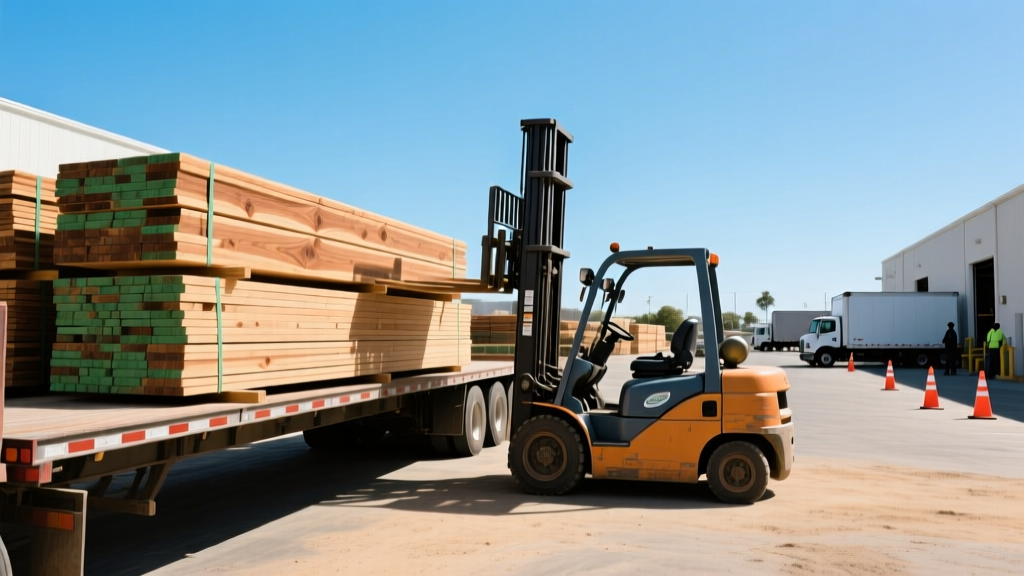
Sourcing prime building materials in Oxnard is only half the battle; getting them to the job site efficiently is where many projects bleed margin. The logistics of material delivery in Oxnard present unique challenges that out-of-town developers frequently underestimate.
- Highway 101 Corridor Congestion: Most regional suppliers dispatch from Ventura, Camarillo, or the San Fernando Valley. Deliveries routed down the 101 during the 6:00 AM to 9:00 AM window are routinely delayed. Always schedule crane-truck drops for mid-morning (10:00 AM) to avoid paying for idle framing crews waiting on lumber packs.
- Crane Truck Access in Historic and Dense Zones: If you are building in the historic Henry T. Oxnard district or executing a teardown-rebuild in tight infill lots near the Channel Islands Harbor, standard 40-foot flatbeds with boom lifts cannot navigate the narrow, tree-canopied streets. You must coordinate with your supplier to use "pup" trailers or arrange for a secondary site forklift to offload at a staging area.
- Coastal Commission Staging Rules: For sites west of Victoria Avenue, the Ventura County Building and Safety division strictly enforces right-of-way and sidewalk obstruction rules. Material drops cannot block pedestrian pathways or bike lanes without a temporary encroachment permit, which takes up to 14 days to process.
Decision Framework: Choosing Your Supply Chain
Do not default to a single supplier for an entire Oxnard build. The most profitable general contractors in Ventura County utilize a hybrid sourcing strategy:
- Phase 1 (Foundation & Framing): Establish a credit line with a dedicated Pro Yard (like Builders FirstSource or a specialized local independent) to secure Select Structural lumber, custom-treated sill plates, and heavy timber beams. Their technical reps can review your architectural plans and flag coastal code discrepancies before the lumber is cut.
- Phase 2 (Insulation & Drywall): Foundation Building Materials (FBM) and similar specialized distributors excel here. They carry the full spectrum of 5/8-inch Type X, mold-resistant, and sound-damping gypsum boards required for Oxnard’s multi-family and luxury attached-housing projects.
- Phase 3 (Finishes & Hardware): Utilize local specialized distributors for exterior hardware. Ensure they stock Simpson Strong-Tie connectors with the ZMAX or HDG (Hot-Dip Galvanized) coatings required for exterior coastal framing, as standard zinc-plated connectors will fail inspection in the coastal zone.
Frequently Asked Questions
Can I use standard galvanized nails for exterior sheathing in Oxnard?
No. If the project is located within the designated coastal wind-borne debris region or within 1,500 feet of the ocean, the California Building Code mandates hot-dip galvanized (ASTM A153) or 316 stainless steel fasteners for exterior connections. Standard electro-galvanized nails will rust and bleed through prime fiber cement or stucco finishes within 18 months in the Oxnard marine layer.
Are there local Oxnard suppliers that manufacture custom structural panels?
While Oxnard itself is primarily a distribution and agricultural hub, several major truss and panel manufacturing facilities operate in neighboring Camarillo and Moorpark. These facilities supply the Oxnard market with engineered floor joists (like Boise Cascade TJI) and roof trusses, typically offering 3-to-4 week lead times for custom residential packages in 2026.
How do I verify the fire rating of roofing materials for eastern Oxnard WUI zones?
Look for materials listed in the California State Fire Marshal’s Building Materials Listing (BML). Prime roofing materials in WUI zones must hold a Class A fire rating and pass the WUI-specific ember intrusion tests. Concrete barrel tiles and heavy-gauge standing seam metal roofs are the most commonly approved prime options for these specific Oxnard zip codes.
Written by
Sarah WhitfieldSarah Whitfield is a chartered quantity surveyor (MRICS) and construction cost analyst with 15 years of experience in material pricing, procurement strategy, and project budgeting. She earned her degree in Construction Management from the University of Reading (UK) and has worked on projects ranging from $2M custom homes to $180M mixed-use developments across North America and Europe. Sarah currently leads cost estimating for BuildMat Insight, maintaining a proprietary database of 4,000+ material price points updated quarterly. She is a frequent contributor to RSMeans cost data panels and has presented at the International Cost Engineering Council (ICEC) congress. Based in Denver, CO, Sarah is an avid trail runner and volunteer mentor for Women in Construction.
More from Sarah Whitfield
View all
Wood & Lumber
What Are the Different Types of Wood? A Builder's Guide
Compare structural softwoods, finish hardwoods, and engineered lumber. Analyze Janka ratings, MOE values, and 2026 pricing for construction.
Aug 4, 2026

Walls & Panels
Steel Framing vs Wood Framing: Corrosion and Moisture Defense
Compare steel framing vs wood framing for moisture resistance. Learn about galvanized coatings, condensation risks, and corrosion protection strategies.
Jul 21, 2026

Stone & Masonry
How to Cut Stone Veneer: Wet Saw vs Grinder Comparison
Compare the best tools for cutting stone veneer. We review wet saws, angle grinders, and chop saws to help you achieve clean, chip-free cuts.
Jul 21, 2026