How the Largest Building Materials Companies Impact Project Costs
Analyze how the largest building materials companies dictate pricing. Discover cost breakdowns, freight multipliers, and direct sourcing strategies.
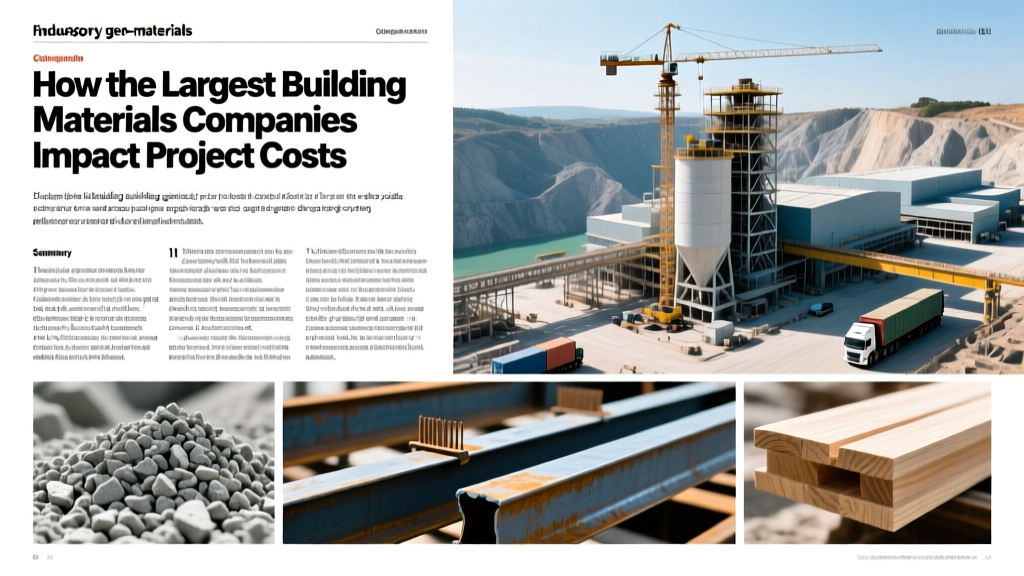
The Oligopoly Effect: How Industry Giants Set the Baseline
The North American construction supply chain is heavily consolidated. When analyzing project budgets, general contractors and developers must understand that the largest building materials companies—namely CRH, Holcim, Vulcan Materials, Martin Marietta, and Knauf—exercise significant pricing power over foundational commodities. These conglomerates control the majority of cement kilns, aggregate quarries, and gypsum manufacturing plants across the continent.
From a cost analysis perspective, this consolidation creates a rigid pricing floor. While finished goods like fixtures or cabinetry see price fluctuations based on consumer demand and retail competition, bulk commodities like Portland cement and #57 crushed stone are priced based on the production capacity and rail-logistics networks of these industry titans. In 2026, understanding the margin structures of these giants is the only way to accurately forecast hard costs for large-scale commercial and infrastructure projects.
Direct-to-Project vs. Distributor Margins: A Cost Breakdown
A common misconception among emerging developers is that buying direct from the largest building materials companies always guarantees the lowest unit cost. While bypassing a middleman saves on distributor markups, it introduces strict minimum order quantities (MOQs), specialized handling requirements, and rigid delivery schedules. Below is a 2026 cost comparison matrix evaluating direct procurement versus purchasing through authorized regional distributors.
| Material (Bulk/Standard) | Direct from Manufacturer (2026) | Regional Distributor (2026) | Hidden Direct Costs |
|---|---|---|---|
| Type I/II Portland Cement (per ton) | $152 - $165 | $178 - $195 | Silo rental, pneumatic truck fees |
| #57 Crushed Granite (per ton) | $22 - $28 (at quarry) | $41 - $55 (delivered) | Freight cliff past 40 miles |
| 5/8" Type X Gypsum (per 4x12 sheet) | $14.50 (full truckload) | $18.20 (mixed pallet) | Crane offloading, weather storage |
As the Portland Cement Association data indicates, bulk cement pricing remains highly localized. The direct price of $152 per ton is only achievable if your project site has the infrastructure to accept pneumatic bulk trailers and maintain a 100-ton on-site silo. For projects lacking this infrastructure, the distributor premium is not just a markup; it is the cost of bagging, palletizing, and storing the material in a climate-controlled warehouse to prevent hydration.
Freight and Logistics: The Hidden Cost Multiplier
When analyzing the cost structures of the largest building materials companies, freight is the single most volatile variable. Aggregates and cement are high-weight, low-value commodities. The raw material cost of crushed limestone is negligible compared to the cost of moving it.
Calculating the Landed Cost of Bulk Aggregates
Contractors must utilize the "Landed Cost Formula" to determine if sourcing from a mega-quarry is actually cheaper than a local, independent pit. The standard industry formula for 2026 heavy-haul trucking is:
- Quarry FOB Price: $24.00/ton (Vulcan/Martin Marietta average for #57 stone).
- Ton-Mile Rate: $0.35 to $0.45 per ton, per mile (subject to diesel surcharges).
- The Freight Cliff: Once a project site exceeds 55 miles from the rail-served distribution yard, the freight cost eclipses the material cost. At 80 miles, the $24.00/ton stone becomes a $56.00/ton stone. At this threshold, sourcing from a smaller, independent local quarry—even if their base extraction cost is 20% higher—becomes the mathematically superior choice.
Strategic Sourcing Framework for Mid-Sized Contractors
Mid-sized general contractors ($50M–$250M annual revenue) often lack the sheer volume to command the deepest tier-1 discounts from the largest building materials companies, yet they are too large to rely on retail lumber yards and bagged cement. To optimize costs, procurement teams should apply the following decision matrix when engaging with industry giants:
- Leverage Rail-Served Sites: If your project is a large campus or infrastructure build, invest in temporary rail spurs or locate your batch plant adjacent to existing Class I railroad lines owned by CRH or Holcim. Rail transport drops the ton-mile cost of cement from $0.35 (truck) to $0.06 (rail), saving hundreds of thousands of dollars on 10,000+ yard pours.
- Negotiate Off-Peak Deliveries: Mega-producers operate their kilns and crushers 24/7 but face bottlenecks at the dispatch yards between 6:00 AM and 10:00 AM. Negotiating a 2% to 4% discount for accepting deliveries between 8:00 PM and 4:00 AM can yield massive savings on high-volume drywall and steel framing orders.
- Utilize "Take-or-Pay" Contracts for Price Locks: In volatile inflationary environments, offer a guaranteed annual volume commitment (Take-or-Pay) in exchange for locking in Q1 pricing for the entire fiscal year. The largest companies prefer predictable volume to feed their continuous-run kilns over spot-market margin maximization.
Frequently Asked Questions
Do the largest building materials companies offer better pricing for sustainable or low-carbon materials?
Currently, low-carbon alternatives like Type IL (Portland-Limestone) cement or geopolymer concretes carry a 5% to 12% premium over traditional OPC (Ordinary Portland Cement). However, companies like Holcim and CRH are heavily subsidizing these lines to meet ESG targets. Contractors can often negotiate parity pricing on low-carbon materials if they agree to feature the manufacturer's branding in the project's LEED or sustainability documentation.
How far in advance should I lock in pricing with major aggregate suppliers?
According to USGS Crushed Stone Statistics, aggregate pricing typically resets in Q1 (January/February) with annual escalators built into contracts. For large earthwork and foundation phases, lock in pricing 90 to 120 days before breaking ground to avoid mid-year diesel surcharge adjustments that major suppliers apply when crude oil markets spike.
Can I bypass the largest companies entirely for structural materials?
While you can source lumber, steel, and finishes from independent distributors, bypassing the giants for cement and heavy aggregates is geographically constrained. Cement kilns require massive capital expenditure (often exceeding $500M per facility), meaning regional monopolies are common. You can bypass them for finishing materials, but for substructure and shell materials, engaging with their authorized regional batch plants is usually unavoidable and, when negotiated correctly, cost-effective.
Written by
Elena RodriguezElena Rodriguez is a civil engineer and technical writer specializing in concrete technology, masonry systems, and ASTM/ACI compliance. She earned her B.S. in Civil Engineering from Texas A&M University and spent a decade at a materials testing laboratory, performing over 2,000 concrete compressive strength tests and masonry prism evaluations. Elena is an ACI-certified Field Testing Technician (Grade I) and a member of ASTM Committee C12 on Natural Building Stone. She currently consults on forensic engineering cases involving concrete failures and moisture intrusion. Based in San Antonio, TX, Elena is a proud member of the Society of Women Engineers (SWE) and coaches her daughter's FIRST Robotics team.
More from Elena Rodriguez
View all
Walls & Panels
Cost Analysis: Light Gauge Steel Framing Advantages and Disadvantages
Evaluate light gauge steel framing advantages and disadvantages through a strict cost analysis lens, comparing material, labor, and lifecycle expenses.
Aug 4, 2026

Walls & Panels
Gypsum Board Types: Exact Specifications, Thickness & Dimensions
Compare standard, Type X, and moisture-resistant gypsum board types. Get exact specifications, thicknesses, dimensions, and ASTM standards for your project.
Aug 4, 2026

Fire Resistance
Best Fire-Resistant Outdoor Decking Materials: 2026 Buyer Guide
Discover the best fire-resistant outdoor decking materials for 2026. Compare Class A PVC, aluminum, and hardwood options for WUI compliance and safety.
Aug 4, 2026