Building Material Guide: Washington Monument & NYT Stone Insights
Explore the building materials of the Washington Monument. A selection guide for marble, granite, and gneiss inspired by NYT restoration coverage.

The Ultimate Benchmark in Monumental Stone Selection
When evaluating a historic building material, the Washington Monument serves as a masterclass in structural durability, petrology, and the long-term consequences of sourcing decisions. Architectural retrospectives in the New York Times (NYT) have frequently highlighted the obelisk’s material history, particularly during the extensive 2014–2019 scaffolding restorations and the structural assessments following the 2011 Virginia earthquake. For modern architects, masonry contractors, and material specifiers in 2026, the monument offers critical, real-world data on how different stone varieties weather, bear loads, and respond to seismic shear over a century-long lifespan.
This selection guide decodes the specific geological materials used in the monument’s construction and translates those historical choices into actionable specifications for contemporary high-durability exterior stone projects.
Decoding the Monument's Material Palette
The Washington Monument is not a monolith of a single stone. It is a carefully engineered composite of three distinct geological materials, each selected for specific structural and aesthetic roles. Understanding these roles is essential for specifying exterior stone in modern load-bearing and cladding applications.
1. Bluestone Gneiss: The Subterranean Foundation
Beneath the visible structure lies the foundation, constructed from bluestone gneiss. This metamorphic rock, characterized by its intense foliation and high compressive strength, was chosen for its ability to distribute the monument's massive 81,000-ton dead load across the underlying soil. Gneiss exhibits a compressive strength often exceeding 20,000 psi, making it virtually impervious to the crushing forces of monumental masonry. While rarely used in modern above-ground aesthetics due to its dark, banded appearance, bluestone gneiss remains a premier choice for heavy-duty retaining walls, subterranean foundations, and high-load paving in 2026 infrastructure projects.
2. Granite: The Base and Lower Steps
The visible base and the massive lower steps of the monument are clad in granite sourced from Maine. Granite’s极低 porosity (typically less than 0.5%) and high resistance to freeze-thaw cycling make it the industry standard for exterior paving, stair treads, and splash zones. The NYT’s coverage of the monument's landscaping and plaza restorations often notes how the granite base has resisted the salt, de-icing chemicals, and foot traffic that would rapidly degrade softer sedimentary stones.
3. The Marble Conundrum: Texas, Sheffield, and Cockeysville
The most famous material lesson from the Washington Monument involves its white marble shaft. Construction began in 1848 using marble from the Texas Station quarry in Maryland. However, funding ran out, and construction halted at the 150-foot mark. When work resumed decades later, the original quarry could no longer supply matching stone. Builders first switched to Sheffield marble from Massachusetts, but it weathered to a different hue. Finally, they settled on Cockeysville marble from Maryland to complete the shaft to its 555-foot apex.
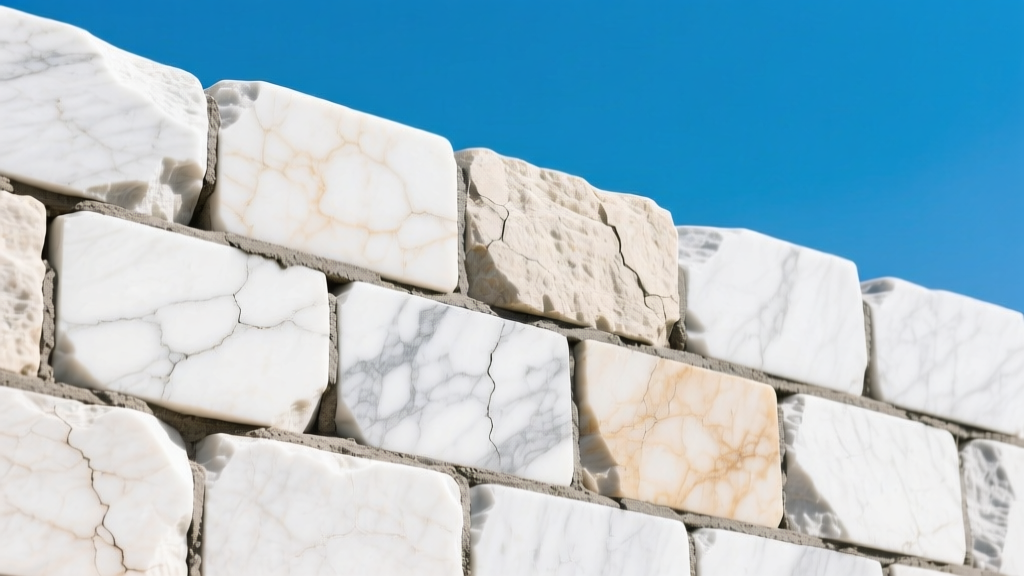
The famous "ring" or color mismatch visible on the monument today is a direct result of differential weathering. The Texas Station marble contained higher concentrations of iron sulfide and organic impurities, causing it to oxidize and darken over time. The Cockeysville marble, being purer calcite, remained brighter. Selection Takeaway: When specifying marble for large-scale exterior cladding, always demand petrographic analysis (ASTM C1721) to ensure chemical consistency across all quarry blocks, even if they visually match at the time of installation.
Modern Equivalents for 2026 Architectural Projects
If you are specifying stone for a modern civic building, memorial, or high-end exterior facade and wish to replicate the performance characteristics of the Washington Monument's materials, you must look to commercially available equivalents that meet current ASTM standards. The original quarries used for the monument are largely depleted or closed to monumental block extraction.
| Historical Material | 2026 Modern Equivalent | Primary Use Case | Avg. Cost (Per Sq. Ft.) |
|---|---|---|---|
| Texas Station Marble | Vermont Danby Marble (Imperial) | Exterior cladding, monuments | $65 - $95 |
| Cockeysville Marble | Georgia Cherokee Marble | Carved elements, bright facades | $50 - $75 |
| Maine Granite (Base) | Barre Gray Granite (Vermont) | Paving, treads, splash zones | $40 - $60 |
| Bluestone Gneiss | Pennsylvania Bluestone (Full Bed) | Retaining walls, heavy paving | $15 - $25 |
Specifying Exterior Stone: Critical ASTM Standards
The NYT archives detailing the 2011 earthquake repairs revealed that the monument's marble panels survived the 5.8 magnitude seismic event largely due to the flexibility of the historic lime-mortar joints, which absorbed the shear stress. Modern material selection must account for both the stone's intrinsic properties and its interaction with setting systems. When drafting your 2026 project specifications, mandate compliance with the following standards:
- ASTM C503 (Standard Specification for Marble Building Stone - Exterior): Requires a minimum compressive strength of 7,500 psi, maximum water absorption of 0.20%, and a minimum density of 162 lb/ft³. Vermont Danby and Georgia Cherokee marbles routinely exceed these baselines.
- ASTM C97 (Absorption and Bulk Specific Gravity): Critical for freeze-thaw durability. Any exterior stone with an absorption rate above 0.5% is highly susceptible to spalling in northern climates. Always request batch-specific C97 test results from the quarry, as porosity can vary wildly within a single vein.
- ASTM C170 (Flexural Strength): Essential for thin-set cladding and ventilated facade systems. For panels thinner than 2 inches, specify a minimum flexural strength of 1,000 psi to prevent wind-load deflection and cracking.
"The longevity of a stone facade is rarely determined by the compressive strength of the rock itself, but rather by its porosity, the chemical purity of its calcite matrix, and the compatibility of the mortar system used to bind it."
— Adapted from structural masonry forensic guidelines, USGS Building Stone Resources.
Sourcing and Quality Control Protocols
When procuring monumental-grade stone, visual inspection at the slab yard is insufficient. To avoid the "color band" mistake that permanently altered the Washington Monument's aesthetic, implement the following quality control protocols during the 2026 procurement phase:
- Block Number Tracking: Require the fabricator to map every exterior panel back to its specific quarry block number. Do not mix blocks from different veins on the same elevation.
- Accelerated Weathering Testing: For high-profile civic projects, commission third-party accelerated UV and acid-rain weathering tests (ASTM C119) on sample coupons to predict 50-year color shifts.
- Mockup Panels: Construct a full-scale, multi-panel mockup using the actual mortar and setting anchors specified for the project. Expose it to the elements for a minimum of 60 days before approving the bulk fabrication run.
Frequently Asked Questions: Exterior Stone Selection
Why did the Washington Monument's marble change color, and how do I prevent this?
The color shift occurred because construction paused for decades, forcing builders to use marble from different geological formations (Texas Station vs. Cockeysville) that contained varying levels of iron and organic impurities. To prevent this, specify a single, active quarry vein for your entire project and mandate ASTM C1721 petrographic analysis to ensure chemical uniformity across all extracted blocks.
Is marble still viable for exterior cladding in freezing climates?
Yes, but only if it meets strict density and porosity thresholds. According to the National Park Service monument specifications and modern ASTM C503 standards, exterior marble must have a water absorption rate of 0.20% or less. High-density marbles like Vermont Danby perform exceptionally well in freeze-thaw cycles, whereas softer, more porous imported marbles will spall and delaminate within a decade.
What mortar should be used with exterior marble to prevent staining?
Never use standard Portland cement mortar with white marble; the soluble salts and iron compounds in the cement will migrate into the stone's porous matrix, causing irreversible yellow and brown staining. Specify a white, polymer-modified, low-alkali mortar specifically formulated for natural stone, and always apply a breathable, penetrating silane/siloxane sealer to the back and edges of the marble panels prior to setting.
For further technical specifications on exterior stone performance and modern testing methodologies, refer to the ASTM C503 Standard Specification for Marble Building Stone.
Written by
Marcus ChenMarcus Chen is a licensed structural engineer (PE) and building materials analyst with over 12 years of experience across residential, commercial, and industrial construction. He holds a Master of Science in Civil Engineering from UC Berkeley and spent six years at Thornton Tomasetti before transitioning to independent consulting and technical writing. Marcus specializes in material selection for seismic-prone regions, concrete reinforcement strategies, and lifecycle cost analysis. His work has been cited by the American Concrete Institute (ACI) and the Structural Engineers Association of California (SEAOC). When he is not on a job site or at his desk, you will find him hiking the Sierra Nevada or restoring a 1920s craftsman bungalow in Oakland, CA.
More from Marcus Chen
View all
Construction Cost
How Much Did the Eiffel Tower Cost to Build?
How much did the Eiffel Tower cost to build in 1889? We adjust for inflation and compare its budget to modern skyscraper construction.
Aug 4, 2026

Fire Resistance
What Is a Fire Resistant Material? Testing & Certification Guide
Discover what is a fire resistant material through ASTM and UL testing. Learn how fire ratings, certifications, and assemblies work in construction.
Aug 4, 2026

Construction Cost
How Much Did the Burj Khalifa Cost to Build?
How much did the Burj Khalifa cost to build? We break down the $1.5B project and extract 5 money-saving strategies for your next build.
Jul 30, 2026