Bamboo Buildings DIY: Structural Installation Guide for Pavilions
Master bamboo buildings DIY with this structural installation guide. Learn Guadua joinery, borax treatment, and foundation steps for a 10x10 pavilion.

The Reality of Structural Bamboo Construction
Constructing bamboo buildings DIY requires shifting your mindset from traditional timber framing to cylindrical, hollow-tube engineering. Unlike dimensional lumber, bamboo lacks uniform flat surfaces and consistent internal density. Success hinges on understanding culm mechanics, specifically how to transfer loads across hollow nodes without crushing the vascular bundles. This guide details the exact specifications, treatment protocols, and joinery techniques required to build a freestanding 10x10-foot bamboo pavilion capable of withstanding regional wind and snow loads, adhering to principles outlined in ISO 22156:2021 (Bamboo structural design).
Material Sourcing: Selecting the Right Culms
Not all bamboo is structural. For load-bearing columns and primary beams, you must source Guadua angustifolia or mature Phyllostachys edulis (Moso bamboo). Guadua offers superior tensile strength (up to 400 MPa) and thicker culm walls, making it the global standard for structural frameworks.
- Column Culms: Specify 80mm to 110mm outer diameter (OD) with a minimum wall thickness of 12mm.
- Beam Culms: Specify 60mm to 80mm OD.
- Purlins (Roof framing): Specify 40mm to 50mm OD.
- Harvest Age: Only purchase bamboo harvested between 4 and 5 years of age. Younger culms (under 3 years) have high moisture content and will shrink and split; older culms (over 6 years) become brittle and lose tensile elasticity.
- Moisture Content: Ensure the supplier has air-dried the culms to a moisture content below 15% before shipping.
Pre-Installation Borax Treatment Protocol
Untreated bamboo contains high levels of starch, making it highly susceptible to powderpost beetles (Dinoderus minutus) and fungal decay. If you receive raw, untreated culms, you must treat them before assembly.
The Cold-Soak Borax Method
- Mix a 10% concentration solution of borax and boric acid (1:1 ratio) in water. For a 100-gallon trough, use 5 lbs of borax and 5 lbs of boric acid.
- Submerge the culms completely. Use cinder blocks to keep them weighted below the surface.
- Soak for 5 to 7 days. The boron salts will diffuse through the vascular bundles via capillary action.
- Remove and stack the culms horizontally on elevated stickers (spacers) in a shaded, well-ventilated area for 14 days to allow surface moisture to evaporate.
Foundation Engineering: Keeping Bamboo Dry
The golden rule of bamboo architecture is that the material must never touch the ground. Moisture wicking leads to rapid cellular degradation. For a 10x10 pavilion, you need four primary corner footings and two mid-span footings for the 10-foot beams.
Excavate post holes to a depth of 36 inches (or below your local frost line). Insert 12-inch diameter Sonotube forms. Fill with 3000 PSI concrete. While the concrete is wet, embed a Simpson ZMAX galvanized adjustable post base (model ABU44Z) into the center of each pier. These bases elevate the bamboo culm exactly 2 inches above the concrete surface, preventing ground-splash moisture absorption and providing a secure mechanical anchor.
Structural Joinery: The Fish-Mouth and Bolt Method
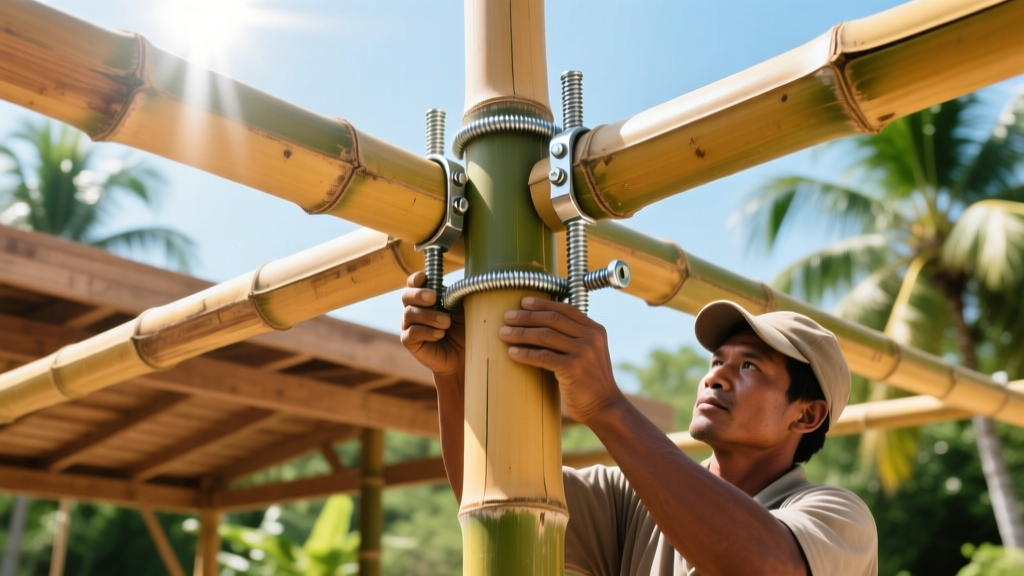
Traditional hemp lashing is aesthetically pleasing but lacks the shear strength required for modern building codes and high-wind zones. For permanent bamboo buildings DIY projects, the bolted fish-mouth joint, reinforced with structural epoxy, is the industry standard recommended by the International Bamboo and Rattan Organization (INBAR).
Step-by-Step Joint Execution
- The Fish-Mouth Cut: To join a horizontal beam to a vertical post, the end of the beam must be carved to match the curvature of the post. Use a contour gauge to trace the post's curve onto the beam. Cut the profile using a reciprocating saw, then refine the fit with a half-round rasp until the contact area is at least 70% flush.
- Internal Cavity Reinforcement: Bamboo is hollow. If you tighten a bolt through an empty culm, the outer wall will crush inward, destroying the joint's integrity. Drill a 1/2-inch hole into the beam near the joint and inject a two-part marine epoxy (such as WEST System 105 resin with 205 hardener) mixed with wood flour to create a structural putty. Pack the hollow cavity at the joint line completely solid. Allow 24 hours to cure.
- Drilling and Bolting: Once the epoxy plug is solid, drill a 13mm hole completely through both the beam and the post. Insert an M12 (12mm diameter) 316-grade stainless steel threaded rod.
- Tightening: Use large 50mm fender washers under the nut and bolt head to distribute the clamping force across the bamboo's outer skin. Tighten to 35 ft-lbs of torque. Do not overtighten.
Joinery Methods Comparison Matrix
| Joint Type | Shear Strength | Skill Level | Best Application |
|---|---|---|---|
| Traditional Cane Lashing | Low (Flexible) | Moderate | Temporary structures, decorative trellises |
| M12 Bolted Fish-Mouth | High (Rigid) | Advanced | Permanent pavilions, load-bearing frames |
| Mortise and Tenon (Wood insert) | Very High | Expert | Multi-story structures, complex trusses |
Cost Breakdown: 10x10 DIY Pavilion Frame
Building with bamboo can be highly cost-effective, but specialized hardware and treatment chemicals add to the baseline material costs. Below is an estimated pricing matrix for a 10x10 structural frame (excluding roofing materials).
- Guadua Bamboo Culms (14 total): $450 - $600 (Includes shipping from specialized distributors)
- Borax & Boric Acid Treatment: $45
- Concrete & Sonotubes (6 piers): $180
- Galvanized Post Bases (Simpson ABU44Z): $110
- M12 Stainless Threaded Rods, Nuts, Washers: $85
- WEST System Epoxy Kit (Quart): $65
- Consumables (Drill bits, saw blades, rasps): $75
Total Estimated Frame Cost: $1,010 - $1,160. This compares favorably to pressure-treated timber or steel framing, which typically ranges from $1,800 to $2,500 for the same footprint, while offering a significantly lower embodied carbon footprint.
Long-Term Maintenance and UV Protection
Bamboo's lignin structure is highly susceptible to ultraviolet (UV) degradation. When exposed to direct sunlight, the outer epidermal layer will photo-oxidize, turning gray and developing micro-fissures within 12 months. These fissures allow moisture ingress, which leads to internal fungal growth.
To prevent this, apply a penetrating UV-inhibiting oil finish immediately after construction. Products like Cabot Australian Timber Oil or specialized bamboo sealers containing transoxide pigments are required. Do not use polyurethane or film-forming varnishes; these trap moisture inside the culm and will peel as the bamboo naturally expands and contracts with seasonal humidity changes. Reapply the penetrating oil every 24 to 36 months, depending on your local UV index and rainfall frequency. Inspect all bolted joints annually, tightening nuts that may have loosened due to the culm's natural seasonal shrinkage.
Written by
Marcus ChenMarcus Chen is a licensed structural engineer (PE) and building materials analyst with over 12 years of experience across residential, commercial, and industrial construction. He holds a Master of Science in Civil Engineering from UC Berkeley and spent six years at Thornton Tomasetti before transitioning to independent consulting and technical writing. Marcus specializes in material selection for seismic-prone regions, concrete reinforcement strategies, and lifecycle cost analysis. His work has been cited by the American Concrete Institute (ACI) and the Structural Engineers Association of California (SEAOC). When he is not on a job site or at his desk, you will find him hiking the Sierra Nevada or restoring a 1920s craftsman bungalow in Oakland, CA.
More from Marcus Chen
View all
Construction Cost
How Much Did the Eiffel Tower Cost to Build?
How much did the Eiffel Tower cost to build in 1889? We adjust for inflation and compare its budget to modern skyscraper construction.
Aug 4, 2026

Fire Resistance
What Is a Fire Resistant Material? Testing & Certification Guide
Discover what is a fire resistant material through ASTM and UL testing. Learn how fire ratings, certifications, and assemblies work in construction.
Aug 4, 2026

Construction Cost
How Much Did the Burj Khalifa Cost to Build?
How much did the Burj Khalifa cost to build? We break down the $1.5B project and extract 5 money-saving strategies for your next build.
Jul 30, 2026