Cost Breakdown: How to Build a Bamboo Wind Chime vs. Buying Retail
Discover the true cost of DIY vs. retail. Learn how to build a bamboo wind chime with our detailed material pricing, tuning steps, and tool breakdown.

The True Cost of Resonance: DIY vs. Store-Bought Bamboo Chimes
Artisanal bamboo wind chimes command premium prices in the retail market, often ranging from $85 to over $150 for high-end, hand-tuned models. The appeal lies in the warm, hollow, percussive resonance that metal or glass simply cannot replicate. However, for builders and DIY enthusiasts, the question remains: is the premium justified by the materials, or are you paying for the luthier's labor? Understanding how to build a bamboo wind chime requires more than just cutting hollow grass; it demands an understanding of acoustic physics, material curing, and precise tuning. This guide breaks down the exact material costs, tool amortization, and step-by-step construction process to determine the real financial and qualitative gap between building your own pentatonic bamboo chime and buying one off the shelf.
• Raw Materials (DIY): $14.50 – $22.00 per 5-tube chime
• Tool Amortization (First Build): $45.00 – $70.00
• Retail Artisanal Equivalent: $95.00 – $160.00
• Estimated Build Time: 4–6 hours (including tuning and finishing)
Material Sourcing: Harvesting vs. Purchasing Bamboo Culms
The most critical failure point in DIY bamboo chimes is using 'green' (uncured) bamboo. Green bamboo has a high moisture content that will cause the culms to shrink, crack, and completely detune within weeks of hanging outdoors. You must source kiln-dried or air-cured bamboo culms that have been stored for a minimum of two to three years.
Species Selection for Acoustics
Not all bamboo sounds the same. The wall thickness and density directly dictate the sustain and timbre. According to material data compiled by the International Bamboo and Rattan Organisation (INBAR), structural density varies wildly across species. For wind chimes, you want a balance of thin walls for resonance and high silica content for a bright attack.
- Phyllostachys aurea (Golden Bamboo): The gold standard for DIY chimes. It features relatively thin walls (4–5mm) and a high silica content, producing a bright, sustained, marimba-like tone. Cost: ~$18 per 10-foot pole (1.5-inch diameter).
- Bambusa tuldoides (Timber Bamboo): Thicker walls yield a deeper, more percussive 'thud' with less sustain. Better for bass notes in larger chimes. Cost: ~$25 per pole.
- Dendrocalamus asper (Giant Bamboo): Avoid for chimes. The walls are too thick and heavy, resulting in a dull, deadened knock rather than a musical ring.
Step-by-Step Build: How to Build a Bamboo Wind Chime
Building a pentatonic chime (5 notes, typically C, D, E, G, A) requires precise length calculations and angular cuts. Bamboo acts as a closed-end acoustic tube (closed at the natural node, open at the cut bottom). The fundamental frequency is determined by the length of the air column from the node to the open bevel.
1. Cutting and Node Selection
Select a section of the culm that has a flat, intact node near the top. Cut the bamboo so that the top node is completely sealed. Measure your initial lengths roughly 15% longer than your target frequency requires. You can always remove material to raise the pitch, but you cannot add material back to lower it.
2. The Tuning Process (The Hidden Labor Cost)
This is where the retail premium is justified. Tuning bamboo is an iterative process of shaving millimeters off the bottom edge.
- Angle the Cut: Cut the bottom of each tube at a 30-degree to 45-degree bevel. This exposes a larger opening, allowing the sound wave to project outward rather than being trapped inside the cylinder.
- Pitch Testing: Strike the tube with a wooden mallet and use a chromatic tuner app (like DaTuner or Peterson iStrobosoft). Bamboo produces complex overtones, so ensure the app is reading the fundamental frequency, not the harmonic.
- Shaving to Pitch: If the note is flat, use a fine-toothed Japanese pull saw or a rasp to remove 2mm of material from the bottom edge. Re-test. Repeat until the pitch is exactly on the target note.
Expert Troubleshooting Tip: If your bamboo tube sounds 'breathy' or lacks a clear fundamental pitch, the wall thickness may be too thick for the diameter. Use a rotary tool with a sanding drum to carefully hollow out the inside wall near the bottom opening by 1-2mm. This reduces the mass at the antinode and clarifies the pitch.
3. Drilling and Suspension
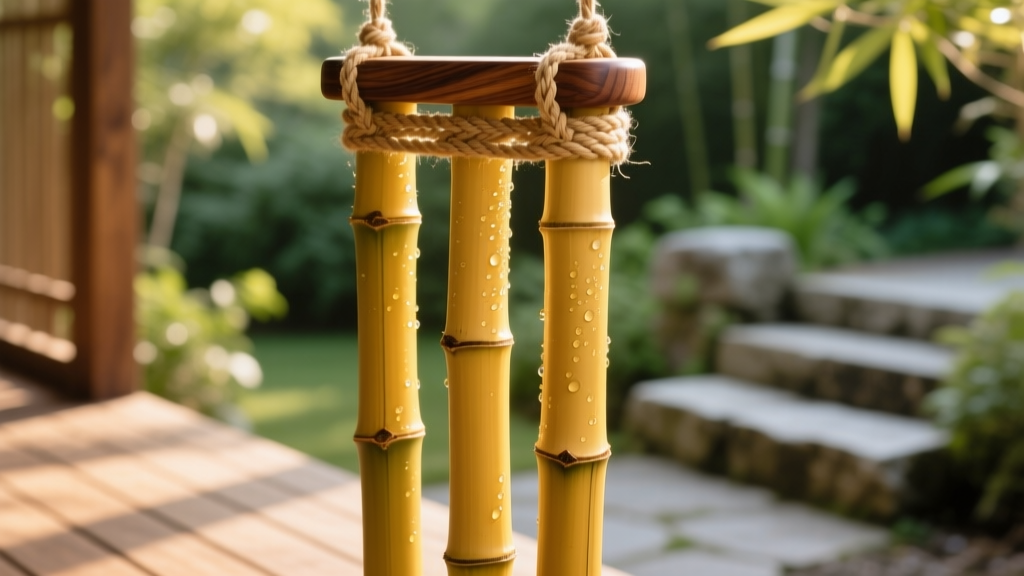
Drill two 3/32-inch holes near the top closed node, exactly opposite each other. Thread 550 paracord or braided hemp twine through the holes. To ensure the chime hangs perfectly plumb and the striker hits the center of gravity, use a double-loop suspension method, tying off to a hardwood top cap (walnut or cherry offcuts work beautifully and cost under $10 at local lumber yards).
Tool Amortization: The Hidden Expense of the First Build
When calculating how to build a bamboo wind chime on a budget, first-time builders often forget tool costs. If you already possess a basic woodworking kit, your marginal cost is just the materials. If you are starting from scratch, the initial investment is higher.
| Tool / Material | Purpose | Estimated Cost |
|---|---|---|
| Japanese Pull Saw (Ryoba) | Clean, splinter-free crosscuts on bamboo | $28.00 |
| Digital Calipers | Measuring wall thickness and precise tuning cuts | $15.00 |
| Drill Press or Hand Drill | Boring clean suspension holes without splitting culms | $45.00 (Hand) |
| Sandpaper (120 to 400 grit) | Smoothing bevels and preparing for finish | $12.00 |
| Total Tool Investment (First Build) | $100.00 | |
According to The Wood Database, bamboo's interlocking grain and high silica content can quickly dull standard steel saw blades. Investing in a specialized Japanese pull saw or carbide-tipped blade is not optional; it prevents the micro-fractures that lead to vertical splitting when the chime is exposed to wind load and humidity changes.
Retail vs. DIY: The Final Cost Comparison Matrix
Once your tools are purchased, the cost per unit drops dramatically. Below is a comparison of building a 5-tube pentatonic chime versus purchasing retail equivalents in 2026.
| Category | DIY Build (Amortized) | Retail Artisanal (e.g., Corinthian) | Mass-Market Import |
|---|---|---|---|
| Raw Bamboo | $8.00 (Kiln-dried) | N/A (Included) | N/A (Often green/poorly cured) |
| Hardware & Cord | $4.50 (Hemp + brass rings) | Included (Heavy-duty nylon) | Included (Cheap cotton, rots quickly) |
| Wood Caps & Striker | $5.00 (Walnut offcuts) | Included (Turned hardwood) | Included (MDF or soft pine) |
| Finish (UV Protection) | $2.50 (Pure Tung Oil) | Included (Marine varnish) | None or low-grade lacquer |
| Total Material Cost | $20.00 | $125.00+ | $35.00 |
| Acoustic Tuning | Manual (Time-intensive) | Precision Luthier Tuned | Random / Untuned |
When to Buy Instead of Build
While the DIY route saves roughly $100 per unit after the first build, retail artisanal chimes offer advantages in extreme weather durability. High-end manufacturers use proprietary marine-grade epoxies to seal the interior nodes and UV-stabilized polyester cords that withstand a decade of direct sunlight. If you lack the time to iterate on the tuning process or do not have access to properly cured, aged bamboo, the retail premium is a justifiable exchange for guaranteed acoustic performance and longevity.
Maintenance and Longevity Costs
Bamboo is a grass, not a wood, and it is highly susceptible to UV degradation and fungal spores if left untreated. The initial build cost must be viewed alongside the 5-year maintenance lifecycle.
Do not use polyurethane on outdoor bamboo chimes; it forms a surface film that will eventually micro-crack, trapping moisture inside the culm and accelerating rot from the inside out. Instead, use a penetrating oil finish like Pure Tung Oil or a specialized bamboo sealer. A $22 can of Pure Tung Oil will yield enough material to seal and maintain over 15 individual chimes. Plan to lightly sand and re-oil the exterior of your chime every 18 to 24 months. The cost of this maintenance is roughly $1.50 per chime per year, keeping the bamboo waterproof while allowing it to breathe and expand naturally with seasonal humidity shifts.
Written by
Sarah WhitfieldSarah Whitfield is a chartered quantity surveyor (MRICS) and construction cost analyst with 15 years of experience in material pricing, procurement strategy, and project budgeting. She earned her degree in Construction Management from the University of Reading (UK) and has worked on projects ranging from $2M custom homes to $180M mixed-use developments across North America and Europe. Sarah currently leads cost estimating for BuildMat Insight, maintaining a proprietary database of 4,000+ material price points updated quarterly. She is a frequent contributor to RSMeans cost data panels and has presented at the International Cost Engineering Council (ICEC) congress. Based in Denver, CO, Sarah is an avid trail runner and volunteer mentor for Women in Construction.
More from Sarah Whitfield
View all
Wood & Lumber
What Are the Different Types of Wood? A Builder's Guide
Compare structural softwoods, finish hardwoods, and engineered lumber. Analyze Janka ratings, MOE values, and 2026 pricing for construction.
Aug 4, 2026

Walls & Panels
Steel Framing vs Wood Framing: Corrosion and Moisture Defense
Compare steel framing vs wood framing for moisture resistance. Learn about galvanized coatings, condensation risks, and corrosion protection strategies.
Jul 21, 2026

Stone & Masonry
How to Cut Stone Veneer: Wet Saw vs Grinder Comparison
Compare the best tools for cutting stone veneer. We review wet saws, angle grinders, and chop saws to help you achieve clean, chip-free cuts.
Jul 21, 2026