Cost of Building Bamboo Fences: 2026 Price Breakdown
Compare the costs of building bamboo fences in 2026. Get detailed pricing for materials, labor, and treatments vs. wood and vinyl alternatives.

The True Cost of Building Bamboo Fences in 2026
Building bamboo fences offers a high-tensile, sustainable alternative to traditional timber or vinyl, but the financial outlay varies wildly based on species selection, preservation methods, and structural engineering. In 2026, the national average cost to install a bamboo privacy fence ranges from $18 to $38 per linear foot, heavily dependent on whether you utilize rolled bamboo screens or structural culms.
Material Costs: Bamboo Formats and Species
The term 'bamboo fencing' encompasses two entirely different product categories with distinct cost profiles and lifespans.
1. Rolled Bamboo Fencing (Screens)
Constructed from 1-inch to 2-inch diameter canes (typically Phyllostachys edulis or Moso bamboo) wired together. These are semi-privacy screens rather than structural barriers.
- Material Cost: $6 to $14 per linear foot (for 6-foot heights).
- Lifespan: 3 to 7 years.
- Best Use: Hiding chain-link fences, decorative trellises, or temporary privacy.
2. Structural Bamboo Poles (Culms)
Utilizing thick-walled, high-tensile species like Guadua angustifolia (4 to 6 inches in diameter) or Bambusa oldhamii. These function as true architectural elements capable of withstanding high wind loads.
- Material Cost: $28 to $55 per individual pole (typically sold in 12-foot lengths).
- Lifespan: 15 to 25+ years (if properly treated and elevated).
- Best Use: Perimeter security, high-end residential privacy, commercial landscaping.
2026 Price Comparison Matrix: Bamboo vs. Wood vs. Vinyl
How does building bamboo fences compare financially to conventional materials over a 20-year horizon? The following matrix breaks down the initial and lifecycle costs for a standard 6-foot-tall privacy fence.
| Material Type | Initial Cost (per lin. ft.) | Expected Lifespan | 15-Year Maintenance Cost | Total 15-Year Cost |
|---|---|---|---|---|
| Rolled Bamboo Screen | $14 - $22 | 4 - 7 years | $25 (replacement cycle) | $39 - $47 |
| Structural Guadua Bamboo | $32 - $48 | 15 - 25 years | $4 (UV sealant) | $36 - $52 |
| Cedar Wood (Stockade) | $28 - $38 | 15 - 20 years | $12 (staining/repairs) | $40 - $50 |
| PVC / Vinyl Privacy | $35 - $50 | 20 - 30 years | $0 | $35 - $50 |
Hidden Costs: Treatment, Hardware, and Foundations
The most common point of failure when building bamboo fences is underestimating the ancillary materials required to prevent biological and chemical degradation.
Preservation and Borate Treatments
Untreated bamboo contains high levels of starch and sugars, making it highly susceptible to powderpost beetles and fungal rot. According to guidelines from the American Wood Protection Association, bamboo must be treated with disodium octaborate tetrahydrate (DOT) to meet outdoor durability standards.
- Professional Pressure Treatment: Adds $3 to $6 per pole.
- DIY Bora-Care Soaking: $85 per gallon (treats approx. 10 poles via the vertical soak method).
Corrosion-Resistant Hardware
Bamboo sap is mildly acidic and reacts aggressively with standard galvanized or zinc-plated screws. Within six months, zinc hardware will corrode, leaving permanent black tannin streaks down the culm and compromising structural integrity.
- Requirement: Use only 304 or 316 marine-grade stainless steel lag bolts, brackets, and tension wires.
- Cost Premium: Expect to pay 40% to 60% more for stainless steel hardware compared to standard galvanized equivalents.
Foundation Engineering: The Ground Contact Rule
Joinery Techniques: Traditional Notching vs. Steel Saddles
How you connect the horizontal bamboo rails to the vertical posts drastically impacts both labor costs and structural longevity.
The Fish-Mouth Joint (Traditional)
This involves carving a concave notch into the horizontal rail so it sits flush against the round vertical post. While aesthetically authentic, it requires skilled carpentry. A poorly executed fish-mouth joint leaves gaps that collect rainwater, accelerating rot at the connection point. Labor cost is high due to the custom carving required for every single joint.
Steel Saddle Brackets (Modern)
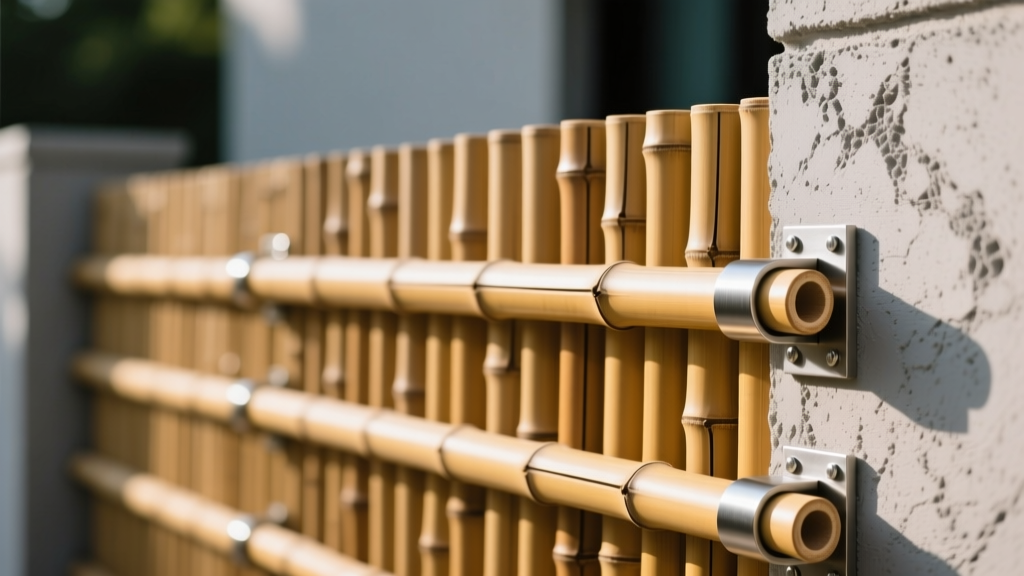
Using powder-coated or stainless steel U-brackets and saddle clamps eliminates the need for notching. The bamboo rests inside the steel cradle and is secured with neoprene-lined U-bolts to prevent crushing the bamboo epidermis. This method reduces installation time by up to 40% and is the preferred technique for commercial contractors in 2026.
Labor and Installation Timelines
Labor accounts for 40% to 55% of the total project cost. Because structural bamboo is irregular and requires custom notching or specialized steel saddles, installation is more labor-intensive than snapping pre-fabricated vinyl panels into place.
- Site Prep & Post Hole Digging: 1-2 days for a 100-foot run.
- Setting Steel Anchors & Concrete: 1 day (requires 48 hours curing time).
- Culm Sizing, Notching, and Mounting: 3-5 days. Custom cutting and drilling stainless steel through-bolts for irregular bamboo diameters slows down the assembly phase.
- Finishing (Sanding and Sealing): 1-2 days applying a penetrating UV-inhibiting oil (e.g., Messmer's UV Plus or Penofin).
Professional Labor Rates: Fence contractors specializing in natural materials typically charge $65 to $95 per hour in 2026, or bid structural bamboo projects at $14 to $22 per linear foot for labor alone.
Sourcing and Sustainability Certifications
When budgeting for building bamboo fences, verify the supply chain. The International Bamboo and Rattan Organization (INBAR) emphasizes that poorly managed bamboo harvesting can lead to local ecosystem depletion, despite the plant's rapid regeneration rate.
For commercial projects or LEED-certified residential builds, specify FSC-certified (Forest Stewardship Council) bamboo. FSC-certified structural poles carry a 10% to 15% price premium but provide the necessary chain-of-custody documentation required for green building credits. You can verify supplier certifications directly through the FSC database.
Maintenance Costs Over a 15-Year Lifecycle
While structural bamboo outlasts rolled screens, it is not a 'set-and-forget' material like PVC. Budget for the following maintenance intervals:
- Year 1-3: No major maintenance required if initially sealed with a high-quality penetrating oil.
- Year 4-5: Reapplication of UV-blocking exterior sealant ($0.85 per linear foot in materials).
- Year 10: Inspection of stainless steel tension wires and brackets; occasional tightening of lag bolts as the bamboo undergoes long-term moisture equilibrium shrinkage.
Written by
Sarah WhitfieldSarah Whitfield is a chartered quantity surveyor (MRICS) and construction cost analyst with 15 years of experience in material pricing, procurement strategy, and project budgeting. She earned her degree in Construction Management from the University of Reading (UK) and has worked on projects ranging from $2M custom homes to $180M mixed-use developments across North America and Europe. Sarah currently leads cost estimating for BuildMat Insight, maintaining a proprietary database of 4,000+ material price points updated quarterly. She is a frequent contributor to RSMeans cost data panels and has presented at the International Cost Engineering Council (ICEC) congress. Based in Denver, CO, Sarah is an avid trail runner and volunteer mentor for Women in Construction.
More from Sarah Whitfield
View all
Wood & Lumber
What Are the Different Types of Wood? A Builder's Guide
Compare structural softwoods, finish hardwoods, and engineered lumber. Analyze Janka ratings, MOE values, and 2026 pricing for construction.
Aug 4, 2026

Walls & Panels
Steel Framing vs Wood Framing: Corrosion and Moisture Defense
Compare steel framing vs wood framing for moisture resistance. Learn about galvanized coatings, condensation risks, and corrosion protection strategies.
Jul 21, 2026

Stone & Masonry
How to Cut Stone Veneer: Wet Saw vs Grinder Comparison
Compare the best tools for cutting stone veneer. We review wet saws, angle grinders, and chop saws to help you achieve clean, chip-free cuts.
Jul 21, 2026