Carbon Footprint of Bamboo Building Materials: LCA Data & LEED
Analyze the life cycle assessment, embodied carbon, and LEED v4.1 compliance of bamboo building materials with real LCA data and procurement specs.
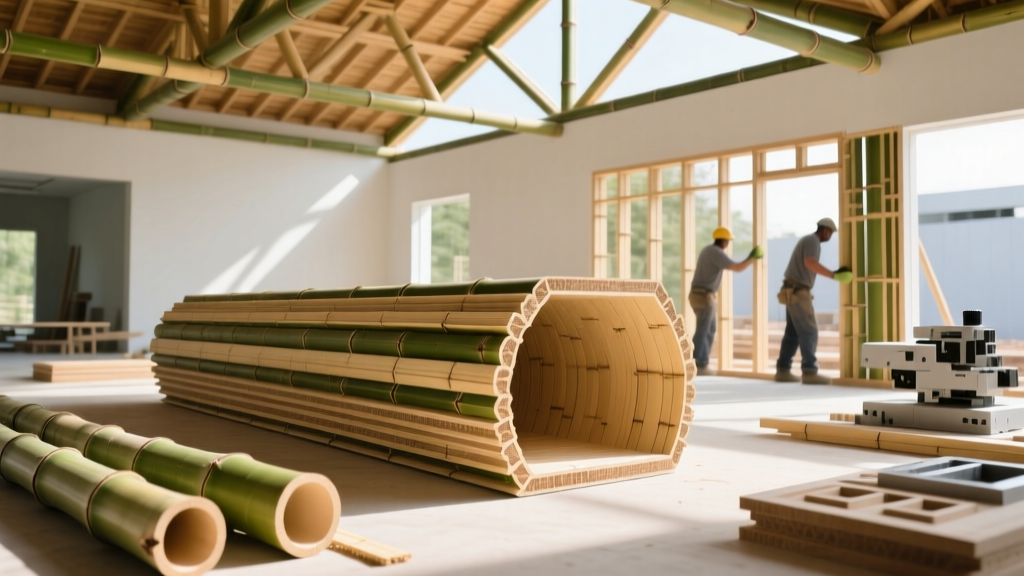
The Carbon Mathematics of Bamboo Building Materials
When evaluating the environmental impact of structural and finish materials, architects and engineers must look beyond marketing claims and examine rigorous Life Cycle Assessment (LCA) data. Bamboo building materials occupy a unique position in sustainable construction: they offer the rapid renewability of an agricultural grass with the structural performance of hardwood or mild steel. However, the carbon footprint of bamboo varies drastically depending on the level of processing, the adhesives used, and the transportation logistics.
Raw Moso bamboo (Phyllostachys edulis) is a carbon sequestration powerhouse. According to the International Bamboo and Rattan Organization (INBAR), a well-managed Moso bamboo forest can sequester between 12 and 15 tonnes of CO2 per hectare annually—significantly outpacing many traditional timber plantations. Furthermore, bamboo reaches structural maturity in 4 to 5 years, compared to 20 to 50 years for softwoods and hardwoods. Yet, the moment bamboo culms are harvested and processed into engineered building products, the carbon calculus shifts from biological sequestration to industrial embodied energy.
Embodied Energy Matrix: Material Comparison
To understand where bamboo building materials fit into a low-carbon specification, we must compare their embodied energy (measured in Megajoules per kilogram, MJ/kg) and global warming potential (GWP, measured in kg CO2e/kg) against traditional alternatives. The data below reflects cradle-to-gate averages for 2026 industry standards.
| Material | Embodied Energy (MJ/kg) | Carbon Footprint (kg CO2e/kg) | End-of-Life Profile |
|---|---|---|---|
| Raw Bamboo Culum (Minimally Processed) | 2.0 - 3.5 | -0.5 (Biogenic Storage) | 100% Biodegradable / Compostable |
| Laminated Bamboo Lumber (LBL) | 4.5 - 6.0 | 0.8 - 1.2 | Biomass Fuel / Downcycling |
| Strand Woven Bamboo (SWB) Flooring | 15.0 - 22.0 | 2.5 - 3.8 | Landfill (Resin prevents composting) |
| Structural Steel (Recycled Content 50%) | 20.0 - 25.0 | 1.5 - 2.0 | Infinitely Recyclable |
| Portland Cement (CEM I) | 4.5 - 5.5 | 0.85 - 0.95 | Downcycled as aggregate |
As the matrix illustrates, minimally processed bamboo acts as a net carbon sink. However, highly engineered products like Strand Woven Bamboo (SWB) carry an embodied energy profile that approaches that of steel, primarily due to the mechanical shredding, high-temperature kiln drying, and high-pressure resin impregnation required during manufacturing.
The Resin Reality: Hidden Carbon in Engineered Bamboo
The most critical, yet frequently overlooked, variable in the LCA of bamboo building materials is the adhesive matrix. To create dimensionally stable panels, beams, and flooring, manufacturers must bind bamboo fibers or strips using synthetic resins. In SWB flooring, resin can account for 15% to 20% of the total product weight.
Specifying Low-Carbon Adhesives
To maintain the sustainability integrity of bamboo building materials, procurement teams must mandate specific adhesive chemistries in their CSI MasterFormat specifications (Division 09 for finishes, Division 06 for wood and plastics).
- MDI (Methylene Diphenyl Diisocyanate): While still a synthetic polymer, MDI reacts completely with the moisture in bamboo to form a stable polyurethane bond, resulting in zero formaldehyde off-gassing and a lower overall application weight compared to PF resins.
- Bio-Based Resins: Emerging in 2026, soy-based and lignin-derived bio-resins are replacing up to 50% of the petrochemical content in interior-grade engineered bamboo. Specifiers should require manufacturers to provide a SDS (Safety Data Sheet) and a resin content breakdown to verify bio-based claims.
Navigating LEED v4.1 with Bamboo Building Materials
For projects targeting LEED v4.1 certification, bamboo building materials can be highly effective for earning points under the Materials and Resources (MR) category, specifically the Building Product Disclosure and Optimization (BPDO) credits. However, simply specifying "bamboo" is no longer sufficient to guarantee points.
Option 1: Environmental Product Declarations (EPD)
To earn BPDO credits, the bamboo product must have a current, third-party verified EPD that is cradle-to-gate or cradle-to-grave. Specifiers must request Type III EPDs from manufacturers. An EPD will detail the exact global warming potential, ozone depletion potential, and acidification potential of the specific bamboo product line. Without an EPD, the material cannot be counted toward the LEED credit threshold.
Option 2: Sourcing of Raw Materials
Bamboo qualifies as a rapidly renewable material, but to claim credit for responsible sourcing, the material must be certified by the Forest Stewardship Council (FSC). FSC certification ensures that the bamboo harvesting does not lead to the deforestation of native ecosystems, protects local water tables, and guarantees fair labor practices. When calculating the MR credit, FSC-certified bamboo building materials are valued at 100% of their cost, providing a significant multiplier effect for the project's sustainable procurement score.
Transport Emissions and the Localization Deficit
A comprehensive sustainability analysis must address the "food miles" equivalent for construction materials. Currently, over 85% of the world's commercial bamboo building materials are harvested, processed, and manufactured in China, specifically in the Zhejiang and Fujian provinces.
Trans-Pacific ocean freight adds approximately 1.2 to 1.8 kg CO2e per kilogram of material transported to North American or European ports. While this is lower than air freight, it fundamentally alters the LCA of heavy products like LBL structural beams. To mitigate this, sustainable procurement frameworks should prioritize:
- High-Value, Low-Volume Applications: Use engineered bamboo for high-wear architectural finishes (flooring, cabinetry, acoustic paneling) where its durability offsets the transport carbon, rather than for bulk structural framing where local mass timber or recycled steel would have a lower transport footprint.
- Regional Processing Hubs: Specify products from manufacturers that have established finishing and milling facilities in the destination continent, reducing inland trucking emissions and supporting localized circular economies.
Procurement Framework: A Specifier's Checklist
To ensure that bamboo building materials deliver on their environmental promises, integrate the following verification matrix into your project's procurement and submittal review process:
| Verification Criteria | Required Documentation | Acceptable Standard / Threshold |
|---|---|---|
| Forest Management | Chain of Custody Certificate | FSC 100% or FSC Mix Credit |
| Carbon & LCA Data | Type III EPD | ISO 14025 compliant, max 5 years old |
| Indoor Air Quality (Resin) | VOC Emission Test Report | California Section 01350 or Greenguard Gold |
| Adhesive Chemistry | Manufacturer SDS & Tech Data | No added UF resins; MDI or Bio-resin preferred |
| Structural Grading (if applicable) | Mill Certificate / Grade Stamp | ISO 22156 or local structural timber equivalent |
By shifting the focus from bamboo as a generic "green" material to a highly specific, data-driven building product, architects and engineers can accurately quantify its carbon benefits. Properly specified bamboo building materials do not just reduce the embodied carbon of a structure; they actively support global agricultural carbon sinks, provided the processing chemistry and transport logistics are rigorously managed.
Written by
Priya KapoorPriya Kapoor is a real estate market analyst and construction economics researcher with expertise in housing affordability, development feasibility, and infrastructure investment. She holds a Master of Regional Planning from Cornell University and previously worked as a senior analyst at CBRE's Investment Properties group, where she modeled returns for $4B in mixed-use development pipelines. Priya now runs an independent research practice advising developers, municipalities, and REITs on construction cost forecasting and market timing. She publishes the quarterly "BuildMat Market Pulse" report tracking material price indices across 12 commodity categories. Based in Austin, TX, Priya serves on the board of Habitat for Humanity Austin and is a marathon runner.
More from Priya Kapoor
View all
Construction Cost
Cost to Build a 1600 Sq Ft Home in 2026: Full Breakdown
Accurate 2026 cost to build a 1600 sq ft home—material, labor, and regional pricing breakdowns included. Plan your budget with real-time estimates.
Aug 11, 2026

Wood & Lumber
Name the Types of Wood for Pressure Treatment and Preservation
Learn how to name the types of wood best suited for pressure treatment. Compare species treatability, chemical retention levels, and 2026 preservation costs.
Aug 4, 2026

Stone & Masonry
Stone Veneer Suppliers Lindenhurst: 2026 Cost Analysis
Analyze 2026 stone veneer costs in Lindenhurst, NY. Compare local supplier pricing, delivery fees, and Suffolk County installation labor rates.
Aug 4, 2026