Designing Modern Bamboo Buildings With Engineered Lumber
Discover how engineered bamboo products like Glubam and LBL are revolutionizing modern bamboo buildings with superior strength, code compliance, and ROI.

The Evolution from Culm to Engineered Timber
For centuries, traditional bamboo construction relied on raw culms. While aesthetically striking, raw bamboo presents severe engineering challenges: natural tapering, hollow internodes, variable wall thickness, and susceptibility to longitudinal splitting. These geometric inconsistencies make standardized joinery and predictable load distribution nearly impossible in large-scale commercial projects. The modern era of bamboo buildings has shifted decisively toward engineered bamboo products (EBP), transforming the raw grass into standardized, high-performance structural lumber.
Engineered bamboo products are manufactured by stripping bamboo culms into uniform slivers or mats, treating them against biological degradation, and bonding them under high heat and pressure using structural adhesives. This process eliminates the natural defects of the raw culm, yielding a material with a higher strength-to-weight ratio than many hardwoods and structural steel. According to the International Bamboo and Rattan Organisation (INBAR), the standardization of these engineered products is the primary catalyst for bamboo's integration into modern, code-compliant municipal and commercial architecture.
Material Matrix: Engineered Bamboo Products for Structural Use
Not all engineered bamboo is created equal. The manufacturing process dictates the mechanical properties, dimensional stability, and appropriate structural application. Below is a comparative matrix of the three primary structural EBPs used in contemporary bamboo buildings.
| Product Type | Manufacturing Process | Density (kg/m³) | Modulus of Elasticity (MOE) | Primary Structural Use | Approx. Cost (2026) |
|---|---|---|---|---|---|
| Laminated Bamboo Lumber (LBL) | Flat bamboo strips glued edge-to-edge and face-to-face. | 700 - 850 | 10,000 - 12,000 MPa | Beams, columns, window frames. | $8.50 - $11.00 / bf |
| Bamboo Scrimber (Strand Woven) | Crushed culms soaked in resin, compressed in molds. | 1,000 - 1,200 | 12,000 - 16,000 MPa | Heavy-duty flooring, shear walls, high-load nodes. | $6.00 - $9.00 / bf |
| Glubam (Glued Laminated) | Bamboo mats and strips layered with orthogonal grain orientation. | 800 - 950 | 11,000 - 14,000 MPa | Long-span trusses, curved beams, panels. | $9.50 - $13.00 / bf |
Deep Dive: Adhesives and Delamination Risks
The structural integrity of any engineered bamboo product relies entirely on its adhesive matrix. For exterior or high-humidity applications in bamboo buildings, phenol-formaldehyde (PF) or Methylene Diphenyl Diisocyanate (MDI) resins are mandatory. Polyvinyl acetate (PVA) wood glues will inevitably fail under sustained moisture exposure. When specifying LBL or Glubam from manufacturers, explicitly require Type I exterior-grade structural adhesives compliant with ASTM D2559. Delamination is the most catastrophic failure mode in engineered bamboo; it occurs not in the bamboo fiber itself, but at the glue line when subjected to cyclic swelling and shrinking.
Structural Assembly: Framing a Bamboo Building
Working with engineered bamboo requires distinct carpentry techniques. Unlike softwood glulam, bamboo scrimber and LBL are exceptionally dense and prone to splitting if fastened incorrectly. Follow this step-by-step protocol for structural frame assembly.
- Moisture Acclimation: Store engineered bamboo beams on-site for 7 to 14 days before installation. The material must acclimate to the local ambient humidity (ideally 40-60% RH) to prevent post-installation dimensional shifts.
- Pre-Drilling Protocol: Never drive screws or nails directly into bamboo scrimber or LBL without pre-drilling. Drill pilot holes to exactly 80% of the fastener's shank diameter. This relieves internal radial stresses and prevents longitudinal splitting.
- Concealed Shear Connectors: For beam-to-column connections, avoid exposed bolted joints which allow water ingress. Use stainless steel concealed shear connectors (e.g., Rothoblaas or Simpson Strong-Tie mass timber brackets) routed into the bamboo.
- End-Grain Sealing: Immediately upon cutting any engineered bamboo beam on-site, seal the exposed end-grain with a polyurethane-based end-sealer. Bamboo fibers act as micro-capillaries; unsealed end-grains will wick moisture deep into the beam, causing internal rot and adhesive degradation.
- Thermal Break Installation: Where engineered bamboo penetrates the exterior building envelope, install a structural thermal break pad (such as Armatherm) to prevent thermal bridging and condensation accumulation at the connection point.
'Engineered bamboo is not just a substitute for timber; it is a distinct bio-composite. Treating it exactly like Douglas Fir glulam on the job site will lead to fastener blowouts and connection failures. Respect the density.' — Structural Engineering Guidelines for Bio-Composites, 2025 Edition.
Cost Analysis and Lifecycle ROI
While the upfront material cost of engineered bamboo can be 10% to 15% higher than standard dimensional softwood lumber, the lifecycle ROI in commercial bamboo buildings often justifies the premium. Engineered bamboo requires no chemical pressure treatment (like CCA or ACQ used in softwoods) because its natural silica content and the high-heat manufacturing process render it immune to termites and fungal decay, provided the glue lines hold.
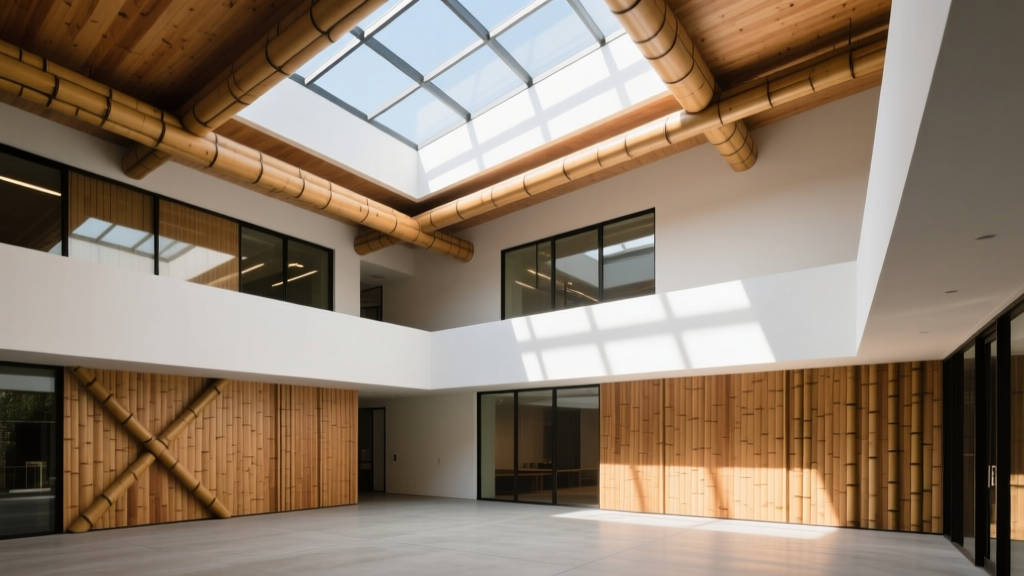
Furthermore, the aesthetic appeal of exposed Glubam or LBL beams eliminates the need for secondary ceiling finishes, drywall, and paint. In a typical 5,000 sq. ft. commercial pavilion, leaving the engineered bamboo structure exposed saves between $12.00 and $18.00 per square foot in finishing costs, effectively neutralizing the premium paid for the structural material.
Common Failure Modes and Mitigation Strategies
Understanding how engineered bamboo fails is critical for designing resilient bamboo buildings. Below are the primary failure modes and their architectural mitigations.
- UV Degradation: Unlike timber, which silvers gracefully, UV exposure on engineered bamboo causes the lignin to break down, resulting in a patchy, dark gray discoloration and surface checking. Mitigation: Apply a penetrating, UV-inhibiting oil finish (e.g., Rubio Monocoat or Osmo Polyx) every 24 months for exterior elements, or specify factory-applied aluminum cladding over structural beams.
- Adhesive Creep: Under sustained heavy loads and high temperatures (above 100°F / 38°C), certain thermoplastic adhesives can exhibit 'creep,' leading to gradual beam deflection over time. Mitigation: Specify thermosetting PF or MDI resins, and design beams with a 20% higher stiffness requirement than the calculated minimum.
- Hardware Corrosion: Bamboo naturally contains trace organic acids. When combined with moisture, these acids can corrode standard galvanized steel fasteners, staining the bamboo black and weakening the joint. Mitigation: Exclusively use 304 or 316 marine-grade stainless steel hardware for all structural connections.
Frequently Asked Questions
Can engineered bamboo be used for multi-story load-bearing walls?
Yes, but typically in the form of cross-laminated bamboo (CLB) panels rather than individual beams. CLB panels are manufactured by stacking and gluing bamboo mats in orthogonal directions, similar to CLT. While technically viable for up to 5 stories, local building codes will dictate the maximum allowable height, often requiring rigorous fire-rating assemblies (like Type X gypsum encapsulation) to meet multi-story combustible material standards.
How does the fire resistance of engineered bamboo compare to steel?
Engineered bamboo behaves predictably in fire, forming a protective char layer that insulates the inner core, much like heavy timber. It does not melt or lose structural integrity abruptly like unprotected steel. A 5.5-inch thick Glubam beam can achieve a 1-hour fire resistance rating through charring calculations, though it must be encapsulated or treated with intumescent coatings to meet strict commercial fire codes.
Is bamboo scrimber suitable for exterior structural columns?
Bamboo scrimber is incredibly strong in compression, making it excellent for columns. However, its high density makes it difficult for penetrating sealants to absorb deeply. For exterior columns, it is highly recommended to use scrimber as a structural core encapsulated within a ventilated rainscreen cladding, or to specify LBL with a factory-applied exterior finish instead.
For comprehensive technical data sheets and load-span tables regarding specific engineered bamboo products, architects should consult the MOSO Bamboo Structural Applications database and review regional material testing certifications prior to specification.
Written by
David NakamuraDavid Nakamura is a licensed architect (AIA) and construction technology writer focused on sustainable building methods, mass timber engineering, and high-performance building envelopes. He holds a Master of Architecture from the University of Washington and is a certified Passive House Consultant (CPHC). David spent eight years at the Seattle firm Mithun, where he led the design of three LEED Platinum projects, before founding his own practice specializing in net-zero residential design. He serves on the editorial advisory board of GreenBuilder Magazine and has authored peer-reviewed papers on cross-laminated timber (CLT) connections for the Journal of Structural Engineering. In his spare time, David teaches woodworking at Pratt Fine Arts Center and kayaks the Puget Sound.
More from David Nakamura
View all
Construction Cost
Labor Cost to Build a Deck Per Sq Ft: 2026 Installation Guide
Discover the exact labor cost to build a deck per sq ft in 2026. This installation guide breaks down contractor rates, complexity factors, and hidden fees.
Aug 4, 2026

Construction Cost
How Much Does It Cost to Build a 3 Bedroom House? Financing Guide
Learn exactly how much it costs to build a 3 bedroom house and explore 2026 financing options, construction loan types, and budget frameworks for your build.
Aug 4, 2026

Construction Cost
Cost to Build a Tennis Court: 2026 Guide
How much does it cost to build a tennis court in 2026? Breakdowns for asphalt, concrete, and synthetic surfaces plus fencing and lighting.
Jul 30, 2026