Treatment Protocols When Building a Bamboo House for Durability
Learn the exact boron treatment ratios, Boucherie methods, and architectural details required when building a bamboo house to prevent beetle and rot damage.

The single greatest point of failure when building a bamboo house is inadequate preservation. Untreated bamboo culms contain high concentrations of starch and reducing sugars, making them highly susceptible to powderpost beetles (Dinoderus minutus), subterranean termites, and brown rot fungi. Without proper chemical treatment and architectural detailing, a bamboo structure will suffer catastrophic biological degradation within 2 to 5 years. This guide details the exact chemical formulations, retention targets, and diffusion protocols required to extend the structural lifespan of bamboo to 25+ years.
The Biology of Bamboo Degradation
Bamboo lacks the natural toxins and heartwood extractives found in durable hardwoods like teak or ipe. Its vascular bundles are surrounded by parenchyma cells, which store starch to fuel the plant's rapid growth. When harvested, these starch reserves remain in the culm.
- Powderpost Beetles: These insects detect the starch and bore perfectly circular 1-2mm flight holes into the bamboo wall, reducing the inner fibers to a fine, talc-like dust while leaving the hard outer epidermis intact. This creates a hidden structural failure.
- Fungal Decay: Fungi require moisture content (MC) above 20%. Bamboo harvested during the wet season or left in contact with soil will rapidly succumb to basidiomycete fungi, causing soft rot and loss of compressive strength.
While traditional knowledge suggests harvesting bamboo only during the dry winter months to minimize starch content, seasonal harvesting alone reduces—but does not eliminate—the risk of infestation. Chemical modification of the starch is mandatory for permanent residential construction.
Choosing the Right Treatment Method
The method you select depends on the state of the bamboo at the time of treatment and the scale of your project. Below is a decision matrix for the three primary preservation techniques used in modern bamboo construction.
| Method | Pole Condition | Timeframe | Penetration Depth | Best Use Case |
|---|---|---|---|---|
| Boucherie (Sap Displacement) | Freshly cut (green), leaves attached | 2–4 hours | 100% (vascular bundles) | Whole, un-split structural columns |
| Cold Bath Diffusion | Air-dried or re-wetted, nodes punctured | 14–21 days | 85–95% (requires node puncturing) | High-volume processing, trusses, purlins |
| Hot/Cold Bath | Air-dried, nodes punctured | 3–5 days | 95%+ | Commercial treatment facilities |
Chemical Formulations and Retention Targets
Chromated Copper Arsenate (CCA) is highly toxic and strictly prohibited in residential bamboo construction due to arsenic leaching. The global standard for residential bamboo preservation is a boron-based salt solution, specifically a mixture of Borax (Sodium tetraborate decahydrate) and Boric Acid.
Boron salts are lethal to insects and fungi by disrupting their digestive enzymes and metabolic processes, yet they exhibit extremely low toxicity to humans and mammals. According to the Food and Agriculture Organization (FAO) Bamboo Preservation Manual, the target retention rate for interior structural bamboo is 1.5 kg/m³, while exterior or high-humidity applications require a minimum retention of 3.0 kg/m³.
Borax dissolves easily in cold water, but Boric Acid has poor solubility at room temperature (approx. 50g per liter at 20°C). To achieve the necessary 10-15% concentration required for proper diffusion, the treatment bath must be heated to 60°C (140°F) during the mixing phase. If mixed in cold water, the boric acid will precipitate to the bottom of the trough, resulting in severely under-treated bamboo.
The Standard 1:1 Boron Mix
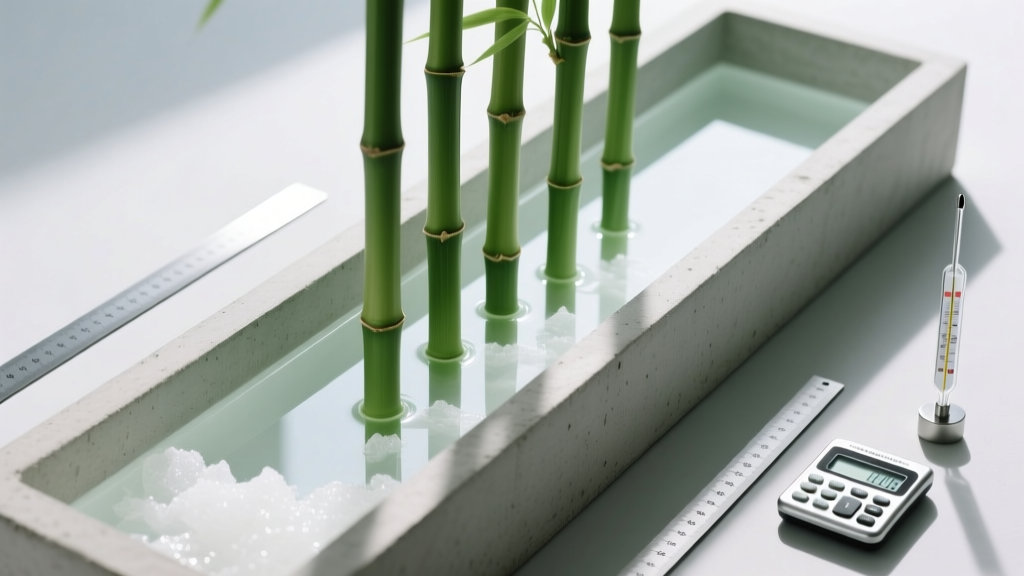
For a standard cold bath diffusion tank (e.g., a 1,000-liter IBC tote or concrete trough), use the following ratio:
- Water: 1,000 Liters
- Borax: 75 kg
- Boric Acid: 75 kg
- Resulting Concentration: ~15% Boron Equivalent (BE)
Step-by-Step Cold Bath Diffusion Protocol
The cold bath method is the most accessible and scalable technique for owner-builders and small contractors. Follow these exact steps to ensure full culm penetration.
- Node Puncturing: Bamboo nodes (diaphragms) are impermeable to liquid flow. Use a 12mm (1/2-inch) rebar or drill bit to punch through the internal nodes of every culm. Do not split the outer wall; simply drive the rod down the hollow interior.
- Submersion and Weighting: Bamboo is highly buoyant. Place the culms in the treatment trough and use a weighted wooden grid or heavy stones to force the poles entirely beneath the surface of the boron solution.
- Diffusion Timeline: Allow the bamboo to soak for a minimum of 14 days for culms under 100mm in diameter, and 21 days for culms exceeding 120mm. The boron salts move via capillary action and osmotic diffusion into the parenchyma tissue.
- Post-Treatment Drying: Remove the poles and stack them horizontally on stickered pallets in a shaded, well-ventilated area. Never dry treated bamboo in direct sunlight. Rapid UV and heat exposure will cause severe longitudinal checking (cracking), which compromises the structural integrity and exposes untreated inner fibers to pests.
Architectural Integration: The "Good Shoes and Hat" Principle
Chemical treatment is only the first line of defense. When building a bamboo house, the architectural design must inherently protect the material from moisture ingress. The International Bamboo and Rattan Organization (INBAR) emphasizes that structural bamboo must never be in direct contact with the ground or exposed to continuous driving rain.
"Good Shoes" (Foundation Isolation)
Every bamboo column must be elevated above the splash zone and soil moisture. Cast concrete or stone stem walls that extend a minimum of 500mm to 600mm (20-24 inches) above the finished grade. The bamboo culm should be anchored to this stem wall using a concealed steel rebar pin or a U-shaped galvanized steel saddle, ensuring a 10mm air gap between the concrete and the bamboo base to prevent capillary moisture wicking.
"Good Hat" (Roof Overhangs)
Design roof eaves with deep overhangs to shield the bamboo walls from UV degradation and rain. For single-story structures, calculate a minimum overhang of 1,200mm to 1,500mm (4-5 feet). In tropical climates with heavy monsoonal rains, overhangs should be extended to 1,800mm, or the design should incorporate wrap-around verandas.
Cost Analysis of Bamboo Treatment
Budgeting for preservation is often overlooked by first-time bamboo builders. Below is a cost breakdown for treating 100 structural-grade Guadua angustifolia or Dendrocalamus asper poles (average 12m length, 100mm diameter) using the cold bath boron method.
| Item / Process | Estimated Cost (USD) | Notes |
|---|---|---|
| Borax & Boric Acid (150kg total) | $225 - $300 | Prices vary by regional agricultural suppliers |
| Concrete Trough Construction | $400 - $600 | One-time capital expenditure (amortized) |
| Labor: Node Puncturing & Loading | $150 - $200 | 2 workers, 2 days |
| Labor: Unloading & Stickered Stacking | $100 - $150 | Requires careful handling to prevent cracking |
| Total Cost per Pole (Amortized) | $5.75 - $8.50 | Varies heavily based on local labor rates |
Note: The chemicals remain in the trough and can be reused for multiple batches. Only the water lost to evaporation and absorption needs to be replenished, along with a 10% top-up of boron salts for subsequent batches.
Frequently Asked Questions
Can I treat bamboo that has already been air-dried?
Yes, but the diffusion process is slower. If the bamboo has been drying for more than 4 weeks, the parenchyma cells lose their moisture, halting osmotic diffusion. You must re-wet the culms by soaking them in plain water for 48 hours before introducing them to the concentrated boron bath.
Is linseed oil or varnish a good alternative to boron salts?
No. Linseed oil, polyurethane, and standard varnishes only coat the outer epidermis. They do not penetrate the vascular bundles to protect the starch-rich inner wall. Furthermore, surface films trap moisture inside the culm if micro-cracks develop, actually accelerating internal fungal rot. Boron salts must be used for primary preservation; surface finishes are only applied later for aesthetic UV protection.
How do I test if the boron treatment was successful?
Use a curcumin (turmeric) indicator test. Dip a piece of filter paper in a solution of turmeric powder and rubbing alcohol. Press it against a freshly cut cross-section of the treated bamboo. If the boron has fully penetrated, the paper will turn a deep red-orange color. If it remains yellow, the diffusion was incomplete, and the pole must be returned to the bath.
Written by
Sarah WhitfieldSarah Whitfield is a chartered quantity surveyor (MRICS) and construction cost analyst with 15 years of experience in material pricing, procurement strategy, and project budgeting. She earned her degree in Construction Management from the University of Reading (UK) and has worked on projects ranging from $2M custom homes to $180M mixed-use developments across North America and Europe. Sarah currently leads cost estimating for BuildMat Insight, maintaining a proprietary database of 4,000+ material price points updated quarterly. She is a frequent contributor to RSMeans cost data panels and has presented at the International Cost Engineering Council (ICEC) congress. Based in Denver, CO, Sarah is an avid trail runner and volunteer mentor for Women in Construction.
More from Sarah Whitfield
View all
Wood & Lumber
What Are the Different Types of Wood? A Builder's Guide
Compare structural softwoods, finish hardwoods, and engineered lumber. Analyze Janka ratings, MOE values, and 2026 pricing for construction.
Aug 4, 2026

Walls & Panels
Steel Framing vs Wood Framing: Corrosion and Moisture Defense
Compare steel framing vs wood framing for moisture resistance. Learn about galvanized coatings, condensation risks, and corrosion protection strategies.
Jul 21, 2026

Stone & Masonry
How to Cut Stone Veneer: Wet Saw vs Grinder Comparison
Compare the best tools for cutting stone veneer. We review wet saws, angle grinders, and chop saws to help you achieve clean, chip-free cuts.
Jul 21, 2026