80 lb Bag of Concrete Selection: Mix Types, Yields, and Uses
Master the 80 lb bag of concrete with our selection guide. Compare mix types, calculate exact yields, and learn pro mixing and curing techniques.
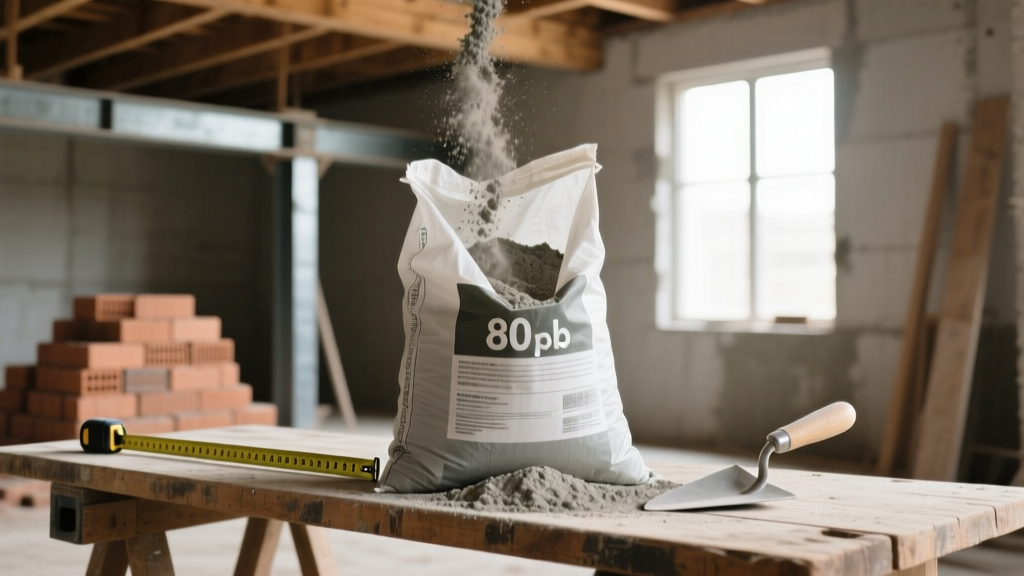
The Anatomy of an 80 lb Bag of Concrete
The 80 lb bag of concrete is the undisputed workhorse of residential masonry, landscaping, and light structural work. However, treating all 80 lb bags as identical is a critical error that leads to cracked slabs, heaving fence posts, and failed structural footings. Modern bagged concrete is a highly engineered composite of Portland cement, graded aggregates (sand and gravel), and proprietary chemical admixtures. Selecting the correct formulation requires understanding the specific taxonomy of available mixes, their exact volumetric yields, and the chemical realities of the hydration process.
Taxonomy of Bagged Concrete Mixes
Manufacturers formulate distinct blends to address specific structural and environmental demands. Below is the definitive breakdown of the primary 80 lb concrete categories available on the market.
| Mix Category | Target PSI (28-Day) | Initial Set Time | Ideal Application | Common Model Example |
|---|---|---|---|---|
| Standard Concrete | 2,500 - 3,000 PSI | 24-48 hours | General slabs, walkways, steps | Quikrete #1004-80 |
| High-Strength (5000) | 5,000 PSI | 12-24 hours | Driveways, heavy-load pads, footings | Quikrete #1007-80 |
| Fast-Setting | 4,000 PSI | 20-40 minutes | Fence posts, anchor bolts, emergency repairs | Quikrete #1006-80 |
| Crack-Resistant | 3,500 - 4,000 PSI | 24-48 hours | Thin overlays, large flatwork, patio slabs | Sakrete Fiber-Reinforced |
| Countertop / Precision | 5,000 - 6,000 PSI | 12-18 hours | Architectural precast, countertops, furniture | Quikrete #1101-80 Countertop |
Yield Mathematics and Slab Coverage
A standard 80 lb bag of concrete yields exactly 0.60 cubic feet of mixed material. Miscalculating this yield is the primary reason DIY projects stall mid-pour. To determine the exact number of bags required, you must calculate the total cubic footage of your formwork and divide by 0.60, then add a 10% waste factor for spillage and subgrade irregularities.
Coverage Chart per 80 lb Bag (0.60 cu. ft.)
| Slab Thickness | Square Foot Coverage per Bag | Bags Needed for 4x4 ft Pad (16 sq ft) |
|---|---|---|
| 2 inches | 3.6 sq ft | 5 bags |
| 3 inches | 2.4 sq ft | 8 bags |
| 4 inches (Standard) | 1.8 sq ft | 10 bags |
| 6 inches (Heavy Duty) | 1.2 sq ft | 15 bags |
The Water-to-Cement Ratio: Where Projects Fail
The most destructive mistake made with bagged concrete is the addition of excess water to make the mix 'easier to work.' According to the Portland Cement Association, the water-to-cement (w/c) ratio is the single most critical factor determining the final compressive strength and durability of concrete.
An 80 lb bag of standard mix requires approximately 3 quarts (0.75 gallons) of clean water. This achieves the optimal w/c ratio of roughly 0.45 to 0.50. When you add a fourth quart of water because the mix looks 'too dry' in the wheelbarrow, you are not just changing the consistency; you are fundamentally altering the chemical matrix.
Correct Mixing Protocol:
- Add 2 quarts of water to the mixer or wheelbarrow first.
- Add the 80 lb bag of dry mix.
- Mix for 2 minutes, then gradually add the remaining 1 quart of water.
- Mix for an additional 3 minutes until the consistency resembles thick oatmeal. It should hold a ridge when troweled, not slump.
Purchasing Strategy and 2026 Cost Realities
Navigating the economics of bagged concrete requires understanding bulk thresholds. As of early 2026, a single 80 lb bag of standard mix retails between $5.80 and $6.50 at major home centers, while high-strength and specialty blends command $7.50 to $9.00 per bag.
If your project requires more than 15 bags, abandon the retail aisle and inquire about pallet pricing. A standard pallet contains 42 bags (totaling 3,360 lbs). Most regional suppliers and big-box pro desks offer a 10% to 15% pallet discount. Furthermore, ordering a pallet ensures all bags are from the same manufacturing lot, guaranteeing uniform color and set times across your entire pour—a critical factor for visible flatwork like stamped patios or exposed aggregate walkways.
Curing Protocols for Bagged Mixes
Concrete does not 'dry'; it cures through an exothermic chemical reaction called hydration. If the surface dries out before the internal hydration is complete, the surface will craze, dust, and crack. The Quikrete Technical Specifications mandate continuous moisture retention for a minimum of 3 to 7 days depending on ambient temperatures.
Effective Curing Methods
- Wet Curing (Best for Slabs): Cover the poured concrete with 4-mil polyethylene sheeting or saturated burlap immediately after final finishing. Keep the material continuously damp for 5 days.
- Chemical Curing Compounds (Best for Vertical/Complex Shapes): Spray a liquid membrane-forming curing compound (like W.R. Meadows or Euclid Chemical brands) immediately after the surface water sheen disappears. This seals the moisture inside.
- Avoid Temperature Extremes: Do not pour bagged concrete if the ambient temperature is forecast to drop below 40°F (4°C) within 48 hours, or exceed 90°F (32°C) without using chilled mixing water and sunshades.
Frequently Asked Questions
Can I mix an 80 lb bag by hand in a wheelbarrow?
Yes, but it requires a specific technique. Use a square-point transfer shovel, not a round-point digging shovel. Chop the dry mix into the water rather than stirring it in a circular motion. Limit hand-mixing to two 80 lb bags at a time; attempting to hand-mix three or more bags will result in uneven hydration and severe physical fatigue before the material is placed.
How long can I store an 80 lb bag before it expires?
Portland cement is highly hygroscopic. Even in its original multi-wall paper and plastic packaging, an 80 lb bag has a maximum shelf life of 90 to 120 days in a humid environment, and up to 6 months in a climate-controlled, dry warehouse. If the bag feels rock-hard or contains 'lumps' that cannot be crushed between your thumb and forefinger, the cement has pre-hydrated and must be discarded. It will not achieve structural strength.
Do I need to add gravel or sand to an 80 lb bag of concrete mix?
No. Products labeled as 'Concrete Mix' already contain the precise ratio of Portland cement, fine sand, and coarse aggregate (usually 3/8-inch pea gravel). Adding extra sand or gravel will dilute the cement paste, destroying the structural integrity. Only add aggregate if you are starting with a pure 'Sand Mix' or 'Portland Cement' bag, which are entirely different products.