Real Cost of Materials in Building a Home: 2026 Breakdown
Discover the true cost of materials in building a residential home in 2026. Detailed price breakdowns, hidden fees, and procurement strategies.
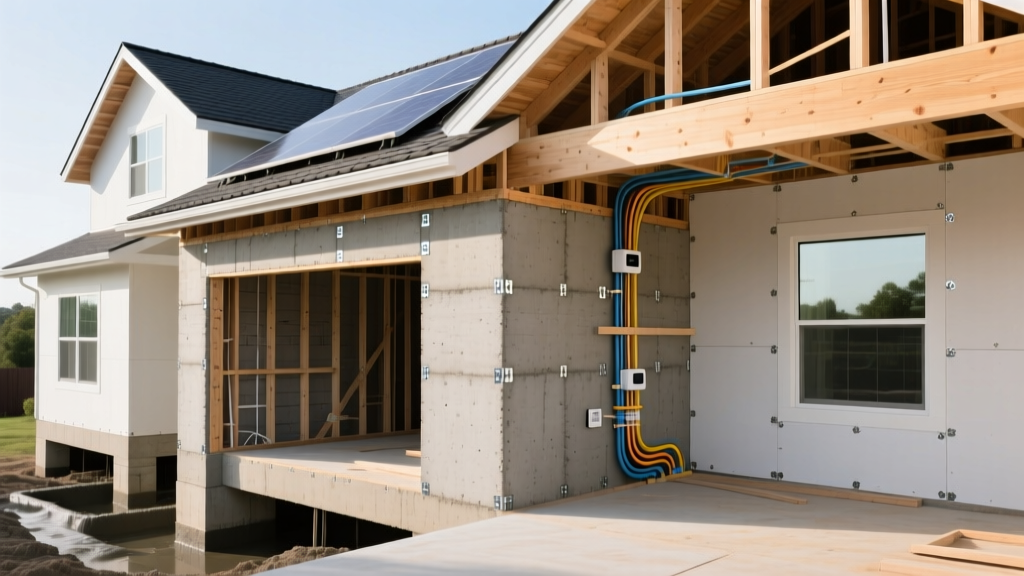
Accurately forecasting the cost of materials in building a custom residential project requires moving beyond basic square-footage multipliers. In 2026, volatile commodity indexing, localized freight surcharges, and tiered manufacturer rebates mean the quoted price of lumber or concrete rarely reflects the final landed cost. This analysis deconstructs the actual material expenditures for a standard 2,500-square-foot single-family home, highlighting specific product selections, hidden procurement fees, and value-engineering matrices.
The Baseline: Core Material Costs Per Square Foot
The foundation, framing, and envelope packages represent roughly 45% of the total hard costs in residential construction. The pricing below reflects Q1 2026 wholesale distributor rates for a mid-tier custom build (excluding labor and general contractor overhead).
| Building Component | Specific Material Selection | Cost per Sq. Ft. (Material Only) | Total Cost (2,500 sq. ft.) |
|---|---|---|---|
| Foundation | 4000 PSI concrete w/ fiber mesh & #5 rebar | $14.50 - $18.00 | $36,250 - $45,000 |
| Floor Framing | Engineered I-joists (TJI 210) & LVL headers | $8.50 - $11.00 | $21,250 - $27,500 |
| Wall Framing | SPF #2 2x6 exterior, 2x4 interior (16" O.C.) | $6.00 - $8.50 | $15,000 - $21,250 |
| Exterior Cladding | James Hardie Artisan lap siding (7" reveal) | $11.00 - $14.50 | $27,500 - $36,250 |
| Roofing | GAF Timberline HDZ architectural shingles | $4.50 - $6.00 | $11,250 - $15,000 |
Hidden Procurement Costs That Destroy Budgets
Builders frequently absorb margin erosion through unanticipated logistical and waste factors. When calculating the true cost of materials in building, you must account for the following hidden expenditures:
- Lumper Fees and Offloading: If a delivery requires a flatbed truck and the job site lacks a forklift, third-party offloading services (lumpers) charge between $150 and $350 per drop. For a multi-drop framing package, this adds $1,200+ to the project.
- Complexity Waste Factors: Standard estimating software applies a 10% waste factor for framing and siding. However, a roofline with multiple valleys, dormers, and hips requires a 15% to 18% waste factor for GAF Timberline HDZ shingles due to cutting and pattern matching. Failing to adjust this results in emergency LTL (Less-Than-Truckload) freight orders, which carry 40% premium surcharges.
- Weather Protection and Dunnage: Engineered lumber and OSB subfloors require immediate weather protection if the building is not dried in within 48 hours. Budgeting for heavy-duty poly sheeting and specialized dunnage to keep materials off wet soil adds roughly $0.45 per square foot to the framing package.
Freight, Tariffs, and the 2026 Supply Chain Reality
According to data tracked by the Bureau of Labor Statistics Producer Price Index, softwood lumber and structural steel remain highly sensitive to international trade policies. In 2026, continued tariffs on Canadian softwood lumber have stabilized SPF (Spruce-Pine-Fir) prices at a premium, making Douglas Fir-Larch a more cost-competitive alternative for load-bearing headers and beams in the Western and Midwestern United States. Builders who lock in 90-day pricing holds with regional distributors can mitigate the risk of mid-project commodity spikes.

Material Substitution Matrix: High-End vs. Value Engineering
Value engineering is not simply buying cheaper products; it is optimizing the ratio of upfront cost to long-term performance and callback reduction. The National Association of Home Builders consistently highlights that reducing material quality in the building envelope leads to exponential warranty costs. Below is a substitution matrix for critical building components.
| Component | Premium Selection | Value-Engineered Alternative | Upfront Savings | Lifecycle & Callback Trade-off |
|---|---|---|---|---|
| Subfloor | Huber AdvanTech (3/4" T&G) | Standard Weyerhaeuser OSB | $2,800 - $3,500 | Standard OSB swells at edges if exposed to rain during framing, requiring $1,500+ in sanding labor before hardwood installation. AdvanTech's 500-day no-sand warranty eliminates this risk. |
| Insulation | Closed-cell spray foam (Icynene) | Blown-in fiberglass (Owens Corning) | $8,000 - $12,000 | Spray foam provides an R-6.5 per inch rating and acts as a vapor barrier, reducing HVAC tonnage requirements by up to 15%. Fiberglass requires separate house-wrap and vapor barrier detailing. |
| House Wrap | Zip System R-sheathing | Tyvek HomeWrap + standard OSB | $4,500 - $6,000 | Zip System integrates the water-resistive barrier (WRB) into the panel, reducing labor time by 30% and eliminating tape-seam failures common in poorly installed traditional wraps. |
Lifecycle Cost Analysis (LCCA) vs. Upfront Spend
"Evaluating the cost of materials in building solely on initial purchase price ignores the time-value of maintenance, energy consumption, and replacement cycles. True economic efficiency is measured over a 50-year building lifecycle."
When selecting exterior cladding, the initial material cost is only a fraction of the total financial commitment. Consider the comparison between natural cedar shingles and fiber cement:
- Western Red Cedar Shingles: Material cost is approximately $9.00 per square foot. However, cedar requires chemical treatment and sealing every 3 to 5 years to prevent UV degradation and moisture rot. Over a 30-year period, maintenance costs will exceed the initial installation cost by 200%.
- James Hardie Fiber Cement: Material cost is roughly $7.50 per square foot. It requires repainting only every 15 years and is impervious to wood-boring insects and rot. The 30-year lifecycle cost is less than half that of cedar, despite similar initial labor costs for installation.
Strategic Procurement Framework for Builders
To maintain margin integrity in 2026, general contractors and custom builders must implement a rigid procurement strategy that leverages volume and timing. Follow this four-step framework to optimize material spend:
- Consolidate Vendor Spend to Hit Tier-1 Rebates: National distributors like Builders FirstSource and 84 Lumber offer backend rebate programs that trigger at specific annual volume thresholds (e.g., $1.5M in annual purchases). Consolidating your framing, siding, and trim packages to a single vendor can yield a 2% to 4% end-of-year rebate, effectively covering your site waste and offloading fees.
- Negotiate 90-Day Price Holds with Escalation Caps: When signing contracts with suppliers for large custom builds, insist on a 90-day price hold clause with a maximum escalation cap of 5%. This protects your fixed-price bids from sudden spikes in the PPI lumber or steel indexes.
- Pre-Fabricate Off-Site: Shift from stick-framing complex components to pre-fabricated wall panels and roof trusses. While the raw material cost of a pre-fab wall panel is 8% higher than stick-framing lumber, it reduces on-site framing labor by 35% and cuts material waste from 15% down to 4%, resulting in a net savings of $4.50 per square foot of wall area.
- Audit Delivery Schedules for Just-In-Time (JIT) Staging: Storing drywall and interior trim on-site before the building is fully dried-in and climate-controlled leads to moisture absorption and edge crushing. Schedule JIT deliveries to ensure materials are installed within 48 hours of dropping off the truck, eliminating replacement costs for water-damaged interior finishes.
Written by
Priya KapoorPriya Kapoor is a real estate market analyst and construction economics researcher with expertise in housing affordability, development feasibility, and infrastructure investment. She holds a Master of Regional Planning from Cornell University and previously worked as a senior analyst at CBRE's Investment Properties group, where she modeled returns for $4B in mixed-use development pipelines. Priya now runs an independent research practice advising developers, municipalities, and REITs on construction cost forecasting and market timing. She publishes the quarterly "BuildMat Market Pulse" report tracking material price indices across 12 commodity categories. Based in Austin, TX, Priya serves on the board of Habitat for Humanity Austin and is a marathon runner.
More from Priya Kapoor
View all
Construction Cost
Cost to Build a 1600 Sq Ft Home in 2026: Full Breakdown
Accurate 2026 cost to build a 1600 sq ft home—material, labor, and regional pricing breakdowns included. Plan your budget with real-time estimates.
Aug 11, 2026

Wood & Lumber
Name the Types of Wood for Pressure Treatment and Preservation
Learn how to name the types of wood best suited for pressure treatment. Compare species treatability, chemical retention levels, and 2026 preservation costs.
Aug 4, 2026

Stone & Masonry
Stone Veneer Suppliers Lindenhurst: 2026 Cost Analysis
Analyze 2026 stone veneer costs in Lindenhurst, NY. Compare local supplier pricing, delivery fees, and Suffolk County installation labor rates.
Aug 4, 2026