Build a House in FL: Materials Only Suited for FL
Discover the exact materials required to build a house in FL. Learn about CBS construction, Miami-Dade impact windows, and FBC-compliant roofing systems.

The Florida Building Code (FBC) Baseline for Extreme Weather
Constructing a residential structure in Florida requires navigating a unique matrix of environmental stressors: Category 5 hurricane wind loads, driving rain, salt-laden coastal air, and aggressive subterranean termite colonies. The Florida Building Code (FBC), currently in its 8th Edition, dictates strict material thresholds that render standard Northern or Midwestern building practices obsolete. When you build a house in FL, materials only suited for mild climates will fail catastrophically under High Velocity Hurricane Zone (HVHZ) testing protocols.
This material overview dissects the specific, code-mandated building products required for Florida residential construction in 2026, focusing on structural shells, fenestration, roofing uplift resistance, and biological defense.
Structural Shell: Why CBS (Concrete Block Stucco) Dominates
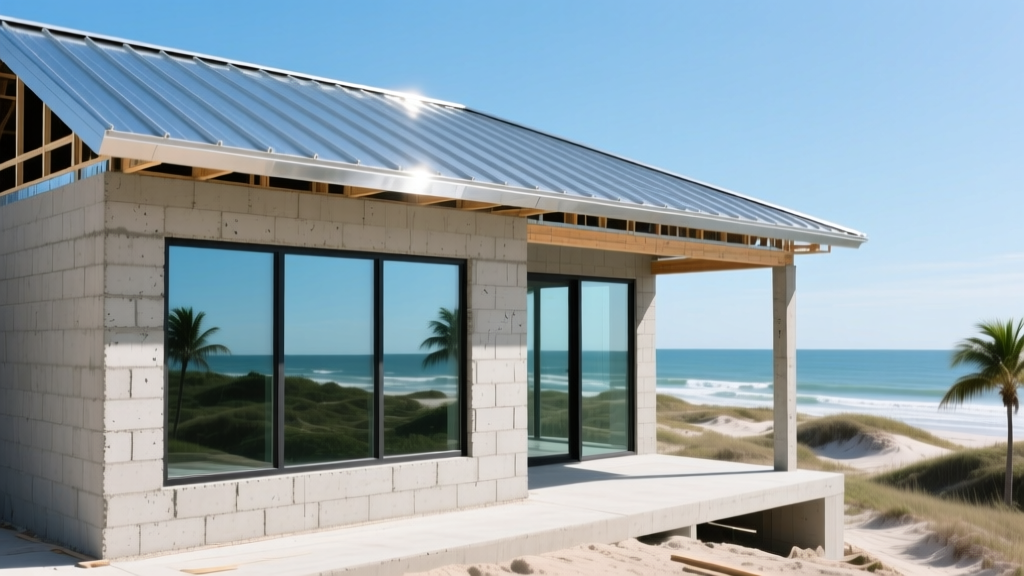
While wood-frame construction with extensive hurricane strapping is permitted in some northern Florida counties, Concrete Block Stucco (CBS) remains the undisputed standard for the central and coastal peninsula. CBS provides inherent mass to resist wind-borne debris and eliminates the primary food source for termites in the exterior envelope.
Technical Specifications for FL Concrete Masonry
- Block Standard: ASTM C90 load-bearing concrete masonry units (CMU), typically 8x8x16 nominal.
- Reinforcement: Grade 60, 5/8-inch galvanized or epoxy-coated rebar placed vertically in grouted cells.
- Grout Spacing: In HVHZ counties (Miami-Dade, Broward), vertical rebar and solid grout cells are required at a maximum of 24 inches on center (o.c.), compared to 48 inches o.c. in non-HVHZ zones.
- Top Bond Beam: A continuous reinforced bond beam at the roof-to-wall connection, secured with 1/2-inch J-bolts embedded 7 inches into the grout to resist uplift.
If opting for wood framing in coastal Volusia or Brevard counties, standard 2x4 studs are insufficient. You must utilize 2x6 studs at 16 inches o.c. with continuous load-path hardware (e.g., Simpson Strong-Tie H2.5A hurricane ties) connecting the truss to the top plate, and the top plate to the studs. Even then, the exterior sheathing requires 5/8-inch CDX plywood rather than OSB to prevent moisture delamination during prolonged driving rain events.
Fenestration: Miami-Dade NOA Impact Glazing
Standard dual-pane vinyl windows will shatter under the impact of a 2x4 wood stud fired at 34 mph (the standard debris test). In Florida, fenestration must either be protected by code-approved shutters or consist of impact-resistant laminated glass. For new builds in 2026, impact windows are the default choice for insurance premiums and energy efficiency.
Decoding the Miami-Dade Notice of Acceptance (NOA)
Products installed in the HVHZ must hold a valid Miami-Dade County Notice of Acceptance (NOA). This certification proves the window assembly has passed cyclic wind pressure testing and large missile impact testing. When specifying windows, look for the following metrics:
- Design Pressure (DP): Minimum DP 50 for coastal structures (capable of withstanding 150+ mph gusts).
- Interlayer: Polyvinyl Butyral (PVB) minimum 0.090 inches thick, or SentryGlas Plus (SGP) for superior post-breakage structural integrity.
- Frame Material: Heavy-wall extruded aluminum (minimum 0.062-inch wall thickness) or fiberglass. Vinyl frames often lack the screw-pullout strength required for HVHZ anchoring schedules.
| Feature | Laminated Impact Windows | Aluminum Accordion Shutters |
|---|---|---|
| Material Cost (per sq ft of opening) | $65 - $95 | $25 - $40 |
| UV & Heat Rejection | High (Low-E coatings standard) | N/A (Only when closed) |
| Insurance Premium Discount | Up to 25% on windstorm | Up to 20% on windstorm |
| Deployment Effort | Zero (Always active) | Manual (Requires physical closure) |
Roofing Systems: Surviving 150+ MPH Uplift
Roof failure is the primary catalyst for total structural loss during a hurricane. Once the roof deck breaches, internal pressurization blows out windows and collapses walls. The Insurance Institute for Business & Home Safety (IBHS) FORTIFIED Home standard heavily influences modern Florida roofing material selection.
Approved Roofing Materials for FL
- Standing Seam Metal (24-Gauge Galvalume): The premier choice for coastal FL. Concealed fasteners eliminate water intrusion points, and the interlocking panels resist uplift far better than screw-down corrugated panels. Must be rated for ASTM E1592 uplift testing.
- Concrete Roof Tile (Profiled): Popular in Mediterranean-style builds. Tiles must be mechanically fastened (screwed and clipped) rather than mortar-set, which becomes brittle and fails under cyclic wind loading.
- Architectural Asphalt Shingles: Must be rated for 130 mph winds (ASTM D3161 Class F or D7158 Class H). Standard 3-tab shingles are effectively banned in new coastal construction due to inadequate wind resistance.
The material itself is only half the equation. Florida code mandates a 6-nail pattern for roof shingles (not 4). Furthermore, the roof decking (minimum 5/8-inch CDX plywood) must be secured to the trusses using 8d ring-shank nails spaced at 4 inches on center at the edges and 6 inches in the field. Standard smooth-shank nails will pull out under negative uplift pressure.
Secondary Water Resistance (SWR)
If the primary roof covering is blown off, SWR prevents water from destroying the interior. In 2026, applying a self-adhering polymer-modified bitumen membrane (peel-and-stick) over the entire roof deck, or at minimum sealing all decking seams with a 4-inch wide tape, is a mandatory best practice for FL builders seeking wind mitigation insurance credits.
Exterior Cladding & Biological Defense
Florida's humidity and biology require materials that resist moisture absorption and Formosan subterranean termites.
Siding Materials
- Fiber Cement (e.g., James Hardie): Impervious to termites, rot, and salt spray. Requires a 1-inch clearance from grade and blind-nailing with stainless steel or hot-dipped galvanized nails to prevent rust-bleeding in humid conditions.
- Stucco (Traditional 3-Coat): Applied directly over CBS walls. Requires a weep screed at the base and acrylic finish coats to allow vapor permeability while shedding bulk water.
- Materials to Avoid: Vinyl siding (becomes brittle in UV and can melt or tear in high winds) and untreated wood lap siding (high maintenance, termite magnet).
Lumber Treatment for Termite Defense
For interior framing, roof trusses, and any wood in contact with concrete, standard pressure treatment is insufficient against the aggressive Formosan termite. Specify lumber treated with inorganic borate (SBX/DOT) to a retention level of 0.25 pcf for above-ground termite protection. Borate treatments are odorless, non-toxic to humans, and lethal to termites that attempt to consume the wood cellulose.
2026 Material Cost Matrix: FL vs. National Average
Building in Florida carries a premium due to the engineered requirements of the FBC. Below is a comparative breakdown of material costs for a standard 2,500 sq. ft. single-family home.
| Material Category | National Average Cost | Florida HVHZ Cost (2026) | Primary Cost Driver in FL |
|---|---|---|---|
| Structural Shell (per sq ft) | $12 - $18 (Wood) | $22 - $28 (CBS) | Rebar/grout density, engineering |
| Fenestration (Whole Home) | $8,000 - $12,000 | $25,000 - $38,000 | Miami-Dade NOA impact glass |
| Roofing System (per sq ft) | $4.50 - $7.00 | $9.00 - $14.50 | Ring-shank nails, SWR, 24ga metal |
| Exterior Doors (Entry) | $1,200 - $2,500 | $3,500 - $6,000 | Fiberglass/Steel with multi-point locks |
Summary: Procuring for the FL Climate
When sourcing materials to build a house in FL, verifying code compliance is a non-negotiable step. Always request the manufacturer's FL Product Approval number and verify it against the state database before materials are delivered to the job site. Substituting a non-approved fastener, window, or roofing membrane will result in failed inspections, voided windstorm insurance policies, and catastrophic vulnerability during the next hurricane season.
Written by
Elena RodriguezElena Rodriguez is a civil engineer and technical writer specializing in concrete technology, masonry systems, and ASTM/ACI compliance. She earned her B.S. in Civil Engineering from Texas A&M University and spent a decade at a materials testing laboratory, performing over 2,000 concrete compressive strength tests and masonry prism evaluations. Elena is an ACI-certified Field Testing Technician (Grade I) and a member of ASTM Committee C12 on Natural Building Stone. She currently consults on forensic engineering cases involving concrete failures and moisture intrusion. Based in San Antonio, TX, Elena is a proud member of the Society of Women Engineers (SWE) and coaches her daughter's FIRST Robotics team.
More from Elena Rodriguez
View all
Walls & Panels
Cost Analysis: Light Gauge Steel Framing Advantages and Disadvantages
Evaluate light gauge steel framing advantages and disadvantages through a strict cost analysis lens, comparing material, labor, and lifecycle expenses.
Aug 4, 2026

Walls & Panels
Gypsum Board Types: Exact Specifications, Thickness & Dimensions
Compare standard, Type X, and moisture-resistant gypsum board types. Get exact specifications, thicknesses, dimensions, and ASTM standards for your project.
Aug 4, 2026

Fire Resistance
Best Fire-Resistant Outdoor Decking Materials: 2026 Buyer Guide
Discover the best fire-resistant outdoor decking materials for 2026. Compare Class A PVC, aluminum, and hardwood options for WUI compliance and safety.
Aug 4, 2026