Leather or Synthetic? Best Material for Ball Control Football Boots
Discover the best material for ball control football boots in 2026. We compare leather vs synthetic polymers, friction coefficients, and top models.
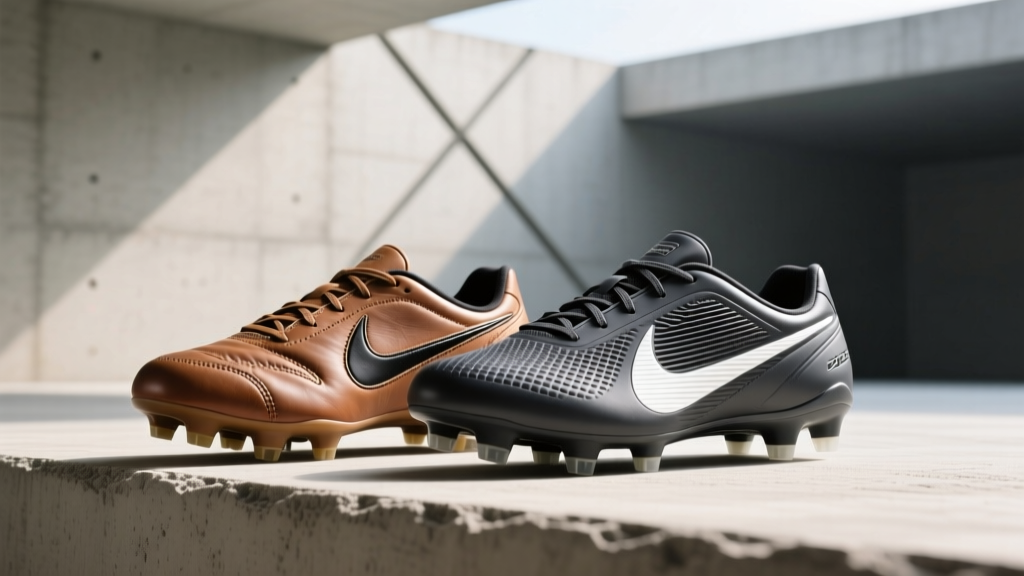
The 2026 Paradigm Shift: Why Natural Leather is Obsolete
The debate over the best material for ball control football boots leather or synthetic has been definitively settled by materials engineering advancements. For decades, Kangaroo leather (K-Leather) was the undisputed champion of touch and ball manipulation. However, as of 2025 and 2026, the elite football manufacturing industry has almost entirely abandoned natural hides in favor of advanced synthetic polymers. This is not merely a result of ethical supply chain shifts or animal welfare campaigns; it is a triumph of textile engineering.
Natural leather is a biological membrane composed of an irregular collagen fiber network. While this grants it high initial tensile strength and a moldable fit, it suffers from severe hydrophilic flaws. Modern synthetic uppers—such as Nike’s FlyTouch Lite, adidas’s Hybridtouch 2.0, and engineered Thermoplastic Polyurethane (TPU) yarns—offer tunable elasticity, zero water absorption, and consistent friction coefficients regardless of climate. For players prioritizing ball control, the best material is unequivocally modern engineered synthetics.
Material Micro-Structures: Collagen Matrices vs. TPU Yarns
To understand why synthetics now dominate ball control, we must examine the micro-structural differences between biological tissues and engineered polymers. According to ScienceDirect's polymer database, Thermoplastic Polyurethane (TPU) offers a unique combination of elastomeric flexibility and high abrasion resistance, making it ideal for high-impact sporting textiles.
The Hydrophilic Flaw of Natural Leather
K-Leather has a thickness of roughly 0.8mm to 1.0mm in premium boots. Its collagen fibers provide an unparalleled barefoot feel. However, leather is hydrophilic. In wet conditions, a natural leather upper can absorb up to 30% of its weight in water. This causes the material to swell, increasing the boot's weight by 40 to 60 grams and drastically lowering its Young’s modulus (stiffness). The boot becomes 'baggy,' destroying the precise mechanical feedback required for first touches and dribbling.
Engineered Synthetics: Hydrophobic and Tunable
Modern synthetic leathers and 3D-knitted TPU yarns are entirely hydrophobic. Materials like Nike’s FlyTouch Lite utilize a microfiber base coated with a proprietary polyurethane resin that mimics the softness of K-Leather but absorbs less than 2% of its weight in water. This ensures that the boot's structural integrity, weight, and surface friction remain identical in the 1st minute and the 90th minute, even in torrential rain.
Early synthetic boots (circa 2010-2018) suffered from delamination, where the synthetic upper peeled away from the soleplate due to adhesive failure. In 2026, manufacturers utilize direct-injection molding and advanced polyurethane hot-melt adhesives that chemically bond the TPU upper to the nylon soleplate at a molecular level, virtually eliminating structural failure.
Material Property Comparison Matrix
The following table contrasts the physical properties of traditional K-Leather against the leading synthetic alternatives used in elite 2026 control boots.
| Material Property | Kangaroo Leather (Legacy) | TPU Microfiber (e.g., FlyTouch Lite) | Textured Knit (e.g., Primeknit + Rubber) |
|---|---|---|---|
| Water Absorption | 20% - 30% | < 2% | < 1% |
| Wet Weight Gain | +45g average | +3g average | +2g average |
| Surface Friction (Wet) | Drops significantly (slippery) | Maintains high tackiness | Mechanical grip maintained |
| Tensile Modulus Stability | Degrades when wet (stretches) | 100% stable | 100% stable |
| Primary Control Mechanism | Material softness / wrapping | Surface tackiness / micro-suction | Rubber elements / 3D texture |
The Physics of Ball Manipulation: Friction and Tackiness
Ball control relies heavily on the coefficient of friction ($\mu$) between the boot upper and the polyurethane casing of the football. When evaluating the best material for ball control football boots leather or synthetic, we must differentiate between material softness and surface tackiness.
Surface Tackiness vs. Mechanical Interlocking
Leather relies on softness to wrap around the ball, increasing the surface area of contact. Modern synthetics, however, utilize surface tackiness. Boots like the adidas Predator Elite feature a Primeknit base overlaid with rubberized 'Controlframe' elements. These rubber elements create a high-friction mechanical interlock with the ball's casing, allowing players to impart spin, kill pace, and drag the ball with microscopic precision. This level of spin manipulation is physically impossible with a smooth leather surface.
According to testing standards outlined by the FIFA Quality Programme, the consistency of equipment performance under varying environmental conditions is paramount. Synthetic uppers pass these rigorous environmental stress tests far more reliably than natural organic hides.
Best Practices: Matching Material to Pitch and Playstyle
Selecting the right synthetic upper depends on your specific biomechanical needs and the surfaces you play on. Use this decision framework to choose your next pair of control boots:
- For Wet, Natural Grass Pitches: Choose TPU Microfiber Synthetics (e.g., Nike Tiempo Legend 10). The hydrophobic nature prevents waterlogging, and the microfiber provides a leather-like softness for trapping long balls without the wet-weather weight penalty.
- For Dry, Artificial Turf (3G/4G): Choose Textured Knits with Rubber Elements (e.g., adidas Predator Elite or Puma Future 7). The abrasive nature of artificial turf will quickly scuff smooth synthetic leathers. Textured knits with raised rubber grips resist abrasion while providing the aggressive friction needed for quick turns on grippy turf.
- For Wide-Footed Players: Choose Unlined TPU Knits. Unlike microfiber synthetics which have a fixed structural shape, 3D-knitted TPU yarns offer multidirectional stretch, accommodating wider metatarsal spreads without causing blisters or requiring a painful break-in period.
Maintenance Protocols for Synthetic Uppers
While synthetics do not require the mink oil and leather balms of the past, they are susceptible to chemical degradation. To maintain the friction coefficient of your synthetic control boots:
- Avoid Harsh Solvents: Never clean TPU or Primeknit uppers with bleach or strong alkaline detergents. These chemicals break down the polyurethane coatings, stripping the boot of its surface tackiness.
- UV Degradation: Prolonged exposure to direct ultraviolet light can cause TPU to become brittle. Store your boots in a dark, climate-controlled environment rather than leaving them in the trunk of a hot car.
- Cold Water Washing: Remove mud and turf pellets using a soft-bristle brush and cold water. Hot water can warp the thermo-bonded adhesives connecting the upper to the soleplate.
Frequently Asked Questions
Do any professional players still wear real leather boots in 2026?
True Kangaroo leather has been almost entirely phased out of elite-tier production due to supply chain inconsistencies and corporate sustainability mandates. Players who previously wore K-Leather (like Kevin De Bruyne or Virgil van Dijk) have transitioned to proprietary synthetic alternatives engineered to mimic the exact tensile modulus of natural hide.
Are synthetic boots better for generating spin on free kicks?
Yes. Synthetics with raised rubber or TPU grip elements generate significantly more rotational force (spin) on the ball compared to smooth leather. The mechanical grip bites into the ball's micro-texture, allowing for greater Magnus effect generation during flight.
How long do synthetic control boots last compared to leather?
High-end synthetic boots generally outlast natural leather in terms of upper integrity. While leather can tear or permanently stretch out of shape, TPU and microfiber synthetics maintain their structural lockdown for 60 to 80 intense match hours before the soleplate studs typically wear down.
Written by
Priya KapoorPriya Kapoor is a real estate market analyst and construction economics researcher with expertise in housing affordability, development feasibility, and infrastructure investment. She holds a Master of Regional Planning from Cornell University and previously worked as a senior analyst at CBRE's Investment Properties group, where she modeled returns for $4B in mixed-use development pipelines. Priya now runs an independent research practice advising developers, municipalities, and REITs on construction cost forecasting and market timing. She publishes the quarterly "BuildMat Market Pulse" report tracking material price indices across 12 commodity categories. Based in Austin, TX, Priya serves on the board of Habitat for Humanity Austin and is a marathon runner.
More from Priya Kapoor
View all
Construction Cost
Cost to Build a 1600 Sq Ft Home in 2026: Full Breakdown
Accurate 2026 cost to build a 1600 sq ft home—material, labor, and regional pricing breakdowns included. Plan your budget with real-time estimates.
Aug 11, 2026

Wood & Lumber
Name the Types of Wood for Pressure Treatment and Preservation
Learn how to name the types of wood best suited for pressure treatment. Compare species treatability, chemical retention levels, and 2026 preservation costs.
Aug 4, 2026

Stone & Masonry
Stone Veneer Suppliers Lindenhurst: 2026 Cost Analysis
Analyze 2026 stone veneer costs in Lindenhurst, NY. Compare local supplier pricing, delivery fees, and Suffolk County installation labor rates.
Aug 4, 2026