What Couch Material Is Best for Cats? A Fabric Durability Guide
Discover what couch material is best for cats. Compare microfiber, Crypton, and leather using expert specs on weave density and scratch resistance.

Selecting upholstery for a home with felines requires looking past aesthetic appeal and analyzing textile engineering. A cat’s scratching behavior is an innate biological imperative used to shed the outer claw sheath, stretch muscles, and deposit territorial pheromones. When evaluating what couch material is best for cats, interior designers and textile engineers prioritize weave density, fiber composition, and surface friction over simple color or pattern choices.
The Physics of Feline Claws: Why Weave Matters More Than Fiber
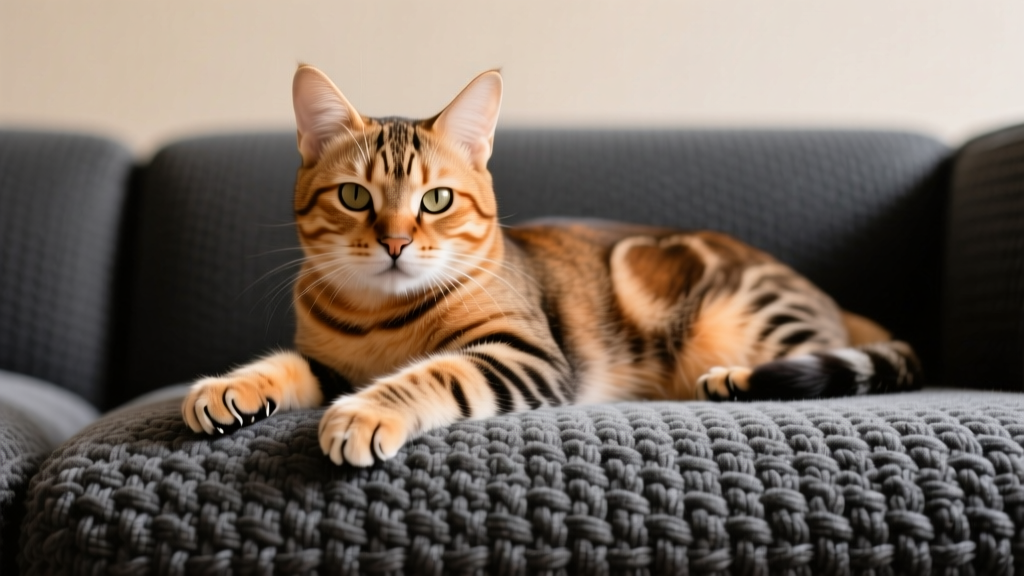
The primary mechanism of couch destruction is not the sharpness of the claw, but the hooking effect. Cat claws act as microscopic grappling hooks. When a cat stretches and drags its claws across a sofa, any fabric with a looped, textured, or loose weave will catch the claw. Once caught, the cat instinctively pulls harder, unraveling the yarn and destroying the textile structure.
According to behavioral guidelines from the ASPCA, cats prefer scratching surfaces that allow them to dig their claws in and pull. Therefore, the ideal upholstery material must be tightly woven with a flat surface profile. The tighter the weave, the less space there is for a claw tip to penetrate between the yarns. A flat-weave textile forces the claw to glide across the surface rather than catching and pulling the threads apart.
Top-Tier Upholstery Materials Ranked for Cat Owners
When sourcing materials for a feline-heavy household, the following textiles consistently outperform standard upholstery fabrics in both abrasion resistance and cleanability.
1. Microfiber and Microsuede (100% Polyester)
Ultra-fine polyester microfiber is widely considered the gold standard for cat owners. The fibers are split to less than 1 denier (thinner than a strand of silk) and woven so tightly that the surface feels like suede. Because there are no loops and the weave is exceptionally dense, cat claws simply slide off the surface. Furthermore, microfiber is naturally hydrophobic, giving you a crucial window to blot up accidents before they set into the fibers.
2. Crypton Home Fabric
Crypton is not a specific fiber, but a proprietary engineering process applied to synthetic and blended fabrics. It features an immuno-paralytic moisture barrier that prevents liquids from penetrating the substrate while remaining breathable. The base fabrics used for Crypton are typically tight, flat-weave polyesters or olefins that resist snagging. If a cat vomits or has a urinary accident, the enzymatic cleaners used will not degrade the fabric's protective backing.
3. Distressed Top-Grain Leather
Leather is highly polarizing in cat households. Aniline leather is a disaster; it is dyed with soluble dyes and lacks a protective topcoat, meaning a single scratch will leave a permanent, highly visible scar. Conversely, distressed or wax-pull-up top-grain leather is heavily treated with oils and waxes. When scratched, the leather lightens, but simply rubbing the scratch with your thumb or a leather conditioner redistributes the oils, effectively erasing the mark. Avoid polyurethane (PU) vegan leather entirely, as feline claws will easily puncture the thin synthetic coating, causing it to peel and flake.
4. Heavyweight Cotton Canvas or Denim (12oz to 16oz)
If you prefer natural fibers, heavyweight cotton duck canvas is your best option. Look for fabrics weighing at least 12 ounces per square yard. The plain weave structure of canvas is tight and flat, offering minimal purchase for claws. While it lacks the inherent stain resistance of synthetics, its high tensile strength means it will not easily tear or unravel under tension.
Material Comparison Matrix
| Material Type | Weave Profile | Scratch Deflection | Liquid Stain Resistance | Typical Cost (Per Yard) |
|---|---|---|---|---|
| Microfiber (100% Poly) | Ultra-tight flat | Excellent | High (Hydrophobic) | $25 - $60 |
| Crypton Home Fabric | Tight synthetic blend | Excellent | Exceptional (Barrier) | $70 - $140 |
| Distressed Leather | Solid hide | Good (Marks hide) | Moderate (Wipes clean) | $150 - $300+ |
| Heavy Canvas (14oz) | Tight plain weave | Very Good | Low (Requires treatment) | $20 - $45 |
| Standard Linen | Loose plain weave | Poor (Snags easily) | Very Low | $30 - $80 |
Materials to Absolutely Avoid
To prevent catastrophic furniture failure, eliminate the following textiles from your consideration list:
- Chenille and Bouclé: These fabrics are constructed using looped yarns. They act as literal claw traps and will unravel within days of feline interaction.
- Tweed and Houndstooth: The multi-yarn, textured weave provides abundant ridges and loops for claws to catch and pull.
- Velvet and Velour: While some synthetic velvets are marketed as 'pet-friendly,' the pile structure is easily crushed and permanently scored by claws dragging in opposite directions.
- Silk and Rayon: These fibers have incredibly low tensile strength and will shred under minimal localized pressure.
Decoding Fabric Specifications: A Buyer's Checklist
When shopping for high-performance upholstery, do not rely on marketing terms like 'pet-friendly' or 'durable.' Instead, request the technical specification sheet from the manufacturer and look for these industry-standard metrics, as outlined by the Association for Contract Textiles (ACT):
- Wyzenbeek Abrasion Test (ASTM D4157): This test measures a fabric's ability to withstand wear by rubbing it with a cotton duck abradant. Standard residential fabrics are rated for 15,000 to 30,000 'double rubs.' For a home with cats, specify a minimum of 50,000 double rubs, which crosses into commercial-grade durability.
- Martindale Abrasion Test (ASTM D4970): The European equivalent to Wyzenbeek. Look for a rating of 40,000 rubs or higher.
- Pilling Resistance (ASTM D3511): Rated on a scale of 1 to 5. Cats pulling on surface fibers can cause severe pilling. Only accept fabrics with a Class 4 or Class 5 rating (indicating slight to no pilling).
- Seam Slippage (ASTM D4034): Measures how easily yarns pull away from the stitching at the seams. High seam slippage means the couch will split at the cushions when the cat jumps on it.
Best Practices for Couch Placement and Maintenance
Material selection is only half the battle. Environmental management and proper maintenance are required to maximize the lifespan of your upholstery. The Humane Society of the United States emphasizes that providing acceptable alternatives is the most effective way to protect furniture.
Strategic Placement of Scratching Alternatives
Cats scratch immediately upon waking and after periods of high activity. Place heavy, stable sisal scratching posts directly adjacent to the corners of the sofa. The post must be taller than the cat's full stretched length (minimum 32 inches) and heavy enough that it will not wobble. If the post wobbles, the cat will abandon it and return to the stable, resistant surface of the couch arm.
Enzymatic Cleaning Protocols
If a cat soils the couch, standard household cleaners or ammonia-based products will not break down the uric acid crystals. You must use a dedicated enzymatic cleaner specifically formulated for feline urine. Apply the cleaner generously, allowing it to penetrate as deeply into the cushion foam as the urine did, and let it air dry completely. For microfiber and Crypton fabrics, the moisture barrier often prevents deep foam penetration, making surface extraction highly effective.
Routine Claw Maintenance
Trim your cat's claws every two to three weeks using sharp, scissor-style clippers. Only remove the translucent, hooked tip of the claw (the 'sheath'). Dull clippers will crush the claw, causing it to splinter and snag on even the tightest microfiber weaves. Alternatively, apply soft vinyl nail caps (such as Soft Paws) which completely blunt the claw and render it incapable of catching on textile fibers.
Written by
Priya KapoorPriya Kapoor is a real estate market analyst and construction economics researcher with expertise in housing affordability, development feasibility, and infrastructure investment. She holds a Master of Regional Planning from Cornell University and previously worked as a senior analyst at CBRE's Investment Properties group, where she modeled returns for $4B in mixed-use development pipelines. Priya now runs an independent research practice advising developers, municipalities, and REITs on construction cost forecasting and market timing. She publishes the quarterly "BuildMat Market Pulse" report tracking material price indices across 12 commodity categories. Based in Austin, TX, Priya serves on the board of Habitat for Humanity Austin and is a marathon runner.
More from Priya Kapoor
View all
Construction Cost
Cost to Build a 1600 Sq Ft Home in 2026: Full Breakdown
Accurate 2026 cost to build a 1600 sq ft home—material, labor, and regional pricing breakdowns included. Plan your budget with real-time estimates.
Aug 11, 2026

Wood & Lumber
Name the Types of Wood for Pressure Treatment and Preservation
Learn how to name the types of wood best suited for pressure treatment. Compare species treatability, chemical retention levels, and 2026 preservation costs.
Aug 4, 2026

Stone & Masonry
Stone Veneer Suppliers Lindenhurst: 2026 Cost Analysis
Analyze 2026 stone veneer costs in Lindenhurst, NY. Compare local supplier pricing, delivery fees, and Suffolk County installation labor rates.
Aug 4, 2026