Green Materials for Home Building: 2026 Best Practices Guide
Discover 2026 best practices for sourcing green materials for home building. Compare costs, certifications, and performance of top sustainable options.

The Shift to High-Performance Sustainable Envelopes
The specification of green materials for home building has evolved from a niche environmental preference to a rigorous, data-driven building science discipline. In 2026, the focus has shifted entirely from simple recycled content to whole-building embodied carbon and lifecycle operational efficiency. Builders and architects are no longer just asking if a material is natural; they are demanding Environmental Product Declarations (EPDs) and verifying hygrothermal performance. Selecting the right sustainable materials requires balancing upfront premiums against long-term durability, moisture management, and structural integrity. According to the EPA's guidelines on green building, optimizing material selection can reduce a home's lifecycle environmental impact by up to 35%, provided the materials are installed according to modern building science principles.
A standard code-built 2,500 sq. ft. wood-frame home generates approximately 150 metric tons of CO2e. By substituting conventional materials with optimized bio-based and low-carbon alternatives, builders are currently achieving envelopes as low as 65 metric tons of CO2e, effectively turning the home's structure into a net carbon sink during its first decade.
Material Matrix: Structural & Envelope Options
Choosing the primary structural and envelope materials dictates the thermal mass, carbon footprint, and construction timeline of the project. Below is a comparative analysis of the top-performing sustainable structural systems currently dominating the custom and high-performance residential market.
| Material System | Embodied Carbon | Installed Cost (per sq. ft.) | Thermal / Structural Notes |
|---|---|---|---|
| Cross-Laminated Timber (CLT) | Net Negative (Carbon Sequestering) | $18.00 - $26.00 | Requires PRG 320 certification. Excellent air-sealing substrate; R-1.25 per inch. |
| Hempcrete (Cast-in-Place) | Net Negative (Biogenic Carbon) | $14.00 - $19.00 | Non-structural. R-2.4 per inch. High vapor permeability (>15 perms). |
| Insulated Concrete Forms (ICF) | Moderate (High cement content) | $12.00 - $16.00 | Use Type IL (Portland-Limestone) cement to reduce carbon 10%. R-22+ assembly. |
| Structural Insulated Panels (SIP) | Low to Moderate | $9.00 - $13.00 | Specify EPS over XPS foam to eliminate high-GWP HFC blowing agents. |
Sourcing Framework: Verifying Authentic Green Claims
The market is saturated with greenwashed products. To ensure the green materials for home building you specify actually deliver environmental benefits, procurement teams must implement a strict verification framework. Relying on marketing brochures is no longer acceptable; third-party certifications and standardized declarations are mandatory.
The 3-Step Verification Protocol
- Demand Environmental Product Declarations (EPDs): An EPD (compliant with ISO 14025) is a standardized document that quantifies a product's environmental impact across its lifecycle. If a manufacturer cannot provide a current, third-party verified EPD for their specific product line, exclude it from your shortlist.
- Verify Wood Sourcing via FSC: For any timber, sheathing, or finish wood, require Forest Stewardship Council (FSC) certification. FSC ensures the wood is harvested from responsibly managed forests that provide environmental, social, and economic benefits. Avoid 'SFI' or generic 'sustainably sourced' labels if strict carbon tracking is your goal.
- Check for Red List Free Status: Cross-reference interior finishes, adhesives, and sealants against the International Living Future Institute's Red List. This ensures your materials are free from the worst-in-class toxic chemicals, protecting indoor air quality.
Do not assume a material is sustainable simply because it is natural. For example, conventional gypsum board requires massive energy to calcine, and non-FSC tropical hardwoods contribute to deforestation. Always verify the extraction and manufacturing processes, not just the base ingredient.
Insulation & Interior Finishes: The Hidden Emitters
While the structural envelope gets the most attention, insulation and interior finishes account for a significant portion of a home's embodied carbon and indoor air quality profile. Selecting the right green materials for home building in these categories requires balancing R-value, vapor dynamics, and toxicity.
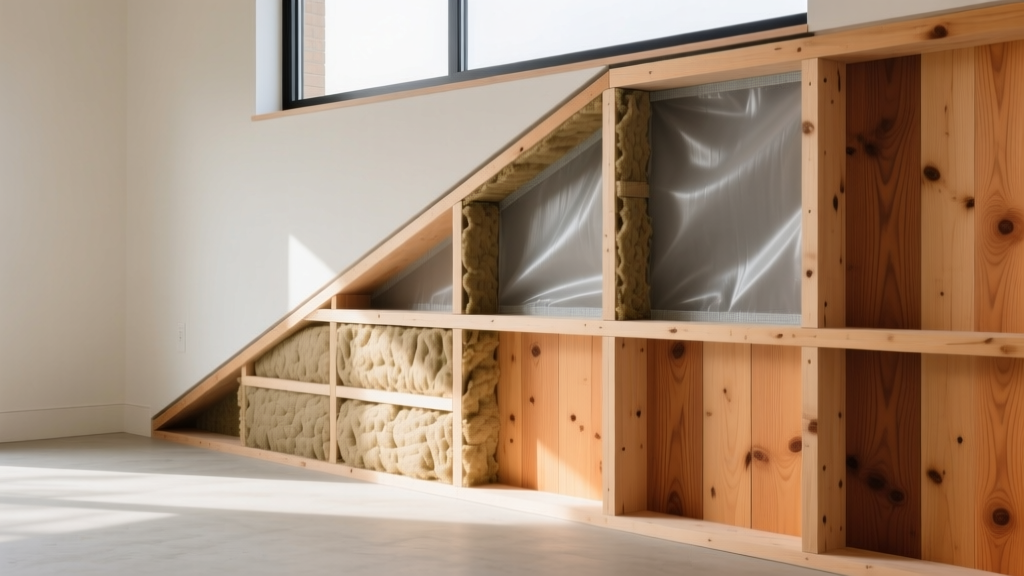
High-Performance Sustainable Insulation Options
- Dense-Pack Cellulose: Made from 80%+ post-consumer recycled newsprint treated with borates for fire and pest resistance. Meets ASTM C739. Best Practice: Install at 3.5 lbs per cubic foot to prevent settling. R-value is approximately 3.7 per inch. Cost: $1.10 - $1.60 per board foot installed.
- Mineral Wool (Stone Wool): Manufactured from basalt rock and slag. While energy-intensive to melt, it offers superior fire resistance (non-combustible up to 2,150°F) and acoustic damping. Best Practice: Use semi-rigid boards (like Rockwool Comfortboard 80) for exterior continuous insulation to eliminate thermal bridging. R-value: 4.3 per inch.
- Expanded Cork Board: A premium, carbon-negative insulation made from cork oak bark, expanded using its own natural resins (suberin) without synthetic binders. Best Practice: Ideal for below-grade or high-moisture applications due to its natural rot resistance and vapor permeability. R-value: 3.6 per inch. Cost: $3.50 - $5.00 per board foot.
Moisture Management & Failure Modes in Bio-Based Materials
The most common cause of failure when utilizing bio-based green materials for home building is applying conventional moisture management strategies to hygroscopic assemblies. Materials like hempcrete, mass timber, and cellulose interact with moisture differently than fiberglass and vinyl.
'The fundamental rule of bio-based building envelopes is that they must be able to dry. If you trap moisture inside a hempcrete or CLT wall assembly with an impermeable vapor barrier or closed-cell spray foam, you will guarantee biological decay and structural failure.'
Troubleshooting Common Bio-Based Failures
Failure Mode 1: Hempcrete Spalling and Mold
Cause: Hempcrete requires extensive drying time. A 12-inch thick cast-in-place hempcrete wall can take 60 to 90 days to dry to a safe moisture content (below 15%). Applying impermeable interior paints or exterior stuccos before the wall is fully cured traps construction moisture.
Best Practice Fix: Use only vapor-open finishes. Interior walls should be finished with lime plaster or clay paint. Exterior walls require a breathable mineral silicate render or a ventilated rain screen cladding system.
Failure Mode 2: Mass Timber Checking and Air Leaks
Cause: Cross-Laminated Timber (CLT) panels will naturally check (crack) and shrink as they acclimate to the interior humidity of a home. If the panel joints are only taped with standard construction tape, this movement will break the seal, leading to massive air infiltration and condensation within the wall cavity.
Best Practice Fix: Specify 3D-mesh breathable tapes (such as Pro Clima INTELLO X) at all panel joints. These tapes can stretch up to 25mm, accommodating the natural seasonal expansion and contraction of the timber without compromising the airtight seal.
Lifecycle ROI & Carbon Economics
Specifying premium green materials for home building inevitably raises the initial construction budget. In 2026, builders typically see an upfront material premium of 8% to 14% for a fully optimized, low-carbon envelope compared to standard code-minimum construction. However, evaluating this purely on day-one costs ignores the shifting economic landscape.
According to the U.S. Green Building Council, homes built to advanced green standards consistently command a 5% to 8% premium in appraised resale value. Furthermore, the operational savings from high-performance, airtight bio-based envelopes reduce heating and cooling loads by 40% to 60%. When factoring in the impending expansion of local carbon-tax credits and utility rebates for embodied carbon reduction, the payback period for premium green materials has shrunk to under seven years in most North American climate zones. The best practice is to present clients with a 30-year lifecycle cost analysis, demonstrating that the initial premium is rapidly eclipsed by energy resilience, durability, and asset valuation gains.
Written by
Elena RodriguezElena Rodriguez is a civil engineer and technical writer specializing in concrete technology, masonry systems, and ASTM/ACI compliance. She earned her B.S. in Civil Engineering from Texas A&M University and spent a decade at a materials testing laboratory, performing over 2,000 concrete compressive strength tests and masonry prism evaluations. Elena is an ACI-certified Field Testing Technician (Grade I) and a member of ASTM Committee C12 on Natural Building Stone. She currently consults on forensic engineering cases involving concrete failures and moisture intrusion. Based in San Antonio, TX, Elena is a proud member of the Society of Women Engineers (SWE) and coaches her daughter's FIRST Robotics team.
More from Elena Rodriguez
View all
Walls & Panels
Cost Analysis: Light Gauge Steel Framing Advantages and Disadvantages
Evaluate light gauge steel framing advantages and disadvantages through a strict cost analysis lens, comparing material, labor, and lifecycle expenses.
Aug 4, 2026

Walls & Panels
Gypsum Board Types: Exact Specifications, Thickness & Dimensions
Compare standard, Type X, and moisture-resistant gypsum board types. Get exact specifications, thicknesses, dimensions, and ASTM standards for your project.
Aug 4, 2026

Fire Resistance
Best Fire-Resistant Outdoor Decking Materials: 2026 Buyer Guide
Discover the best fire-resistant outdoor decking materials for 2026. Compare Class A PVC, aluminum, and hardwood options for WUI compliance and safety.
Aug 4, 2026