Cost Breakdown: Materials to Build Raised Garden Beds (2026)
Compare the 2026 lifecycle costs of materials to build raised garden beds. Analyze lumber, masonry, metal, and composite pricing and durability.

The True Cost of Raised Beds: Upfront vs. Lifecycle
Selecting materials to build raised garden beds requires evaluating more than the initial receipt. A $150 cedar bed that rots in four years carries a significantly higher annualized cost than a $450 masonry bed that lasts four decades. In 2026, material inflation and supply chain shifts have altered the traditional hierarchy of landscaping budgets. To make an economically sound decision, builders and homeowners must analyze the 10-year lifecycle cost, factoring in material degradation, structural maintenance, and soil interaction.
This cost analysis breaks down the primary materials used in raised bed construction, evaluating their upfront capital requirements against their long-term amortization.
The 10-Year Lifecycle Cost Matrix
The following matrix models a standard 4-foot by 8-foot raised bed (32 square feet of growing space) with a 24-inch depth. Costs reflect Q1 2026 national averages for materials only, excluding soil and labor.
| Material Category | Upfront Cost (4x8x2 bed) | Expected Lifespan | Annualized Cost | Maintenance Requirement |
|---|---|---|---|---|
| Untreated Western Red Cedar | $380 - $450 | 7 - 10 Years | $45 - $55 / year | Annual sealing recommended |
| UC4A Pressure-Treated Pine | $160 - $210 | 15 - 20 Years | $9 - $12 / year | None required |
| Composite (e.g., Trex) | $650 - $850 | 25+ Years | $26 - $34 / year | Cross-brace inspection |
| Concrete Masonry Units (CMU) | $420 - $550 | 50+ Years | $8 - $11 / year | Weed control in cores |
| 26-Gauge Galvanized Steel | $280 - $340 | 15 - 25 Years | $13 - $18 / year | Liner replacement (10 yrs) |
Lumber: Navigating Rot, Toxicity, and Price
Wood remains the most common choice for raised beds, but the cost variance between species and treatment levels is massive. The critical error most DIYers make is purchasing the wrong grade of treated lumber, leading to premature structural failure.
Untreated Cedar and Redwood (The Premium Organics)
Western Red Cedar and Redwood contain natural tannins and oils that resist fungal decay. However, not all cedar is equal. You must specify heartwood; sapwood lacks these protective oils and will rot within three years when in direct contact with damp soil. Expect to pay a 40% premium for clear, all-heartwood grades compared to construction-grade cedar. To maximize lifespan, apply a liquid polyurethane membrane to the interior walls before filling with soil, which blocks moisture wicking and extends the wood's life by up to 50%.
Pressure-Treated Pine (The UC4A Imperative)
Pressure-treated southern yellow pine is the most cost-effective material on the market, provided you purchase the correct retention level. According to the American Wood Protection Association (AWPA), lumber is categorized by its intended use environment. You must specifically source UC4A (Ground Contact) rated lumber, which contains a higher concentration of preservatives (typically Micronized Copper Azole, or MCA) than UC3B (Above Ground) lumber. Using UC3B for a raised bed will result in corner-post rot within 36 months.
Modern MCA-treated wood (post-2004) no longer contains arsenic or chromium (CCA). Studies reviewed by university extension programs, including the University of Maryland Extension, confirm that copper leaching from MCA wood is negligible and well below EPA thresholds for soil toxicity. However, if growing highly acidic crops (pH below 5.5) or if you prefer absolute zero-risk, lining the interior with a 6-mil food-grade HDPE plastic barrier costs an additional $25 per bed and eliminates leaching entirely.
Masonry and Metal: High Initial Capital, Low Amortization
For permanent landscape integrations, inorganic materials eliminate the threat of biological decay, shifting the cost burden entirely to the initial installation phase.
Concrete Masonry Units (CMU) and Retaining Wall Blocks
Standard 8x8x16-inch CMU blocks cost between $2.50 and $3.50 each. A two-course high (16-inch) 4x8 bed requires roughly 36 blocks. While the blocks themselves are cheap, the hidden costs lie in the base preparation and reinforcement. CMU beds require a compacted gravel base and vertical rebar pinning driven into the earth through the block cores to prevent frost-heave displacement in northern climates. Filling the cores with concrete and rebar adds approximately $85 to the project but guarantees the wall will never bow under the lateral hydrostatic pressure of wet soil.
Corrugated Galvanized Steel
Corrugated metal beds have surged in popularity due to their modern aesthetic and rapid assembly. When sourcing metal, verify the zinc coating rating. You need G90 galvanization (0.90 ounces of zinc per square foot) to withstand constant soil moisture. Thinner G60 panels, often found in budget kit beds, will develop rust weep-holes within five years. Furthermore, highly acidic soils (common in the Pacific Northwest and parts of the Southeast) will strip zinc coatings rapidly. For acidic soil profiles, budget an extra $30 for a heavy-duty geotextile and polyethylene liner to separate the soil from the metal walls.
Composite Lumber: The Hidden Structural Tax
Composite boards (made from wood fibers and recycled HDPE plastics) offer a 25+ year lifespan with zero rot risk. However, their cost analysis must include structural reinforcement. Composite lacks the tensile strength and rigidity of natural wood. An 8-foot span of 1-inch composite board will experience severe lateral deflection (bowing outward) when subjected to the weight of 2,000+ pounds of wet soil.
Engineering Rule of Thumb: When using composite for raised beds, you must install aluminum or treated-wood cross-braces every 4 feet. Failure to include cross-ties in your material takeoff will result in a bed that looks like a bulging barrel by its second spring.
Additionally, composite expands and contracts significantly with temperature fluctuations. Fastening systems must allow for a 1/8-inch lateral slip at the joints, requiring specialized slotted-hole brackets that add roughly $45 to the hardware budget per bed.
Hidden Cost Multipliers: Fasteners, Liners, and Bracing
The most common budget overruns in raised bed construction occur in the hardware aisle. Standard exterior wood screws will corrode and snap when exposed to the copper in pressure-treated wood or the tannins in cedar. Factor in these mandatory hardware upgrades:
- 316 Stainless Steel Structural Screws: Mandatory for pressure-treated wood (copper reacts with standard galvanized zinc, causing rapid corrosion). Cost: ~$35 per box of 100.
- 304 Stainless Steel Screws: Sufficient for cedar and redwood. Cost: ~$22 per box of 100.
- Interior Liquid Membrane: Brush-on rubberized asphalt or polyurethane to seal wood pores against soil moisture. Cost: ~$40 per gallon (covers two 4x8 beds).
- Heavy-Duty Corner Brackets: For beds over 18 inches tall, interior steel L-brackets prevent the corners from splitting under soil pressure. Cost: ~$18 for a set of four.
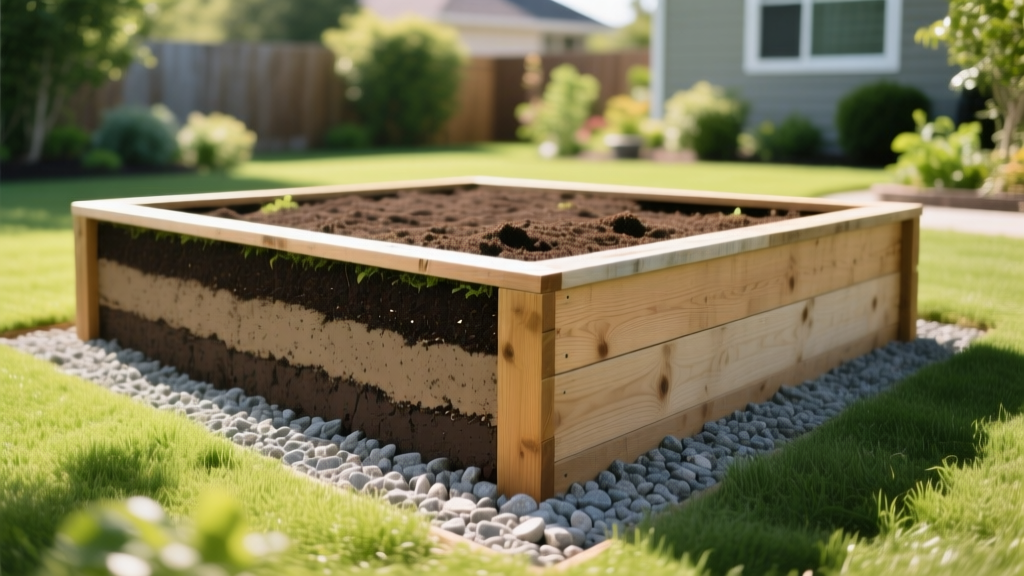
Procurement Framework: Matching Material to Budget
Use the following decision matrix to select the optimal material based on your specific financial and temporal constraints:
- If your budget is under $200 per bed and you prioritize speed: Use UC4A Pressure-Treated Pine with 316 stainless steel screws. It offers the lowest upfront cost and a 15-year lifespan with zero maintenance.
- If you are growing root vegetables in organic-certified soil and have a $400+ budget: Use All-Heartwood Western Red Cedar, sealed on the interior with a liquid rubber membrane. This provides maximum biological safety and a 10-year structural guarantee.
- If this is a permanent, multi-generational landscape feature: Use reinforced CMU blocks with a compacted gravel base. The high initial labor and material cost amortizes to less than $10 a year over a 50-year lifespan.
- If you require wheelchair-accessible heights (30+ inches): Avoid wood and composite due to extreme lateral pressure at that height. Use poured concrete or engineered retaining wall blocks with geogrid tie-backs to handle the immense hydrostatic load of deep soil profiles.
By analyzing the lifecycle cost rather than just the sticker price, you can select materials to build raised garden beds that align with both your immediate budget and your long-term landscape strategy.
Written by
Priya KapoorPriya Kapoor is a real estate market analyst and construction economics researcher with expertise in housing affordability, development feasibility, and infrastructure investment. She holds a Master of Regional Planning from Cornell University and previously worked as a senior analyst at CBRE's Investment Properties group, where she modeled returns for $4B in mixed-use development pipelines. Priya now runs an independent research practice advising developers, municipalities, and REITs on construction cost forecasting and market timing. She publishes the quarterly "BuildMat Market Pulse" report tracking material price indices across 12 commodity categories. Based in Austin, TX, Priya serves on the board of Habitat for Humanity Austin and is a marathon runner.
More from Priya Kapoor
View all
Construction Cost
Cost to Build a 1600 Sq Ft Home in 2026: Full Breakdown
Accurate 2026 cost to build a 1600 sq ft home—material, labor, and regional pricing breakdowns included. Plan your budget with real-time estimates.
Aug 11, 2026

Wood & Lumber
Name the Types of Wood for Pressure Treatment and Preservation
Learn how to name the types of wood best suited for pressure treatment. Compare species treatability, chemical retention levels, and 2026 preservation costs.
Aug 4, 2026

Stone & Masonry
Stone Veneer Suppliers Lindenhurst: 2026 Cost Analysis
Analyze 2026 stone veneer costs in Lindenhurst, NY. Compare local supplier pricing, delivery fees, and Suffolk County installation labor rates.
Aug 4, 2026