Best Light Weight Material for Engine Blocks: Heavy Machinery Guide
Find the best light weight material for engine blocks in heavy construction equipment. Compare aluminum, magnesium, and CGI alloys for modern machinery.

The Shift Toward Lightweighting in Heavy Construction Equipment
Heavy construction equipment manufacturers face immense pressure to reduce machine weight to improve fuel efficiency, increase payload capacity, and meet stringent Tier 4 Final and Stage V emission standards. The engine block, traditionally a massive cast iron anchor weighing upwards of 400 kg in mid-size excavators and wheel loaders, is the primary target for lightweighting. Selecting the best light weight material for engine blocks is no longer just an automotive pursuit; it is a critical engineering and industrial manufacturing challenge that directly impacts the performance of bulldozers, cranes, and earthmovers.
Transitioning away from traditional grey cast iron requires a deep understanding of metallurgy, thermal dynamics, and the specific industrial construction requirements needed to cast these advanced alloys. Below, we evaluate the top contenders for heavy machinery engine blocks, analyzing their material properties, cost structures, and the facility upgrades required to manufacture them.
Top Contenders: Evaluating the Best Light Weight Material for Engine Blocks
Aluminum-Silicon (Al-Si) Alloys: The Industry Standard
Aluminum-silicon alloys, specifically A356-T6 and A319, represent the most mature lightweight alternative to cast iron. With a density of approximately 2.68 g/cm³, an Al-Si engine block can reduce the overall engine weight by 40% to 50% compared to a traditional grey iron block.
For construction equipment like compact track loaders and mid-size wheel loaders, this weight reduction translates directly to higher tipping loads and better fuel economy. Al-Si alloys offer exceptional thermal conductivity (roughly 150 W/m·K), which is critical for dissipating the intense heat generated by high-torque diesel engines operating in dusty, high-ambient-temperature construction sites.
- Density: 2.68 g/cm³
- Tensile Strength: 260–300 MPa (after T6 heat treatment)
- Estimated Material Cost: $2.80 – $3.20 per kg (2026 market average)
- Limitation: Lower fatigue strength at elevated temperatures compared to iron; requires cast iron cylinder liners or specialized plasma-transferred wire arc (PTWA) coatings to prevent piston scuffing.
Magnesium Alloys: The Ultra-Light Frontier
Magnesium alloys, such as AZ91D and AM60B, are the lightest structural metals available, boasting a density of just 1.74 g/cm³—35% lighter than aluminum. While historically limited to transmission housings and intake manifolds, advances in high-temperature creep-resistant magnesium alloys (like MRI153M) are pushing this material into the engine block conversation for smaller construction machinery, such as skid steers and light towers.
However, magnesium presents severe manufacturing challenges. It is highly reactive and flammable in molten form, requiring specialized cover gases like sulfur hexafluoride (SF6) or sulfur dioxide (SO2) during the die-casting process. Furthermore, its poor high-temperature creep resistance makes it unsuitable for the massive thermal loads of heavy-duty mining excavators.
Compacted Graphite Iron (CGI): The Heavy-Duty Compromise
When discussing the best light weight material for engine blocks in extreme heavy-duty applications (e.g., 50-ton mining trucks and large dozers), Compacted Graphite Iron (CGI) is the undisputed champion. While CGI has a density of 7.1 g/cm³ (heavier than aluminum), its tensile strength is roughly 45% higher than traditional grey iron, and its fatigue limit is nearly double.
This immense strength allows engineers to design engine blocks with significantly thinner walls and optimized ribbing. The net result is a CGI block that is 15% to 20% lighter than a grey iron block of the same displacement, while maintaining the superior damping capacity and wear resistance required for high-torque, low-RPM construction diesels.
Industrial Building Insight: Foundry Requirements for CGI
Casting CGI requires a much tighter process control window than grey iron. The magnesium treatment used to compact the graphite flakes must be precise; a variance of just 0.005% can result in flake or spheroidal graphite, ruining the block. Consequently, foundries producing CGI blocks require advanced industrial construction features, including real-time thermal analysis stations, automated spectrographic sorting, and specialized sand reclamation systems to manage the unique binder chemistries used in CGI mold-making.
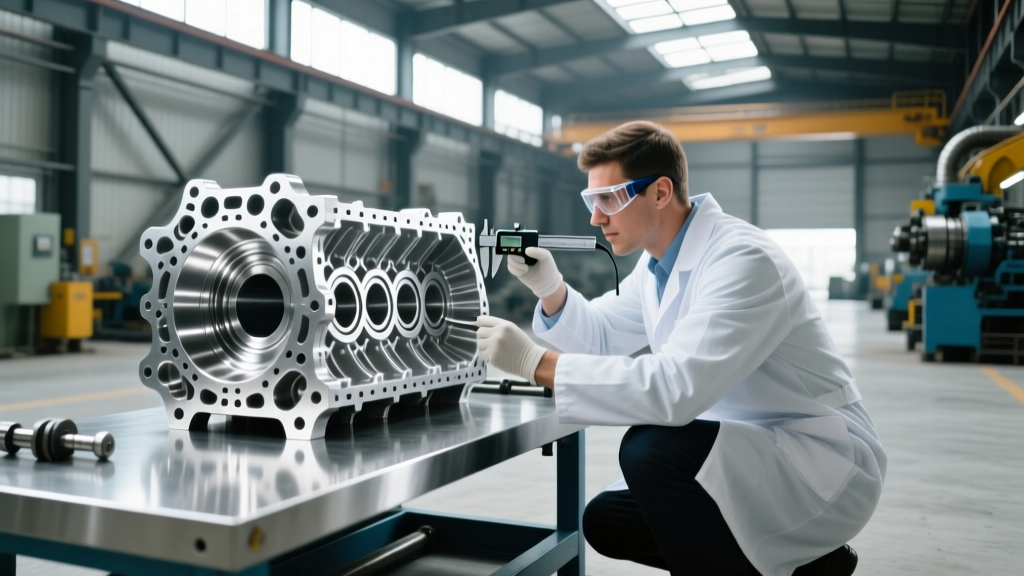
Comparative Matrix: Weight, Cost, and Thermal Performance
The table below synthesizes the critical engineering and economic data for heavy machinery engine block materials.
| Material | Density (g/cm³) | Tensile Strength (MPa) | Cost per kg (USD) | Ideal Construction Application |
|---|---|---|---|---|
| Grey Cast Iron | 7.20 | 200 – 250 | $1.20 – $1.50 | Legacy equipment, stationary pumps |
| CGI (Grade 450) | 7.10 | 450 – 500 | $1.80 – $2.20 | Mining trucks, heavy dozers, large excavators |
| Al-Si (A356-T6) | 2.68 | 260 – 300 | $2.80 – $3.20 | Wheel loaders, compact track loaders, cranes |
| Magnesium (AZ91D) | 1.74 | 230 – 250 | $4.50 – $6.00 | Skid steers, light towers, auxiliary housings |
Manufacturing and Facility Implications for Builders
When evaluating the best light weight material for engine blocks, construction and facility engineers must look beyond the metallurgy. The choice of material dictates the architectural, mechanical, and electrical (MEP) design of the foundry and machining facilities. According to the U.S. Department of Energy's lightweight materials initiatives, scaling up advanced alloy production requires significant infrastructure investment.
Facility Upgrades for Magnesium Casting
If a manufacturer opts for magnesium to achieve maximum weight reduction, the facility must be built to handle severe fire hazards. Molten magnesium reacts explosively with water. Therefore, the foundry building must incorporate:
- Specialized Fire Suppression: Standard sprinkler systems are lethal in a magnesium fire. Facilities require Class D dry powder extinguishing systems and automated sand-dumping mechanisms.
- Electrical Classifications: Machining and finishing areas where magnesium dust is present must be constructed to NEC Class II, Division 1 explosion-proof standards, requiring sealed conduits and specialized HVAC dust collection systems.
- Environmental Controls: The use of SF6 cover gas (a potent greenhouse gas) requires advanced scrubbing and ventilation systems to meet modern environmental building codes.
Facility Upgrades for Aluminum Low-Pressure Die Casting (LPDC)
Aluminum engine blocks for heavy machinery are typically cast using Low-Pressure Die Casting. This process requires massive, multi-ton dies and automated ladle systems. The facility floor must be reinforced with deep concrete piers to handle the dynamic vibration of the clamping units, and the building's crane infrastructure must be rated for continuous 20-ton lifts to facilitate rapid die changes.
Decision Framework: Selecting the Right Alloy for Your Fleet
Choosing the optimal engine block material requires aligning the alloy's properties with the specific operational demands of the construction equipment. Use the following framework to guide your engineering and procurement decisions:
- Assess the Torque and Thermal Profile: If the engine is a high-displacement, low-RPM diesel (e.g., 15L+ for mining trucks), CGI is mandatory. Aluminum will suffer from thermal fatigue and cylinder bore distortion under these extreme continuous loads.
- Evaluate the Payload vs. Fuel Matrix: For mid-size equipment where road transport weight limits and fuel consumption are primary concerns (e.g., mobile cranes and wheel loaders), Al-Si alloys provide the best balance of weight savings, thermal management, and manufacturing maturity.
- Analyze the Total Cost of Ownership (TCO): While magnesium offers the highest weight reduction, its raw material cost ($4.50+ per kg) and the massive capital expenditure required for explosion-proof foundry construction make it economically unviable for high-volume, heavy-duty engine blocks. Reserve magnesium for non-structural auxiliary components.
'The transition to lightweight engine blocks in off-highway construction equipment is not merely a material substitution; it is a systemic redesign of the powertrain. A CGI block allows for higher cylinder pressures, which increases thermal efficiency, effectively turning the engine block into an active participant in meeting Stage V emission targets.'
— Advanced Powertrain Engineering Report, Environmental Protection Agency (EPA) Automotive Trends Analysis
Final Considerations for 2026 and Beyond
As the construction industry pushes toward electrification and hybrid powertrains, the definition of the 'best' engine block material will continue to evolve. Hybrid excavators, which use smaller displacement engines supplemented by high-torque electric motors, are increasingly adopting Al-Si blocks to offset the massive weight of onboard battery packs. For procurement managers, facility planners, and design engineers, understanding the precise metallurgical and industrial construction requirements of these lightweight materials is essential for maintaining a competitive edge in heavy machinery manufacturing.
Written by
Priya KapoorPriya Kapoor is a real estate market analyst and construction economics researcher with expertise in housing affordability, development feasibility, and infrastructure investment. She holds a Master of Regional Planning from Cornell University and previously worked as a senior analyst at CBRE's Investment Properties group, where she modeled returns for $4B in mixed-use development pipelines. Priya now runs an independent research practice advising developers, municipalities, and REITs on construction cost forecasting and market timing. She publishes the quarterly "BuildMat Market Pulse" report tracking material price indices across 12 commodity categories. Based in Austin, TX, Priya serves on the board of Habitat for Humanity Austin and is a marathon runner.
More from Priya Kapoor
View all
Construction Cost
Cost to Build a 1600 Sq Ft Home in 2026: Full Breakdown
Accurate 2026 cost to build a 1600 sq ft home—material, labor, and regional pricing breakdowns included. Plan your budget with real-time estimates.
Aug 11, 2026

Wood & Lumber
Name the Types of Wood for Pressure Treatment and Preservation
Learn how to name the types of wood best suited for pressure treatment. Compare species treatability, chemical retention levels, and 2026 preservation costs.
Aug 4, 2026

Stone & Masonry
Stone Veneer Suppliers Lindenhurst: 2026 Cost Analysis
Analyze 2026 stone veneer costs in Lindenhurst, NY. Compare local supplier pricing, delivery fees, and Suffolk County installation labor rates.
Aug 4, 2026