Best Material for BBQ Grill Grates: Thermal Specs & Alloy Guide
Compare the best material for BBQ grill grates using thermal conductivity, alloy specs, and corrosion data to choose cast iron, stainless, or enameled steel.

The Thermodynamics of Searing: Mass vs. Conductivity
Identifying the best material for BBQ grill grates requires moving beyond marketing claims and examining the metallurgical and thermodynamic properties of the alloys involved. The primary function of a grill grate is to transfer thermal energy to food rapidly, initiating the Maillard reaction (browning) while resisting structural deformation at temperatures exceeding 600°F (315°C).
A common engineering misconception is that thermal conductivity (W/m·K) is the sole metric for searing performance. According to data from The Engineering Toolbox, cast iron possesses a thermal conductivity of approximately 52 W/m·K, while 304 stainless steel measures much lower at 16.2 W/m·K. However, searing relies heavily on volumetric heat capacity (the product of density and specific heat capacity) and total mass. A thick cast iron grate stores vastly more thermal energy per square inch than a thin stainless steel rod, preventing the localized temperature drop that occurs when cold meat contacts the hot metal surface.
Key Thermal Metrics for Grate Alloys
- Cast Iron (High Carbon): Density ~7,200 kg/m³ | Specific Heat ~460 J/kg·K | High thermal mass, moderate conductivity.
- 304 Stainless Steel: Density ~8,000 kg/m³ | Specific Heat ~500 J/kg·K | Lower conductivity, requires thicker gauge to match cast iron's heat retention.
- Aluminum (Rare for grates): Density ~2,700 kg/m³ | Specific Heat ~900 J/kg·K | Exceptional conductivity (~205 W/m·K) but low melting point and poor high-temp structural integrity.
Metallurgical Breakdown of Grate Alloys
Cast Iron: High-Carbon Alloy & Polymerization
Cast iron contains 2% to 4% carbon, creating a microstructure of graphite flakes embedded in an iron matrix. This high carbon content makes the material inherently brittle but exceptionally capable of retaining heat. The primary failure mode of cast iron is oxidation (rust) when exposed to atmospheric moisture and acidic food compounds.
To prevent oxidation, cast iron requires a polymerized seasoning layer. When unsaturated fats (like flaxseed or canola oil) are heated past their smoke point (typically 400°F to 450°F), the triglycerides undergo oxidative cross-linking, forming a hard, hydrophobic polymer matrix bonded to the iron's porous surface. This requires ongoing maintenance but yields the highest emissivity and non-stick performance over time.
Austenitic Stainless Steel: Grade 304 vs. 316
When evaluating stainless steel, the crystalline structure dictates performance. Austenitic stainless steels, specifically Grade 304 (18% chromium, 8% nickel) and Grade 316 (16% chromium, 10% nickel, 2% molybdenum), are the only acceptable grades for high-heat culinary applications. As detailed in AZoM's metallurgical profiles, the nickel content stabilizes the austenite phase, providing superior high-temperature strength and oxidation resistance.
The chromium in these alloys reacts with oxygen to form a microscopic, self-healing passivation layer of chromium oxide. If scratched by a grill brush, this layer reforms instantly in the presence of oxygen, preventing the substrate from rusting. Grade 316 offers higher resistance to pitting corrosion from chlorides (salt), making it the superior choice for coastal environments, though 304 remains the industry standard for premium residential grills.
⚠️ The 430 Stainless Steel Deception
Many mid-tier grill manufacturers in 2026 use Grade 430 stainless steel to cut costs. Grade 430 is a ferritic stainless steel containing 16-18% chromium but zero nickel. It is magnetic and highly susceptible to intergranular corrosion and surface rust when subjected to repeated thermal cycling above 500°F. Always test your grates with a magnet; if a magnet sticks strongly to the cooking surface, it is likely 430 grade and will eventually degrade.
Porcelain-Enameled Carbon Steel: Glass Frit Fusion
Porcelain-enameled grates consist of a carbon steel or cast iron core coated in a glass-ceramic frit, fused at temperatures exceeding 1,400°F. The resulting surface is completely non-porous, highly resistant to acidic foods, and requires zero seasoning. The USDA Food Safety and Inspection Service notes that intact porcelain surfaces are highly sanitary and prevent bacterial harboring in microscopic pores.
However, the critical failure mode is thermal shock and mechanical spalling. Dropping a porcelain grate or striking it with a metal scraper can chip the glass layer. Once the substrate is exposed, the underlying carbon steel oxidizes rapidly, leading to structural flaking that can contaminate food. Porcelain also possesses lower thermal conductivity than bare metal, slightly inhibiting the initial sear compared to bare cast iron.
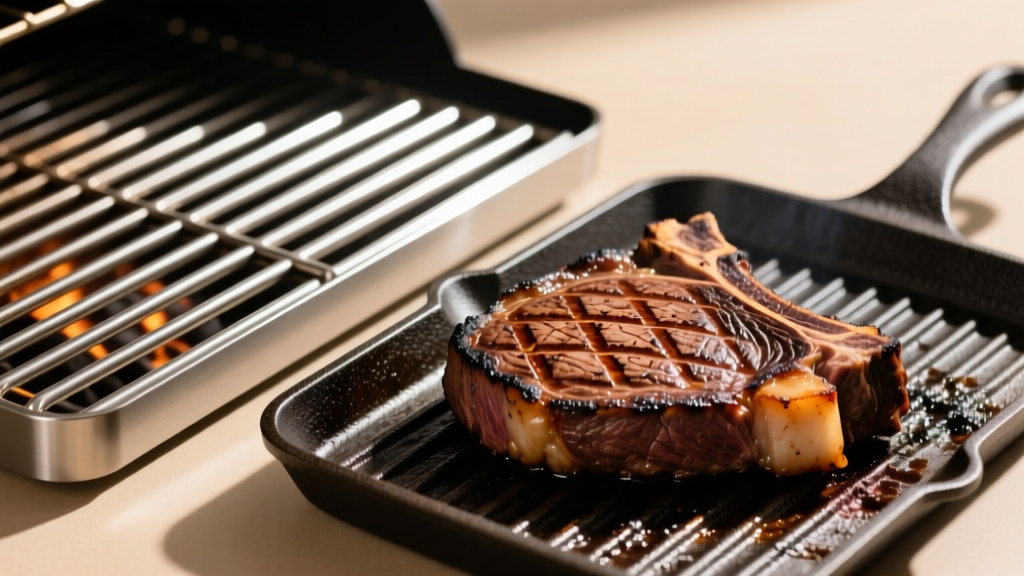
Engineering Matrix: Performance & Failure Data
| Material | Thermal Conductivity (W/m·K) | Max Continuous Temp (°F) | Primary Failure Mode | Est. Cost (Standard Set, 2026) |
|---|---|---|---|---|
| Heavy Cast Iron | ~52.0 | 1,200+ | Oxidation, Thermal Shock Cracking | $45 - $75 |
| 304 Stainless (7mm+) | ~16.2 | 1,500+ | Thermal Warping (if under-gauged) | $90 - $140 |
| 430 Stainless | ~26.1 | 1,200 | Intergranular Corrosion, Scaling | $40 - $60 |
| Porcelain-Enameled Steel | ~45.0 (Core) | 800 (Coating Limit) | Spalling, Substrate Rusting | $50 - $85 |
Structural Deflection and Gauge Tolerances
Material selection is only half the engineering equation; structural geometry dictates longevity. When metals are heated to 600°F, they expand. If the grate lacks sufficient mass or cross-sectional thickness, the differential expansion between the hot center and cooler edges causes plastic deformation (warping).
- Stainless Steel Rods: Must be a minimum of 7mm (0.275 inches) in diameter. Rods thinner than 5mm will inevitably warp under the weight of heavy proteins like bone-in ribeyes or whole poultry, causing the grate to bind in the grill's firebox rails.
- Cast Iron Fins: Should feature a minimum thickness of 6mm at the top crest. Thinner fins are prone to snapping under mechanical stress from aggressive wire brushing.
- Weld Points: For multi-piece stainless grates, inspect the cross-support welds. TIG-welded joints with full penetration will withstand thermal cycling, whereas cheap spot-welds will fracture after two to three seasons of high-heat use.
Maintenance Chemistry: Preventing Oxidation
Proper maintenance extends the lifecycle of your chosen alloy by mitigating environmental degradation. The approach varies strictly by material:
Bare Cast Iron & Carbon Steel
Never use soap or water for routine cleaning, as this strips the polymerized lipid layer and introduces flash-rust conditions. Instead, utilize thermal pyrolysis: heat the grill to 500°F for 15 minutes to carbonize food residue, then brush with a stiff brass or stainless coil brush. Immediately apply a micro-thin layer of high-iodine oil (like grapeseed or flaxseed) to re-cross-link the polymer surface before storage.
304/316 Stainless Steel
Stainless steel requires no polymerization, but it does require passivation maintenance. Over time, carbon buildup and iron particles from grill brushes can embed in the surface, creating galvanic cells that lead to localized pitting. Clean the grates with a dedicated stainless steel alkaline degreaser or a paste of baking soda and water. Avoid chloride-based cleaners (like bleach or harsh oven cleaners), as chloride ions aggressively attack the chromium oxide passivation layer, causing irreversible pitting.
Porcelain-Enameled Surfaces
Avoid metal scraping tools entirely. Use nylon-bristle brushes or wooden grill scrapers to remove carbonized debris. If food is heavily baked on, allow the grate to cool completely and soak in warm water with a mild, non-abrasive detergent. Never subject a hot porcelain grate to cold water; the resulting thermal shock (rapid contraction of the metal core against the rigid glass coating) will cause immediate micro-fracturing and eventual spalling.
Final Specification Recommendation
For competition pitmasters and users prioritizing maximum heat retention and traditional sear marks, heavy cast iron remains the optimal choice, provided the user commits to the polymerization maintenance cycle. For residential users seeking a balance of excellent searing, zero rust risk, and low maintenance, 7mm (or thicker) 304 stainless steel is the definitive best material for BBQ grill grates, offering decades of structural integrity without the fragility of porcelain or the oxidation risks of bare iron.
Written by
James ThorntonJames Thornton is a construction industry veteran with 25 years of hands-on experience in wood framing, lumber grading, and residential building codes. He started as a framing carpenter in rural Oregon, earned his ICC Residential Building Inspector certification, and eventually became a senior plan reviewer for the City of Portland Bureau of Development Services. James holds a B.S. in Wood Science & Technology from Oregon State University and is a certified lumber grader through the West Coast Lumber Inspection Bureau (WCLIB). He has inspected over 3,000 residential construction sites and authored the city's internal guide on advanced framing techniques (2x6 at 24" O.C.). James lives in Bend, OR, where he builds custom timber-frame cabins and competes in lumberjack sports.
More from James Thornton
View all
Insulation
Best Home Insulation Materials: Complete 2026 Guide
Compare top home insulation materials for 2026. Find R-values, installed costs per square foot, and best uses for fiberglass, spray foam, and mineral wool.
Aug 4, 2026

Sustainable Building
Certify Your Green Building Material for LEED and WELL
Step-by-step guide to certifying a green building material for LEED v5 and WELL v2. Master EPDs, HPDs, and VOC limits for 2026 project specifications.
Aug 4, 2026

Stone & Masonry
Veneer Stacked Stone Panels: Interior Design & Style Showcase
Discover how veneer stacked stone panels transform interiors. Explore modern design profiles, material pairings, and technical installation specs.
Aug 4, 2026