Sourcing Hyde Park Building-Material Supplies: 2026 Guide
Discover best practices for sourcing Hyde Park building-material supplies in 2026. Learn local logistics, historic compliance, and top vendor strategies.

The Unique Landscape of Hyde Park Construction
Sourcing materials for construction in the Hudson Valley requires navigating a complex intersection of historic preservation, rural logistics, and strict environmental codes. When evaluating Hyde Park building-material supplies, contractors and homeowners must account for the area's specific architectural heritage—ranging from pre-1920s masonry estates near the Vanderbilt corridor to modern infill builds along Route 9G. Unlike standard suburban developments, Hyde Park projects frequently demand specialized material grades, precise aesthetic matching, and strategic delivery scheduling to avoid local infrastructure bottlenecks.
The 2026 construction landscape in Dutchess County has seen a stabilization in softwood lumber pricing, but specialized masonry and custom millwork continue to face extended lead times due to regional kiln closures and artisan labor shortages. Understanding where to source specific material categories—and how to transport them to constrained job sites—is the primary differentiator between a profitable build and one plagued by change orders and municipal delays.
Evaluating Hyde Park Building-Material Supplies: Vendor Matrix
Relying on a single supplier for a mixed-scope project in Hyde Park is a critical error. The most efficient procurement strategy involves a bifurcated approach: utilizing regional big-box centers for high-volume, standardized commodities, while leveraging local specialty yards for historically accurate and climate-specific materials. Below is a strategic breakdown of supply channels available to Hudson Valley contractors in 2026.
| Supplier Profile | Best Material Categories | Typical Lead Time | Pricing Tier |
|---|---|---|---|
| Local Independent Lumberyard (Route 9 Corridor) | Custom millwork, cedar siding, specialized structural fasteners | 3–7 Days | Premium (+12-18%) |
| Regional Big Box Pro Desk (Poughkeepsie/Kingston) | Bulk SPF framing, 5/8" Type X drywall, standard fiberglass batts | Same Day / 24 Hrs | Baseline Market |
| Hudson Valley Specialty Masonry Supply | NHL lime mortars, matching clay pavers, natural stone veneer | 2–4 Weeks | Specialty / Custom |
| Direct-from-Mill Timber Framers | Heavy timber beams, rough-sawn oak, architectural glulam | 4–8 Weeks | High Premium |
According to recent National Association of Home Builders (NAHB) supply chain reports, regional distributors have heavily invested in localized inventory buffers for standard commodities, but specialty historic materials remain highly susceptible to global shipping delays. Securing masonry and custom millwork deposits at least 60 days prior to the framing phase is now an industry standard for Hudson Valley project managers.
Logistics and Delivery Best Practices
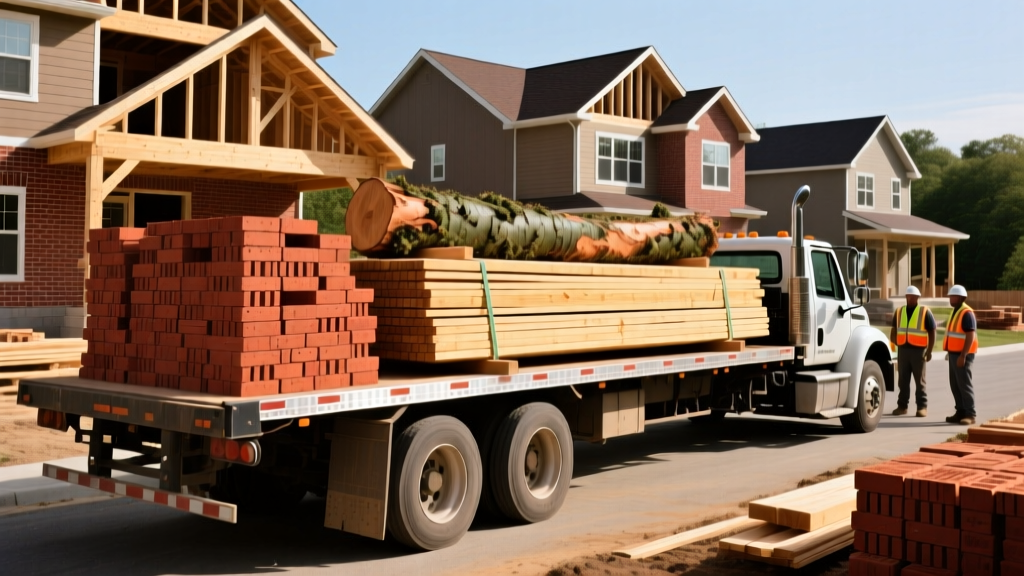
The physical geography and municipal infrastructure of Hyde Park dictate strict logistical parameters. Delivering a 53-foot flatbed loaded with 40,000 lbs of masonry block to a residential infill lot off Route 9G is a recipe for damaged property and stranded freight. Implement the following delivery protocols to ensure materials arrive safely and on schedule.
- Verify Spring Thaw Weight Restrictions: Dutchess County enforces seasonal weight restrictions on secondary roads during the spring thaw (typically March 1 to April 15). Full tractor-trailer loads are often prohibited during this window. Schedule heavy material deliveries—like concrete foundations, bulk gravel, or palletized brick—either before late February or after mid-April to avoid requiring expensive tri-axle split-loads.
- Specify Moffett Forklift Delivery: Many historic properties in Hyde Park feature long, narrow driveways with tight turning radii and overhead tree canopies that prevent standard boom-truck access. Always specify a truck-mounted Moffett forklift for lumber and roofing deliveries. This allows the driver to unload the truck on the main road and navigate the pallets directly to the staging area without damaging landscaping or requiring a secondary telehandler rental.
- Stage on Gravel, Not Topsoil: The Hudson Valley experiences heavy seasonal precipitation. Staging drywall, insulation, or untreated lumber directly on topsoil guarantees moisture wicking and mold growth within 48 hours. Require suppliers to deliver dunnage (4x4 timber blocks) with every load, or prepare a crushed-stone staging pad before the first framing package arrives.
- Coordinate Crane Lifts for Historic Retrofits: When replacing slate roofs or installing heavy structural steel in tight historic village centers, street closures require a minimum 30-day lead time with the local highway department. Material delivery must be timed exactly with the crane mobilization window, as laydown space on adjacent properties is rarely available.
Material Spotlight: Masonry and Lumber in the Hudson Valley
Choosing the correct material specifications is not just a matter of code compliance; it is critical for the long-term structural integrity of buildings in Hyde Park's specific microclimate. The freeze-thaw cycles of the Hudson Valley, combined with the area's historic building stock, demand precise material selection.
Historic-Grade Masonry and Type O Mortar
Hyde Park is home to numerous pre-1920s brick and stone structures. When repointing or expanding these buildings, using modern, high-strength Portland cement mortars is a catastrophic mistake. Standard Type N or Type S mortars possess compressive strengths exceeding 2,600 psi. When applied to softer, historic clay bricks, the rigid mortar prevents natural thermal expansion, forcing the brick faces to spall and crack during winter freeze-thaw cycles.
Best practice dictates the use of a Type O mortar (approx. 350 psi) or a custom NHL 3.5 (Natural Hydraulic Lime) blend. As outlined in the National Park Service Preservation Brief 2 on Repointing Mortar Joints, the mortar must always be softer and more permeable than the masonry unit it surrounds. Source your NHL lime from specialized masonry suppliers in the Northeast, as standard big-box yards do not carry historically appropriate, low-cement lime putties.
Framing Lumber Specifications for Local Snow Loads
For exterior framing and roof trusses, the 2026 ground snow load requirement for Dutchess County sits at 35 psf (pounds per square foot) based on ASCE 7-22 standards, as referenced in FEMA Building Science Publications regarding regional load mapping. To meet these structural demands without over-engineering the budget, specify #2 Grade or better SPF (Spruce-Pine-Fir) for wall studs and joists.
Avoid #3 grade lumber entirely for structural applications in this region. #3 grade exhibits excessive wane (bark edges) and large knot sizes that severely compromise joist shear capacity under heavy snow loads. For exposed architectural elements, such as timber frame porches or pergolas, specify Coastal Douglas Fir or Western Red Cedar. While SPF will rot quickly if exposed to Hudson Valley humidity, Douglas Fir offers superior natural decay resistance and dimensional stability for semi-exposed structural applications.
Upon delivery of interior millwork and hardwood flooring, immediately verify the moisture content using a pinless moisture meter. Lumber stored in unheated Hyde Park warehouses during January will typically read 9-11% moisture content. If installed directly over running radiant floor heating without a 7-day acclimation period in the climate-controlled interior, the wood will rapidly dry to 6%, resulting in severe cupping and joint separation.
Frequently Asked Questions
- Do I need a permit to store building materials on the street in Hyde Park?
Yes. If your delivery requires placing materials (like dumpsters, lumber packages, or scaffolding) on the public right-of-way or blocking a sidewalk, you must obtain a Right-of-Way Permit from the local highway or zoning department at least two weeks in advance. - Where can I source matching slate for historic roof repairs?
- Are there local recycling mandates for construction debris?
Dutchess County has strict solid waste management regulations. Asphalt shingles, clean gypsum, and untreated wood must be separated and taken to designated recycling facilities rather than the standard municipal landfill. Factor the cost of multiple sorted dumpsters into your initial material logistics budget. - Are there local recycling mandates for construction debris?
Written by
Sarah WhitfieldSarah Whitfield is a chartered quantity surveyor (MRICS) and construction cost analyst with 15 years of experience in material pricing, procurement strategy, and project budgeting. She earned her degree in Construction Management from the University of Reading (UK) and has worked on projects ranging from $2M custom homes to $180M mixed-use developments across North America and Europe. Sarah currently leads cost estimating for BuildMat Insight, maintaining a proprietary database of 4,000+ material price points updated quarterly. She is a frequent contributor to RSMeans cost data panels and has presented at the International Cost Engineering Council (ICEC) congress. Based in Denver, CO, Sarah is an avid trail runner and volunteer mentor for Women in Construction.
More from Sarah Whitfield
View all
Wood & Lumber
What Are the Different Types of Wood? A Builder's Guide
Compare structural softwoods, finish hardwoods, and engineered lumber. Analyze Janka ratings, MOE values, and 2026 pricing for construction.
Aug 4, 2026

Walls & Panels
Steel Framing vs Wood Framing: Corrosion and Moisture Defense
Compare steel framing vs wood framing for moisture resistance. Learn about galvanized coatings, condensation risks, and corrosion protection strategies.
Jul 21, 2026

Stone & Masonry
How to Cut Stone Veneer: Wet Saw vs Grinder Comparison
Compare the best tools for cutting stone veneer. We review wet saws, angle grinders, and chop saws to help you achieve clean, chip-free cuts.
Jul 21, 2026