Finding the Best Material for Guitar Picks: A Material Science Review
Discover the best material for guitar picks through a material science lens. Compare celluloid, Delrin, Ultem, and metal for tone, durability, and friction.

The Tribology and Acoustics of Plectrum Design
When evaluating the best material for guitar picks, most consumer reviews focus on subjective 'feel' or vague tonal descriptors. From a materials science and acoustic engineering perspective, however, a plectrum is a complex transducer interface. The material dictates the attack transient, the coefficient of friction against nickel-plated steel or bronze strings, and the mechanical damping of high-frequency overtones. For acoustic studio builders, luthiers, and serious instrumentalists, understanding the polymer physics and metallurgy behind these small tools is critical for optimizing tracking environments and minimizing unwanted string noise.
The interaction between a pick and a string is governed by tribology—the study of friction, wear, and lubrication. A material with a high static friction coefficient will 'grab' the string, producing a pronounced, percussive attack but generating excessive surface wear. Conversely, materials with high self-lubricity glide off the string, facilitating high-speed articulation but often sacrificing low-end harmonic complexity. In 2026, advancements in polymer compounding and CNC micro-machining have expanded the available material matrix far beyond traditional celluloid, requiring a rigorous, data-driven approach to material selection.
Thermoplastic Polymers: The Industry Standard
The vast majority of mass-produced picks are die-stamped or injection-molded from thermoplastic polymers. These materials offer an optimal balance of flexibility, tensile strength, and manufacturing scalability.
Celluloid (Nitrocellulose and Camphor)
Introduced in the early 20th century as an ivory substitute, celluloid remains a benchmark material. It is not a true polymer but a plasticized natural polymer, typically consisting of roughly 70% nitrocellulose and 30% camphor. The camphor acts as a plasticizer, yielding a Shore D hardness of approximately 80. Celluloid is prized for its high-friction 'grip' and warm, mid-focused acoustic profile. However, it suffers from severe mechanical limitations: it is highly susceptible to UV degradation, outgasses camphor over time (leading to brittleness), and exhibits a high wear rate when used with aggressive down-picking techniques on heavy-gauge strings.
Polyoxymethylene (POM / Delrin)
When players seek the best material for guitar picks that balances durability with low friction, Polyoxymethylene (POM) is the premier choice. Marketed by DuPont as Delrin, this acetal homopolymer features a highly crystalline structure that provides exceptional stiffness and a remarkably low coefficient of friction (typically between 0.1 and 0.2 against steel). Delrin picks, such as the industry-standard Tortex line (which utilizes a proprietary POM blend), exhibit a Shore D hardness of 83 to 85. The material's low surface energy means it releases from the string almost instantaneously, reducing pick drag and making it the dominant choice for high-tempo alternate picking and complex syncopation.
Polyetherimide (PEI / Ultem)
For maximum rigidity and high-frequency clarity, Polyetherimide (PEI), widely known by SABIC's trade name Ultem, is unmatched. Originally engineered for aerospace and high-heat medical applications, Ultem boasts a tensile strength of 105 MPa and a continuous use temperature exceeding 170°C. In plectrum form, this translates to an incredibly stiff, unyielding pick that transfers nearly 100% of the kinetic energy directly into the string without mechanical damping. The resulting tone is exceptionally bright, articulate, and rich in upper-order harmonics, making it highly favored by technical metal guitarists and mandolin players who require precise note separation.
Material Property Comparison Matrix
The following data table synthesizes the mechanical properties of the most common pick materials, tested under standard ASTM D638 tensile conditions and standardized tribological friction models.
| Material | Shore D Hardness | Tensile Strength (MPa) | Friction Coeff. (vs Steel) | Primary Acoustic Profile |
|---|---|---|---|---|
| Celluloid | 80 | 48 | 0.35 - 0.45 | Warm, compressed, percussive attack |
| Nylon (Polyamide) | 75 - 82 | 70 - 85 | 0.25 - 0.30 | Dark, malleable, low high-end transient |
| Delrin (POM) | 83 - 85 | 65 - 70 | 0.10 - 0.20 | Balanced, articulate, low drag |
| Acrylic (PMMA) | 85 - 90 | 70 | 0.40 - 0.50 | Bright, glassy, high-mass transient |
| Ultem (PEI) | 90 - 92 | 105 | 0.25 - 0.35 | Hyper-articulate, stiff, high-frequency rich |
| Brass (Alloy 260) | N/A (Rockwell B 55) | 395 | 0.30 - 0.40 | Metallic, extreme sustain, harsh overtones |
High-Density and Rigid Alternatives
Beyond standard thermoplastics, the market for boutique and specialized picks includes rigid polymers and metals. Acrylic (Polymethyl Methacrylate or PMMA) is frequently CNC-machined into thick, beveled picks (often 3.0mm to 6.0mm). Because acrylic is highly brittle and lacks the crystalline slip planes of POM, it produces a massive, glassy attack transient that excels in heavy, down-tuned rhythm playing where the pick must not flex under high string tension.
Metal picks, typically milled from brass, stainless steel, or titanium, introduce complex electromagnetic variables. While they offer infinite durability and a unique scraping texture, using a ferromagnetic or highly conductive metal pick near single-coil or high-output humbucking pickups induces localized eddy currents. This interaction subtly alters the magnetic field of the pickup, often resulting in a slight attenuation of high frequencies and an increase in electromagnetic interference (EMI) noise floor—a critical consideration when designing the isolation shielding in a professional recording studio control room.
'The choice of plectrum material is the first stage of the acoustic signal chain. A highly damped material like nylon will absorb high-frequency kinetic energy before it ever reaches the guitar's tonewood or the pickup's magnetic field, fundamentally altering the EQ curve at the source.'
Application-Specific Decision Framework
Selecting the best material for guitar picks requires aligning the material's mechanical properties with the specific biomechanical demands of the playing style. Use the following framework to specify the correct material for your application:
Strumming and Rhythm (Acoustic & Electric)
Recommended Material: Celluloid or Nylon (0.60mm - 0.88mm)
Rationale: The lower Shore D hardness and higher flexibility allow the pick to glide across multiple strings without catching, reducing wrist fatigue. The higher friction coefficient of celluloid adds a desirable 'pick click' percussive element that cuts through dense acoustic mixes.
High-Speed Alternate Picking & Shredding
Recommended Material: Delrin / POM (0.73mm - 1.00mm)
Rationale: The ultra-low coefficient of friction is non-negotiable for minimizing string drag at high BPMs. Delrin's high stiffness-to-weight ratio ensures the pick returns to its neutral position instantly after string release, maintaining tight rhythmic synchronization.
Technical Metal, Djent, and Precision Bass
Recommended Material: Ultem / PEI or Acrylic (1.00mm - 3.00mm+)
Rationale: When playing heavily distorted, down-tuned riffs, pick flex introduces micro-timing inaccuracies and muddy transients. Ultem's 105 MPa tensile strength provides zero flex, ensuring the exact millisecond of string contact is translated to the amplifier with maximum high-frequency clarity and aggressive attack.
Manufacturing Tolerances and Edge Profiling
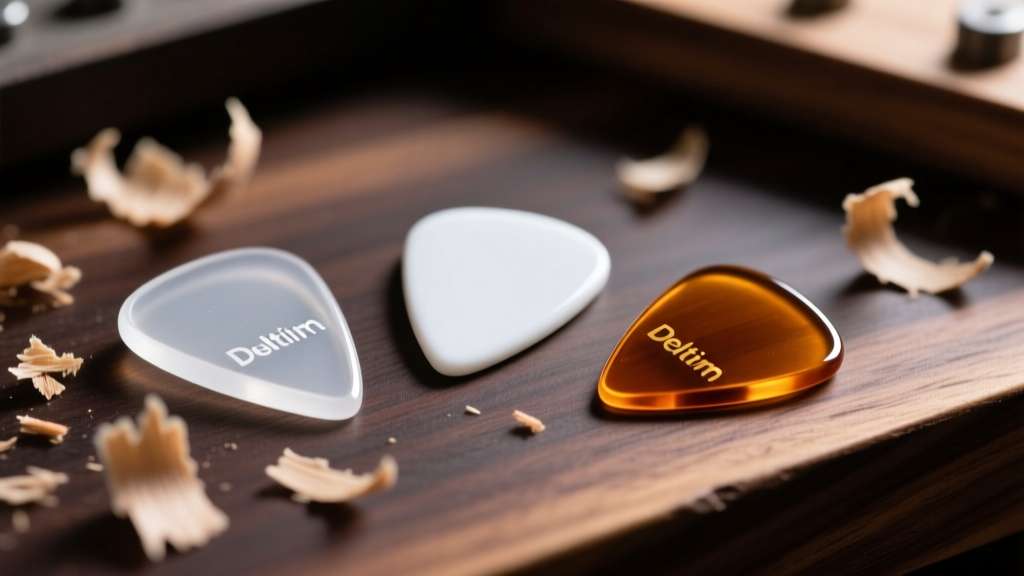
Material selection is only half the equation; the manufacturing process dictates the final edge geometry, which profoundly impacts string release. Die-stamped picks (common for celluloid and Delrin) are punched from extruded sheets, leaving a microscopic burr or rounded edge that requires a break-in period. In contrast, modern CNC-machined picks (common for Acrylic, Ultem, and metals) allow for precise edge profiling. A 45-degree speed bevel reduces the surface area contacting the string, effectively lowering the dynamic friction regardless of the base material's inherent tribological properties. When sourcing picks for professional tracking sessions in 2026, specifying CNC-machined edges with a mirror polish on high-friction materials like Ultem provides the optimal balance of grip and release.
Environmental and Longevity Considerations
From a sustainability and lifecycle perspective, thermoset plastics and metals offer distinct advantages over traditional celluloid. Celluloid is highly flammable and degrades rapidly, contributing to microplastic dust in studio environments. Delrin and Ultem, while derived from petrochemicals, possess wear rates so low that a single 1.0mm Ultem pick can outlast dozens of celluloid equivalents, reducing overall material consumption. For eco-conscious builders and musicians, bio-based polymers and sustainably harvested hardwoods (like Lignum Vitae) are emerging as viable, albeit acoustically darker, alternatives that minimize reliance on volatile organic compounds (VOCs) inherent in traditional plasticizer-heavy manufacturing.
Written by
James ThorntonJames Thornton is a construction industry veteran with 25 years of hands-on experience in wood framing, lumber grading, and residential building codes. He started as a framing carpenter in rural Oregon, earned his ICC Residential Building Inspector certification, and eventually became a senior plan reviewer for the City of Portland Bureau of Development Services. James holds a B.S. in Wood Science & Technology from Oregon State University and is a certified lumber grader through the West Coast Lumber Inspection Bureau (WCLIB). He has inspected over 3,000 residential construction sites and authored the city's internal guide on advanced framing techniques (2x6 at 24" O.C.). James lives in Bend, OR, where he builds custom timber-frame cabins and competes in lumberjack sports.
More from James Thornton
View all
Insulation
Best Home Insulation Materials: Complete 2026 Guide
Compare top home insulation materials for 2026. Find R-values, installed costs per square foot, and best uses for fiberglass, spray foam, and mineral wool.
Aug 4, 2026

Sustainable Building
Certify Your Green Building Material for LEED and WELL
Step-by-step guide to certifying a green building material for LEED v5 and WELL v2. Master EPDs, HPDs, and VOC limits for 2026 project specifications.
Aug 4, 2026

Stone & Masonry
Veneer Stacked Stone Panels: Interior Design & Style Showcase
Discover how veneer stacked stone panels transform interiors. Explore modern design profiles, material pairings, and technical installation specs.
Aug 4, 2026