Designing a Fiber Optic Materials Research Building: Best Practices
Learn best practices for designing a fiber optic materials research building, covering vibration control, ISO cleanrooms, and hazardous chemical exhaust.

Structural Foundation and Vibration Isolation
Constructing a fiber optic materials research building requires mitigating micro-vibrations that can disrupt nanometer-scale interferometry, fiber Bragg grating inscription, and preform drawing. Standard commercial slabs are insufficient. The facility must be designed around stringent Vibration Criterion (VC) curves, specifically targeting VC-E (1.56 µm/s) or VC-F (0.78 µm/s) for the most sensitive optical testing labs.
To achieve VC-F compliance, the architectural foundation must utilize an 18-inch to 24-inch post-tensioned concrete waffle slab, completely isolated from the main building superstructure using neoprene or fiberglass isolation pads. For optical tables housing Mach-Zehnder interferometers or near-field scanning optical microscopes (NSOM), active pneumatic isolation pedestals are mandatory. These pedestals must be anchored directly to the isolated waffle slab, bypassing the finished floor entirely to prevent foot-traffic induced resonance.
Design Insight: Never place heavy mechanical equipment (like HVAC chillers or vacuum pumps) on the same structural block as the optical labs. Utilize a 'building-within-a-building' structural approach, separating the lab core from the mechanical penthouse and service corridors via structural expansion joints.
Cleanroom Classifications by Manufacturing Process
Fiber optic material development involves multiple distinct processes, each with varying particulate sensitivity. A monolithic cleanroom approach wastes energy and capital. Instead, segment the facility based on the specific contamination risks of each manufacturing phase, adhering to ISO 14644-1 cleanroom standards.
| Process Step | Required ISO Class | Primary Contamination Risk | Airflow Strategy |
|---|---|---|---|
| Preform Fabrication (MCVD/OVD) | ISO Class 7 (Class 10,000) | Airborne dust altering refractive index profiles | Unidirectional laminar flow at 0.45 m/s |
| Fiber Drawing Tower Operations | ISO Class 5 (Class 100) | Micro-particulates causing cladding micro-bends and scattering losses | Vertical laminar flow HEPA ceiling grid |
| Coating and Buffering Application | ISO Class 8 (Class 100,000) | Dust inclusions in UV-cured acrylate coatings | Non-unidirectional turbulent flow with high ACH |
| Interferometric & Photonic Testing | ISO Class 6 (Class 1,000) | Particulates on lens surfaces or fiber end-faces | Laminar flow benches within a controlled anteroom |
For the fiber drawing towers, which often exceed 15 meters in height, the cleanroom must accommodate multi-story vertical shafts. Use computational fluid dynamics (CFD) modeling during the design phase to ensure that the thermal buoyancy from the 2000°C silica furnace does not disrupt the downward laminar HEPA airflow, which could otherwise draw unfiltered air into the critical neck-down region.
Hazardous Chemical Containment and Exhaust
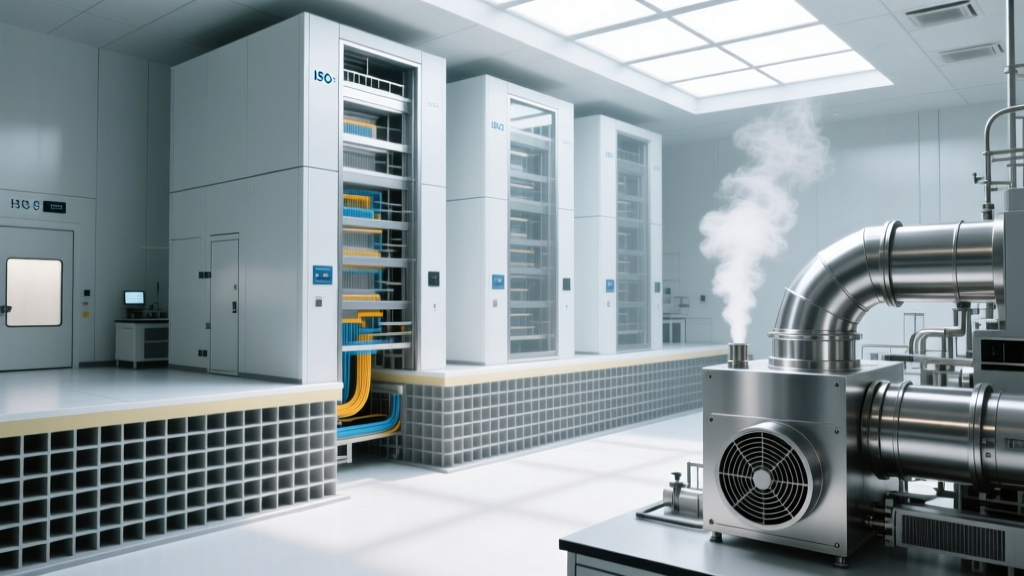
The synthesis of silica preforms via Modified Chemical Vapor Deposition (MCVD) or Vapor-phase Axial Deposition (VAD) relies on highly toxic and corrosive precursor gases and liquids. These include silicon tetrachloride (SiCl4), germanium tetrachloride (GeCl4), phosphorus oxychloride (POCl3), and hydrofluoric acid (HF) used for quartz tube etching.
Critical Safety Requirement: Hydrofluoric acid (HF) poses severe systemic toxicity risks and penetrates tissue rapidly. Exhaust systems handling HF fumes must never use standard galvanized or stainless steel ductwork, which will corrode and fail. Mandate the use of flame-retardant polyvinylidene fluoride (PVDF) or high-density polypropylene (PP) ductwork, coupled with continuous wet-scrubber systems utilizing calcium hydroxide to neutralize fluoride ions before atmospheric release, in strict compliance with OSHA laboratory safety standards.
Furthermore, SiCl4 and GeCl4 react violently with ambient moisture to form dense, corrosive hydrochloric acid mists. The exhaust system must maintain a minimum duct transport velocity of 3,000 feet per minute (fpm) to prevent particulate settling. Install redundant exhaust fans with automated failover and static pressure sensors to ensure negative pressure is never lost within the chemical fume hoods or gloveboxes used for precursor handling.
Thermal Stability and Precision HVAC
Optical measurements, particularly those involving wavelength division multiplexing (WDM) filter characterization and optical time-domain reflectometry (OTDR), are highly susceptible to thermal drift. A temperature fluctuation of just 1°C can alter the refractive index of the testing environment and cause mechanical expansion in optical mounts, ruining phase-sensitive measurements.
- Delta-T Requirements: Testing laboratories must maintain a strict temperature tolerance of ±0.1°C (±0.18°F). Standard commercial CRAC (Computer Room Air Conditioning) units, which typically swing ±1.5°C, are unacceptable.
- Chilled Water Valves: Utilize 3-way modulating chilled water valves with high-resolution actuators (0-10V control signals) paired with PID controllers tuned for minimal overshoot.
- Humidity Control: Maintain relative humidity (RH) at 45% ±3%. High humidity risks condensation on chilled optical surfaces, while low humidity increases electrostatic discharge (ESD) risks, which can destroy sensitive photodetectors and indium phosphide (InP) laser diodes.
- Airflow Management: Implement a displacement ventilation strategy. Supply conditioned air through low-velocity perforated floor tiles and extract it at the ceiling level to sweep heat loads away from the optical benches without creating turbulent drafts that induce micro-vibrations.
For comprehensive mechanical design parameters, facility engineers should reference the laboratory ventilation chapters outlined in the ASHRAE HVAC Applications handbook, specifically adapting the high-precision metrology guidelines for the optical testing wings.
EMI Shielding and Power Quality
Advanced photonics research frequently involves detecting single-photon events or measuring ultra-low noise signals from avalanche photodiodes (APDs). These measurements are easily corrupted by electromagnetic interference (EMI) from variable frequency drives (VFDs), elevator motors, or external RF broadcasts.
Construct a localized Faraday cage around the most sensitive dark-rooms using continuous copper mesh embedded in the drywall or specialized EMI-shielding architectural panels. Ensure all penetrations for HVAC and plumbing are fitted with waveguide-beyond-cutoff vents and EMI gaskets. Electrically, the facility requires a dedicated, isolated ground (IG) system separate from the building's main structural ground. Power conditioning units with active harmonic filtering must be installed upstream of the lab panels to eliminate voltage sags and harmonic distortion generated by the building's heavy mechanical loads.
Written by
Sarah WhitfieldSarah Whitfield is a chartered quantity surveyor (MRICS) and construction cost analyst with 15 years of experience in material pricing, procurement strategy, and project budgeting. She earned her degree in Construction Management from the University of Reading (UK) and has worked on projects ranging from $2M custom homes to $180M mixed-use developments across North America and Europe. Sarah currently leads cost estimating for BuildMat Insight, maintaining a proprietary database of 4,000+ material price points updated quarterly. She is a frequent contributor to RSMeans cost data panels and has presented at the International Cost Engineering Council (ICEC) congress. Based in Denver, CO, Sarah is an avid trail runner and volunteer mentor for Women in Construction.
More from Sarah Whitfield
View all
Wood & Lumber
What Are the Different Types of Wood? A Builder's Guide
Compare structural softwoods, finish hardwoods, and engineered lumber. Analyze Janka ratings, MOE values, and 2026 pricing for construction.
Aug 4, 2026

Walls & Panels
Steel Framing vs Wood Framing: Corrosion and Moisture Defense
Compare steel framing vs wood framing for moisture resistance. Learn about galvanized coatings, condensation risks, and corrosion protection strategies.
Jul 21, 2026

Stone & Masonry
How to Cut Stone Veneer: Wet Saw vs Grinder Comparison
Compare the best tools for cutting stone veneer. We review wet saws, angle grinders, and chop saws to help you achieve clean, chip-free cuts.
Jul 21, 2026