Technical Specs for Building with Reclaimed Materials
Master the technical specifications for building with reclaimed materials. Learn grading, moisture limits, and load-bearing standards for safe construction.

Engineering Tolerances for Reclaimed Structural Materials
Integrating salvaged components into modern structural frameworks requires moving beyond aesthetic appreciation to rigorous material science. While the Environmental Protection Agency (EPA) heavily promotes the diversion of construction and demolition (C&D) debris, the structural reuse of these materials demands strict adherence to engineering tolerances. Reclaimed wood, masonry, and steel exhibit variable mechanical properties shaped by decades of environmental exposure, original manufacturing inconsistencies, and deconstruction stresses. This guide details the exact technical specifications, testing protocols, and compatibility matrices required for building with reclaimed materials in load-bearing and critical envelope applications.
Dimensional Lumber and Heavy Timber Specifications
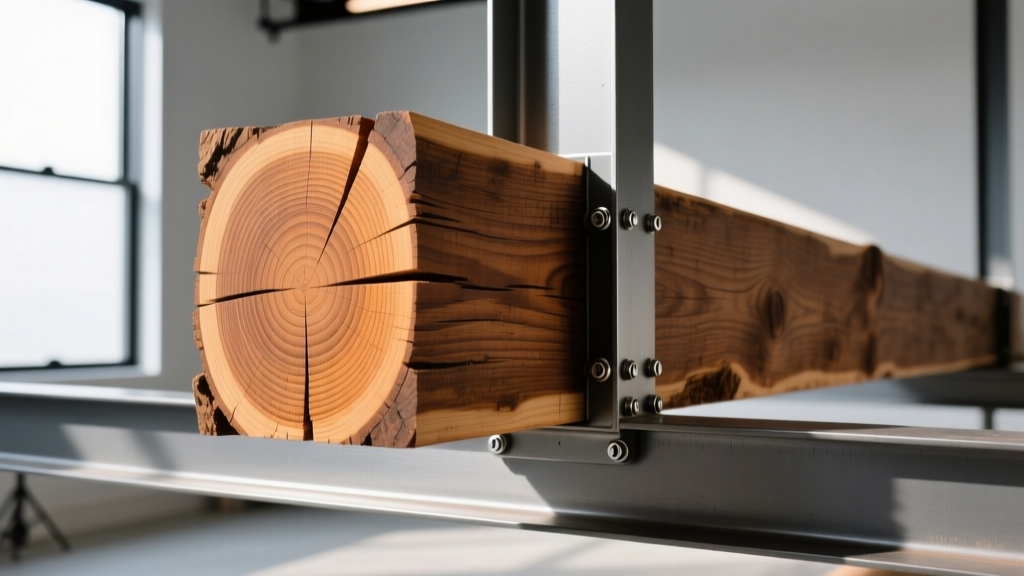
Reclaimed timber—particularly old-growth Douglas Fir, Longleaf Heart Pine, and White Oak—offers superior density and dimensional stability compared to modern plantation-grown lumber. However, verifying its structural integrity requires precise moisture management and grading protocols.
Moisture Content and Acclimation Tolerances
Surface moisture readings are insufficient for reclaimed heavy timber. The core moisture content (MC) can lag behind the shell by months. For interior conditioned spaces, the target Equilibrium Moisture Content (EMC) is 8% to 12%. For exterior or unconditioned applications, the maximum allowable MC is 19%.
- Testing Protocol: Use a pin-type moisture meter with insulated electrodes (e.g., Delmhorst J-2000 or Lignomat Ligno-VersaTec). Insulated pins ensure readings are taken at the beam's core (typically 2 to 3 inches deep for 8x8 timbers) rather than the dry surface shell.
- Acclimation Timeframe: Kiln-drying reclaimed timber to 12% MC typically requires 4 to 6 weeks in a dehumidification kiln operating at 110°F to 120°F. Air-drying dense heart pine can take 12 to 18 months per inch of thickness.
Grading Standards and Load-Bearing Capacity
Reclaimed timber cannot be visually graded using standard new-lumber rules without accounting for historical checks, splits, and nail holes. The American Wood Council (AWC) and the Western Wood Products Association (WWPA) provide guidelines for re-grading. Timber must be re-sawn or surfaced (S4S) to remove surface degradation before visual grading or mechanical stress rating (MSR). For structural beams, specify a minimum bending design value (Fb) of 1,200 psi for reclaimed Douglas Fir and 1,400 psi for Longleaf Heart Pine, assuming a Select Structural grade post-milling.
Reclaimed Masonry and Brick Load-Bearing Limits
Salvaged brick presents unique compressive and chemical challenges. Pre-1930s brick was often fired in clamp kilns, resulting in high variability in hardness and compressive strength within the same batch. When building with reclaimed materials like masonry, matching the mortar to the brick's compressive yield is critical to prevent spalling.
Compressive Strength and ASTM Classifications
According to Brick Industry Association (BIA) Technical Notes, modern hard brick routinely exceeds 8,000 psi in compressive strength. In contrast, reclaimed interior-grade soft brick often tests between 2,000 and 3,500 psi. Using modern, high-Portland cement mortars (Type S or Type N) on soft reclaimed brick traps moisture and transfers structural stress directly to the weaker brick unit during freeze-thaw cycles, causing the brick face to sheer off.
| Brick Era / Type | Avg. Compressive Strength | Required Mortar Type (ASTM C270) | Mortar Mix Ratio (Cement:Lime:Sand) |
|---|---|---|---|
| Pre-1900 Soft Brick | 1,500 - 2,500 psi | Type K or Type O | 1 : 3 : 10 (Type K) / 1 : 2 : 9 (Type O) |
| 1900-1940 Common Brick | 3,000 - 5,000 psi | Type O or Type N | 1 : 2 : 9 (Type O) / 1 : 1 : 6 (Type N) |
| Post-1950 Hard Brick | 6,000 - 10,000+ psi | Type N or Type S | 1 : 1 : 6 (Type N) / 1 : 0.5 : 4.5 (Type S) |
Structural Steel and Hardware Reuse
Reusing structural steel I-beams and heavy hardware requires verifying the alloy composition and fracture toughness. Historical steel (pre-1960s) often lacks modern Charpy V-notch toughness ratings, making it susceptible to brittle fracture under dynamic or seismic loading.
AISC Guidelines for Unknown Alloys
When original mill certificates are unavailable, the American Institute of Steel Construction (AISC) Design Guide 15 mandates conservative baseline assumptions. Unmarked historical steel is typically assumed to have a minimum yield strength (Fy) of 24 ksi to 33 ksi, compared to the 50 ksi standard of modern ASTM A992 steel.
"Never weld reclaimed structural steel without prior metallurgical testing. High carbon content in early 20th-century steel can cause heat-affected zone (HAZ) cracking during standard SMAW or GMAW welding processes."
If welding is required, specify a low-hydrogen electrode (e.g., E7018) and mandate pre-heating the steel to 200°F–250°F to slow the cooling rate and prevent martensite formation in the weld zone.
Fastener and Connector Compatibility Matrix
Reclaimed wood, particularly oak and heart pine, contains high concentrations of tannins and residual acids. These compounds accelerate the corrosion of standard zinc-plated fasteners, leading to catastrophic connection failures over time. When building with reclaimed materials, fastener selection must account for both the wood's chemical profile and the environmental exposure class.
| Reclaimed Material | Chemical Risk Factor | Approved Fastener Specification | Prohibited Fasteners |
|---|---|---|---|
| White Oak / Chestnut | High (Tannic Acid) | 304 or 316 Stainless Steel | Galvanized, Zinc-Plated, Aluminum |
| Longleaf Heart Pine | Medium (Resin/Pitch) | Hot-Dipped Galvanized (HDG) ASTM A153 | Electroplated Zinc |
| Douglas Fir (Creosote-treated) | High (Copper Naphthenate/Creosote) | 316 Stainless Steel or Silicon Bronze | HDG, Aluminum, Carbon Steel |
Non-Destructive Testing (NDT) Workflows
Visual inspection cannot detect internal decay, hidden joinery failures, or core voids in reclaimed heavy timbers. Implementing NDT protocols ensures structural reliability without destroying the material's historical patina.
Resistograph and Ultrasonic Testing
- Micro-Drill Resistance (Resistograph): A 1/8-inch needle is driven into the timber at a constant rate. The device measures the electrical resistance of the drill bit, generating a graph of wood density. Sudden drops in resistance indicate internal rot, termite galleries, or hidden checks. Expect to budget $15 to $25 per linear foot for professional Resistograph testing.
- Ultrasonic Pulse Velocity (UPV): Transducers are placed on opposite sides of the beam. The time it takes for an acoustic wave to travel through the wood correlates directly to its modulus of elasticity (MOE). Sound old-growth timber typically transmits waves at 4,500 to 5,500 meters per second. Readings below 3,000 m/s indicate severe internal degradation requiring the beam to be downgraded to non-structural veneer use.
- Pull-Out Testing for Embedded Hardware: For reclaimed timber containing existing lag bolts or threaded rods, use a hydraulic tensioner to apply 150% of the design load to verify the thread grip has not been compromised by internal checking.
Written by
Marcus ChenMarcus Chen is a licensed structural engineer (PE) and building materials analyst with over 12 years of experience across residential, commercial, and industrial construction. He holds a Master of Science in Civil Engineering from UC Berkeley and spent six years at Thornton Tomasetti before transitioning to independent consulting and technical writing. Marcus specializes in material selection for seismic-prone regions, concrete reinforcement strategies, and lifecycle cost analysis. His work has been cited by the American Concrete Institute (ACI) and the Structural Engineers Association of California (SEAOC). When he is not on a job site or at his desk, you will find him hiking the Sierra Nevada or restoring a 1920s craftsman bungalow in Oakland, CA.
More from Marcus Chen
View all
Construction Cost
How Much Did the Eiffel Tower Cost to Build?
How much did the Eiffel Tower cost to build in 1889? We adjust for inflation and compare its budget to modern skyscraper construction.
Aug 4, 2026

Fire Resistance
What Is a Fire Resistant Material? Testing & Certification Guide
Discover what is a fire resistant material through ASTM and UL testing. Learn how fire ratings, certifications, and assemblies work in construction.
Aug 4, 2026

Construction Cost
How Much Did the Burj Khalifa Cost to Build?
How much did the Burj Khalifa cost to build? We break down the $1.5B project and extract 5 money-saving strategies for your next build.
Jul 30, 2026