Specifying the Best Material for Rugs in Commercial Builds
An architectural guide to specifying the best material for rugs, covering acoustics, ASTM flammability, traffic ratings, and subfloor prep.
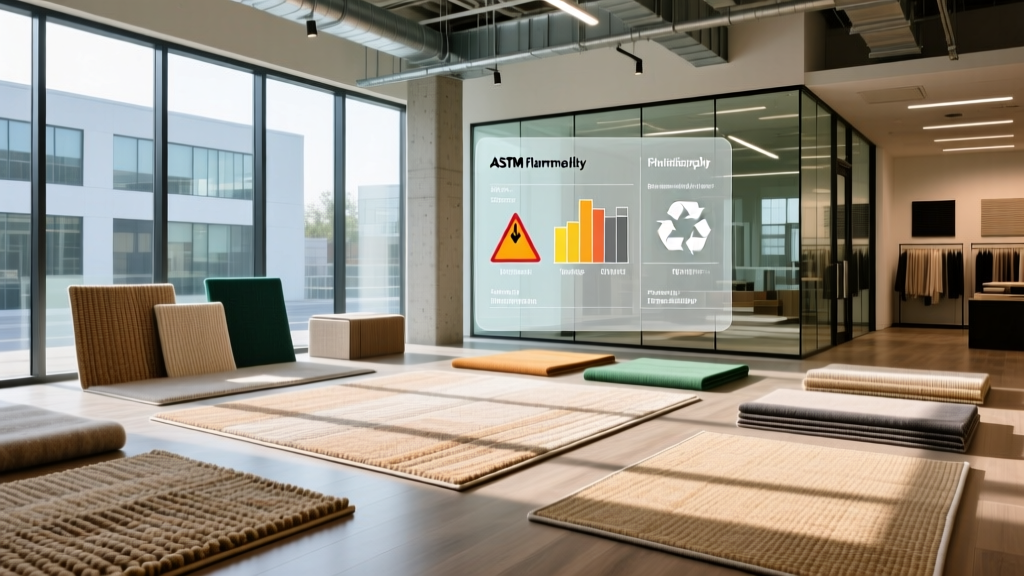
The Architectural Impact of Rug Specifications
Selecting floor coverings for commercial and high-end residential fit-outs requires balancing acoustic performance, lifecycle maintenance, and strict building codes. When determining the best material for rugs in architectural applications, designers must look beyond surface aesthetics and evaluate polymer structures, face weights, and flammability ratings. A poorly specified rug in a high-traffic corporate lobby or an acoustically sensitive open-plan office will lead to premature matting, excessive reverberation, and costly early replacement. This guide provides a technical framework for specifying rug materials based on empirical performance data and industry standards.
Material Matrix: Performance by Polymer Type
The table below outlines the primary rug materials used in commercial and architectural fit-outs, comparing their physical properties against critical performance metrics.
| Material | Best Application | Face Weight Range | Flammability (ASTM E648) | Stain / UV Resistance | Relative Cost |
|---|---|---|---|---|---|
| Nylon 6,6 | Heavy commercial, lobbies, corridors | 24 - 36 oz/yd² | Class 1 (with treatment) | Excellent (if solution-dyed) | $$$ |
| Wool | Boutique hospitality, executive suites | 28 - 45 oz/yd² | Class 1 (naturally) | Moderate (prone to fading) | $$$$ |
| Triexta (PTT) | Mixed-use, residential, light commercial | 20 - 30 oz/yd² | Class 2 (typically) | Exceptional (inherent) | $$ |
| Polypropylene | Outdoor terraces, moisture-prone zones | 15 - 22 oz/yd² | Class 2 / 3 (highly flammable) | Excellent (hydrophobic) | $ |
Deep Dive: Specifying the Best Material for Rugs by Use Case
Nylon 6,6: The Heavy-Duty Commercial Standard
For high-traffic commercial zones, Nylon 6,6 remains the undisputed benchmark. The molecular structure of Nylon 6,6 features a tighter polymer chain than standard Nylon 6, resulting in superior resilience and crush resistance. When specifying Nylon 6,6, architects should mandate solution-dyed fibers rather than piece-dyed. In solution-dyed nylon, the color pigment is added to the liquid polymer before extrusion, making the fiber completely impervious to bleach-based cleaning agents and UV degradation. For heavy commercial applications, specify a minimum face weight of 24 oz/yd² and a density rating of 5,000 or higher. Density can be calculated using the industry standard formula: Density = (Face Weight × 36) / Pile Height in inches.
Wool: The Premium Acoustic and Biophilic Choice
Wool is the premier choice for projects targeting biophilic design and superior acoustic dampening. New Zealand wool, characterized by its long staple lengths (5 to 8 inches), minimizes shedding and pilling. From a building code perspective, wool is unique: it naturally meets the stringent ASTM E648 Class 1 critical radiant flux requirement without the need for topical chemical flame retardants. Furthermore, wool's complex fiber structure scatters sound waves, often achieving Noise Reduction Coefficient (NRC) ratings between 0.35 and 0.55 when paired with a high-density felt pad. However, wool is highly hygroscopic; it can absorb up to 30% of its weight in moisture without feeling wet. Never specify wool rugs for below-grade installations or areas with high ambient humidity, as prolonged moisture exposure will cause the natural jute backings to rot and the fibers to mildew.
Triexta (PTT): The Emerging Stain-Resistant Contender
Polytrimethylene terephthalate (PTT), commonly branded as Triexta, is a highly durable polymer that offers inherent stain resistance without the need for topical coatings that degrade over time. Unlike nylon, which requires periodic reapplication of fluorochemical stain blockers, Triexta's molecular structure naturally repels water-based stains. It also exhibits excellent UV stability, making it a strong secondary option for sun-drenched atriums where traditional nylon might fade. While its resilience is slightly lower than Nylon 6,6, its lower cost and exceptional lifecycle maintenance profile make it highly attractive for mid-tier commercial and luxury multi-family residential fit-outs.
Never install high-VOC adhesives or unverified rug backings before the building's HVAC system is fully commissioned and operational. Off-gassing trapped in unventilated spaces will permanently embed odors into porous wool and nylon fibers. Always verify that all rug materials and associated pads carry the Carpet and Rug Institute (CRI) Green Label Plus certification to comply with LEED v4.1 Low-Emitting Materials credits.
Acoustic Performance and Reverberation Control
In modern open-plan architecture, hard surfaces like glass and polished concrete create severe acoustic reverberation. Rugs act as critical acoustic treatments. To optimize acoustic performance, the rug material must be evaluated in conjunction with its underlayment. A 32 oz/yd² wool rug paired with a 40 oz/yd² synthetic felt pad can reduce impact noise (IIC) by up to 15-20 decibels compared to hard surface flooring. When specifying rugs for boardrooms or executive offices, prioritize high-pile wool or dense nylon cut-piles, as the varied fiber heights trap and dissipate high-frequency sound waves more effectively than low-loop commercial carpets.

Subfloor Preparation and Moisture Mitigation
The most expensive rug will fail prematurely if installed over an improperly prepared concrete subfloor. Moisture vapor emission and alkaline pH are the primary culprits of adhesive failure and fiber degradation.
- Moisture Testing: Mandate in-situ relative humidity (RH) testing per ASTM F2170. Probes must be embedded at 40% depth of the concrete slab. The maximum acceptable RH for most rug adhesives and backings is 75%.
- pH Levels: Test the concrete surface pH. Highly alkaline floors (pH > 9.0) will saponify water-based adhesives, turning them into a soapy, non-bonding sludge. The ideal pH range is between 7.0 and 9.0.
- Pad Selection: Avoid PVC or vinyl-backed rug pads when placing rugs over Luxury Vinyl Tile (LVT) or finished hardwood borders. The plasticizers in PVC will migrate and permanently yellow the adjacent hard surfaces. Specify closed-cell polyurethane or 100% synthetic felt pads instead.
Application-Specific Decision Framework
Use the following decision matrix to finalize your material specification based on the specific spatial requirements of your project.
Scenario A: High-Traffic Corporate Lobbies & Corridors
Specification: Solution-Dyed Nylon 6,6.
Parameters: Minimum 28 oz face weight, tight loop pile or low cut-pile, synthetic primary and secondary backings. Ensure the material passes the GSA Facilities Standards (P100) for heavy commercial rolling loads.
Scenario B: Boutique Hospitality & Executive Suites
Specification: 100% New Zealand Wool.
Parameters: 36-45 oz face weight, cut-pile for acoustic dampening. Must be paired with a high-density felt pad. Ensure the space is strictly climate-controlled (30-50% relative humidity) to prevent fiber expansion and contraction.
Scenario C: Sun-Drenched Atriums & Transitional Zones
Specification: Triexta or Solution-Dyed Polypropylene.
Parameters: UV-stable fibers are mandatory. Polypropylene is preferred if the area is subject to water ingress (e.g., exterior entryways), as it is entirely hydrophobic and will not wick moisture or support mold growth. Note that polypropylene has a low melting point; specify walk-off mats to prevent friction burns from heavy luggage or carts.
Long-Term Maintenance and Lifecycle Costing
When calculating the total cost of ownership (TCO) for architectural rug installations, factor in the extraction cleaning cycles required for the specified material. Nylon requires hot water extraction every 6 to 12 months, and the application of a fluorochemical protector every third cycle. Wool requires specialized, low-pH cleaning agents; alkaline cleaners will strip the natural lanolin, leaving the fibers brittle and prone to rapid soiling. By aligning the polymer chemistry with the facility management team's maintenance capabilities, architects can ensure the specified rug material performs flawlessly throughout its intended lifecycle.
For further guidance on maintaining healthy indoor environments during and after installation, refer to the EPA Indoor Air Quality Guidelines, which provide comprehensive protocols for managing particulate and chemical off-gassing in newly fitted commercial spaces.
Written by
Priya KapoorPriya Kapoor is a real estate market analyst and construction economics researcher with expertise in housing affordability, development feasibility, and infrastructure investment. She holds a Master of Regional Planning from Cornell University and previously worked as a senior analyst at CBRE's Investment Properties group, where she modeled returns for $4B in mixed-use development pipelines. Priya now runs an independent research practice advising developers, municipalities, and REITs on construction cost forecasting and market timing. She publishes the quarterly "BuildMat Market Pulse" report tracking material price indices across 12 commodity categories. Based in Austin, TX, Priya serves on the board of Habitat for Humanity Austin and is a marathon runner.
More from Priya Kapoor
View all
Construction Cost
Cost to Build a 1600 Sq Ft Home in 2026: Full Breakdown
Accurate 2026 cost to build a 1600 sq ft home—material, labor, and regional pricing breakdowns included. Plan your budget with real-time estimates.
Aug 11, 2026

Wood & Lumber
Name the Types of Wood for Pressure Treatment and Preservation
Learn how to name the types of wood best suited for pressure treatment. Compare species treatability, chemical retention levels, and 2026 preservation costs.
Aug 4, 2026

Stone & Masonry
Stone Veneer Suppliers Lindenhurst: 2026 Cost Analysis
Analyze 2026 stone veneer costs in Lindenhurst, NY. Compare local supplier pricing, delivery fees, and Suffolk County installation labor rates.
Aug 4, 2026