What Is the Best Material for Furring Strips? Wood vs. Metal Guide
Discover what is the best material for furring strips. Compare wood vs. metal furring channels, costs, and application specs for masonry and framing.

The Core Dilemma: Wood Furring vs. Metal Furring Channels
When framing out a basement, leveling an uneven masonry wall, or creating an air gap for moisture management, builders must answer a critical question: what is the best material for furring strips? The answer depends entirely on the substrate, the load requirements, and the environmental conditions of the space. There is no single universal winner; rather, there is a correct material for specific application parameters.
Dimensional lumber (wood) remains the standard for heavy load-bearing attachments, structural blocking, and scenarios where deep cavity insulation is required. Cold-formed steel (metal furring channels, often called hat channels) is the superior choice for moisture-prone environments, acoustic decoupling, and creating perfectly plumb planes over severely bowed concrete or CMU (Concrete Masonry Unit) walls.
Dimensional Lumber (Wood) Furring Strips
Wood furring strips are typically milled from SPF (Spruce-Pine-Fir) dimensional lumber. The most common profiles are 1x2 (actual dimensions: 3/4" x 1-1/2") and 1x3 (actual dimensions: 3/4" x 2-1/2"). For any interior application, wood furring must be stamped KD-19 (Kiln-Dried to 19% moisture content or less). Using green or construction-grade wet lumber guarantees twisting and bowing as the wood acclimates, which will telegraph through the finished drywall and cause fastener pops.
When attaching wood furring directly to below-grade masonry, building codes require a moisture barrier or the use of pressure-treated lumber. However, modern alkaline copper quaternary (ACQ) pressure treatments are highly corrosive to standard steel fasteners, requiring hot-dipped galvanized or stainless steel screws, which increases overall project costs.
Cold-Formed Steel (Metal) Furring Channels
Metal furring strips, specifically 7/8" hat channels and 1-1/2" Z-channels, are manufactured from galvanized steel sheet. According to ClarkDietrich technical specifications, these channels are roll-formed to provide high strength-to-weight ratios without the risk of organic rot or moisture absorption.
- 25-Gauge (0.0179"): The standard for vertical wall applications supporting 1/2" or 5/8" gypsum board.
- 20-Gauge (0.0329"): Required for ceiling applications, heavy tile backing, or areas subject to impact.
- 16-Gauge (0.0538"): Used in commercial shaft walls or when supporting heavy stone veneers.
Material Selection Matrix: Matching Furring to the Substrate
Selecting the right material requires analyzing the substrate you are fastening to. The following matrix outlines the optimal furring material based on common structural backings.
| Substrate Type | Best Furring Material | Recommended Fastener | Primary Rationale |
|---|---|---|---|
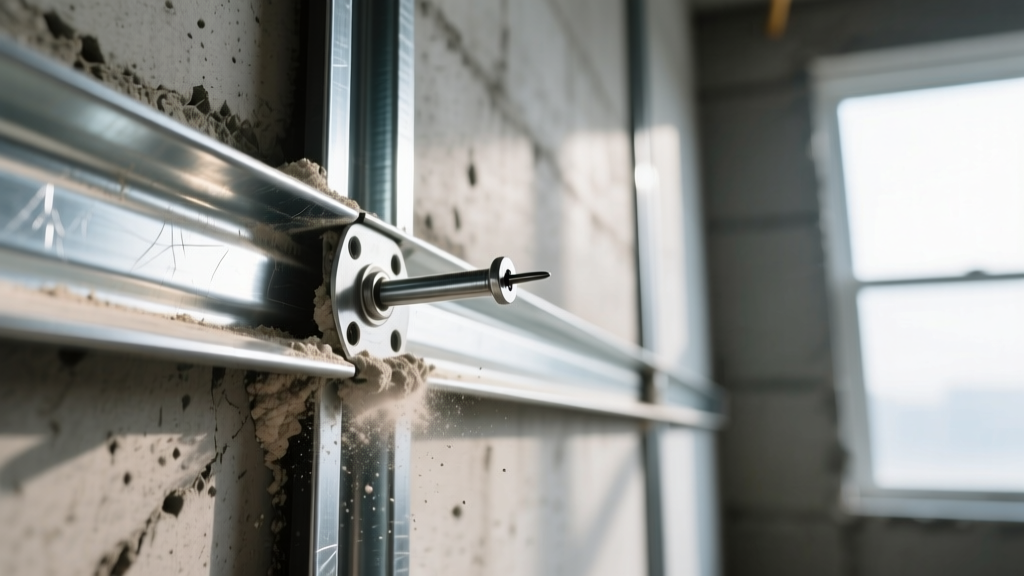
| Poured Concrete (Below Grade) | 25ga or 20ga Galvanized Hat Channel | Powder-actuated pins (e.g., Hilti X-HS) or Tapcon screws | Impervious to moisture; thin profile allows for leveling shims without losing floor space. |
| CMU / Cinder Block | 1x3 Pressure-Treated Wood or 20ga Metal | #8 x 1-3/4" Tapcon masonry screws | Wood allows for easier plumbing via shimming; metal prevents rot if CMU weeps moisture. |
| Wood Framing (Soundproofing) | 25ga Resilient Channel (RC-1) | 1-1/4" Type S drywall screws | Decouples drywall from studs to break acoustic vibration paths. |
| Steel Studs (Commercial) | 1-1/2" Z-Channel (20ga) | 7/16" Type S-12 self-drilling screws | Z-profile provides a nailing flange for attachment and a wide flange for drywall. |
Application Guide: Fastening and Spacing Specifications
Proper installation is just as critical as material selection. The Gypsum Association GA-216 standard dictates strict spacing and fastening schedules to prevent drywall deflection and joint failure.
Spacing Requirements
For standard 1/2" gypsum board applied to furring strips, the maximum spacing is 16 inches on center (o.c.). If you are using 5/8" Type X fire-rated board, you can extend the spacing to 24 inches o.c. However, in high-humidity environments or when applying heavy wallcoverings, maintaining a strict 16-inch o.c. layout is highly recommended regardless of board thickness to prevent sagging.
Leveling and Shimming Techniques
Masonry walls are rarely perfectly plumb. When using wood furring, builders must use composite shims behind the strips at every fastener point to create a flat plane. This is labor-intensive. Metal hat channels solve this problem through the use of rigid foam insulation boards cut to varying thicknesses behind the channel, or by utilizing specialized adjustable metal furring clips that allow for micro-adjustments after the channel is pinned to the concrete.
Critical Failure Modes and How to Avoid Them
Warning: Galvanic Corrosion in Mixed Materials
Never use standard aluminum furring channels in direct contact with pressure-treated wood or concrete containing chloride accelerators. The alkaline environment will cause rapid galvanic corrosion, destroying the aluminum within a few years. Always specify G60 or G90 hot-dipped galvanized steel for masonry applications.
Failure Mode: Wood Twist and Fastener Pop
If wood furring strips are installed with a moisture content above 19%, they will twist as they dry in the climate-controlled interior. This twisting exerts lateral force on the drywall screws, causing the gypsum core to crush and the screw head to "pop" through the paper face. Fix: Only purchase KD-19 stamped lumber and store it indoors for 72 hours before installation.
Acoustic Short-Circuiting
When using resilient metal channels for soundproofing, a common error is driving a drywall screw too deep, penetrating the channel and biting into the structural stud behind it. This creates a rigid mechanical bridge that completely defeats the acoustic decoupling. Use a depth-sensitive dimpler on your drill to ensure screws only penetrate the metal channel flange.
Cost Breakdown: Material and Labor Realities (2026 Baselines)
Material costs fluctuate based on regional supply chains, but the labor differential between wood and metal furring is often the deciding factor for contractors. Metal furring is significantly faster to install on flat surfaces, while wood is faster to shim on highly irregular surfaces.
| Cost Factor | 1x3 Wood Furring (SPF #2) | 25ga Galvanized Hat Channel |
|---|---|---|
| Material Cost (per linear foot) | $0.55 - $0.75 | $0.38 - $0.52 |
| Fastener Cost (per sq. ft. of wall) | $0.12 (Masonry screws) | $0.08 (Powder-actuated pins) |
| Labor Time (per 100 sq. ft.) | 2.5 - 3.5 hours (includes shimming) | 1.2 - 1.8 hours (snap lines and pin) |
| Waste Factor | 10% (knots, splits, warping) | 3% (clean cuts, no structural defects) |
| Total Installed Cost (per sq. ft.) | $2.85 - $3.40 | $1.90 - $2.35 |
Note: Pricing reflects early 2026 national averages for commercial/residential construction. Wood prices are highly susceptible to regional lumber mill disruptions, whereas steel channel pricing remains more stable but sensitive to energy and zinc coating costs.
Insulation and Cavity Depth Considerations
The choice of furring material directly impacts your insulation strategy. A standard 1x3 wood furring strip provides exactly 2.5 inches of cavity depth. This is sufficient for 2.5" rigid polyiso foam boards (yielding an R-value of roughly R-15), but it is entirely inadequate for standard fiberglass or mineral wool batts, which require a minimum of 3.5 inches (a 2x4 stud cavity) to perform correctly without compression.
Compressing a 3.5" batt into a 2.5" wood furring cavity reduces its thermal resistance and creates thermal bridging through the wood itself. If your design requires batt insulation against a masonry wall, you must abandon furring strips and instead frame a freestanding 2x4 or 2x6 stud wall with a 1-inch air gap behind it. Metal hat channels (7/8") provide even less depth and are strictly meant for rigid foam insulation or uninsulated finish walls.
Final Verdict: Which Material Wins?
To definitively answer what is the best material for furring strips: 25-gauge galvanized steel hat channel is the best overall material for modern masonry and concrete applications. It eliminates moisture rot, resists warping, installs faster with powder-actuated tools, and costs less per square foot when labor is factored in.
However, 1x3 KD-19 wood furring remains the mandatory choice when you need deep structural blocking for heavy wall-mounted cabinets, when you are integrating complex plumbing runs within the furring cavity, or when working on historical restorations where modern steel profiles are incompatible with existing lath and plaster substrates. Match the material to the specific mechanical and environmental demands of your project, rather than defaulting to a single solution for every wall.
Written by
Sarah WhitfieldSarah Whitfield is a chartered quantity surveyor (MRICS) and construction cost analyst with 15 years of experience in material pricing, procurement strategy, and project budgeting. She earned her degree in Construction Management from the University of Reading (UK) and has worked on projects ranging from $2M custom homes to $180M mixed-use developments across North America and Europe. Sarah currently leads cost estimating for BuildMat Insight, maintaining a proprietary database of 4,000+ material price points updated quarterly. She is a frequent contributor to RSMeans cost data panels and has presented at the International Cost Engineering Council (ICEC) congress. Based in Denver, CO, Sarah is an avid trail runner and volunteer mentor for Women in Construction.
More from Sarah Whitfield
View all
Wood & Lumber
What Are the Different Types of Wood? A Builder's Guide
Compare structural softwoods, finish hardwoods, and engineered lumber. Analyze Janka ratings, MOE values, and 2026 pricing for construction.
Aug 4, 2026

Walls & Panels
Steel Framing vs Wood Framing: Corrosion and Moisture Defense
Compare steel framing vs wood framing for moisture resistance. Learn about galvanized coatings, condensation risks, and corrosion protection strategies.
Jul 21, 2026

Stone & Masonry
How to Cut Stone Veneer: Wet Saw vs Grinder Comparison
Compare the best tools for cutting stone veneer. We review wet saws, angle grinders, and chop saws to help you achieve clean, chip-free cuts.
Jul 21, 2026