The Best Material for Subwoofer Box Enclosures: A Technical Density & Stiffness Guide
Compare MDF, Baltic Birch, and Fiberglass for subwoofer enclosures. Analyze density, Young's modulus, and damping to find the best material for subwoofer box builds.

The Physics of Enclosure Inertia: Why Material Dictates Bass Response
Selecting the best material for subwoofer box construction is not a matter of aesthetics; it is an exercise in structural engineering and acoustic physics. A subwoofer driver moves massive volumes of air, generating immense internal pressure variations. If the enclosure walls flex, vibrate, or store acoustic energy, that energy is released out of phase with the driver's output, resulting in transient smearing, coloration, and a loss of mechanical Q (Qms). The ideal enclosure material must exhibit high mass, extreme stiffness (Young's Modulus), and high internal damping to dissipate vibrational energy as negligible heat rather than audible resonance.
Material Comparison Matrix: Density, Stiffness, and Damping
The following matrix evaluates the primary enclosure materials based on their mechanical properties. Data reflects standard 18mm (3/4-inch) thicknesses unless otherwise noted, with pricing based on early 2026 market averages for raw sheet goods.
| Material | Density (kg/m³) | Young's Modulus (GPa) | Internal Loss Factor | Approx. Cost (4x8 Sheet) |
|---|---|---|---|---|
| Standard MDF (18mm) | ~750 | 3.0 - 3.5 | High | $65 - $85 |
| 13-Ply Baltic Birch (18mm) | ~680 | 9.5 - 11.0 | Medium | $140 - $180 |
| Fiberglass (Hand-laid, 6mm) | ~1800 | 18.0 - 22.0 | Low | $45 / sq. ft. (resin+mat) |
| HDPE / StarBoard (19mm) | ~950 | 0.8 - 1.2 | Very Low | $220 - $280 |
| Corian Solid Surface (12mm) | ~1700 | 7.5 - 8.5 | Medium | $120 / sq. ft. |
Medium Density Fiberboard (MDF): The High-Mass Baseline
MDF remains the most ubiquitous choice for commercial and DIY subwoofer enclosures due to its uniform density and lack of grain direction. Unlike solid wood, MDF is an isotropic material, meaning its acoustic and mechanical properties are identical across all axes. This predictability makes it highly favorable for Thiele-Small parameter modeling and CAD-based enclosure simulation.
Grade Selection and CARB Compliance
Not all MDF is engineered equally. For acoustic applications, specify SierraPine Medite II or an equivalent premium grade. These formulations use a higher concentration of wood fibers and refined resins, yielding a denser, heavier panel that resists screw pull-out better than economy-grade MDF. Furthermore, ensure the material is CARB Phase 2 compliant to minimize formaldehyde off-gassing, which is critical when building enclosures for indoor home theater environments.
13-Ply Baltic Birch: The Audiophile Standard
When evaluating the best material for subwoofer box builds where weight-to-stiffness ratio is paramount, 13-ply Baltic Birch plywood is the undisputed champion. Sourced primarily from Northern Europe, genuine Baltic Birch is constructed from uniform, cross-banded veneers without the core voids found in standard construction plywood.
The Danger of Core Voids in Standard Plywood
Standard CDX or ACX plywood features alternating grain directions but often contains internal gaps and football patches. Under the extreme acoustic pressure generated by a 15-inch or 18-inch driver operating at maximum excursion (Xmax), these voids act as localized resonance chambers, creating secondary panel ringing typically between 200Hz and 400Hz. Baltic Birch's solid, void-free core ensures a continuous shear transfer across the panel, pushing the fundamental resonance frequency far above the subwoofer's low-pass crossover threshold.
According to mechanical testing documented in the USDA Forest Products Laboratory Wood Handbook, the cross-lamination of birch veneers dramatically increases the shear modulus, allowing an 18mm Baltic Birch panel to match the flexural rigidity of 25mm (1-inch) MDF while weighing 25% less.
Fiberglass Reinforced Plastic (FRP): Complex Geometries
For custom car audio installations or architecturally integrated home enclosures requiring non-rectilinear shapes, Fiberglass Reinforced Plastic (FRP) is the optimal solution. FRP allows for the creation of compound curves that eliminate internal parallel walls, effectively destroying internal standing waves without the need for heavy internal acoustic stuffing.
However, FRP requires meticulous layup techniques to achieve adequate stiffness. A standard chopped strand mat (CSM) layup will flex under bass pressure. To achieve the necessary Young's Modulus, builders must incorporate woven roving and structural core materials like Divinycell or end-grain balsa. As detailed in the DragonPlate Composite Materials Guide, sandwiching a lightweight foam core between two layers of woven fiberglass exponentially increases the moment of inertia, yielding a panel that is acoustically dead and exceptionally rigid at a fraction of the weight of MDF.
High-Density Polyethylene (HDPE): Marine and Outdoor Applications
When building subwoofers for marine environments, UTVs, or open-air patios, wood and fiberglass are compromised by UV degradation and water intrusion. HDPE (often sold under the brand name King StarBoard) is completely impervious to moisture, rot, and salt spray.
The critical engineering challenge with HDPE is its exceptionally low Young's Modulus (~1.0 GPa). It is inherently flexible. To use HDPE as a subwoofer enclosure material, the wall thickness must be increased to 25mm (1-inch) minimum, and the internal bracing matrix must be doubled compared to an equivalent MDF design to prevent panel ballooning under high sound pressure levels (SPL).
Structural Engineering: Bracing and Joint Topologies
The best material for subwoofer box construction will fail if the joint topology and internal bracing are inadequate. A 25mm thick MDF panel spanning 24 inches will still exhibit acoustic resonance. Bracing reduces the unsupported span of the panel, which exponentially increases the resonant frequency of the cabinet walls.
Dado Joints vs. Butt Joints
A standard butt joint secured with wood glue and brad nails offers minimal shear resistance and relies entirely on the glue's edge-grain adhesion. Upgrading to a 6mm deep dado joint increases the glued surface area by over 300%. This creates a monolithic, interlocking corner that resists the immense internal pressure variations generated by high-excursion drivers, effectively turning the enclosure into a single, continuous acoustic mass.
Windowpane and Cross-Bracing Matrices
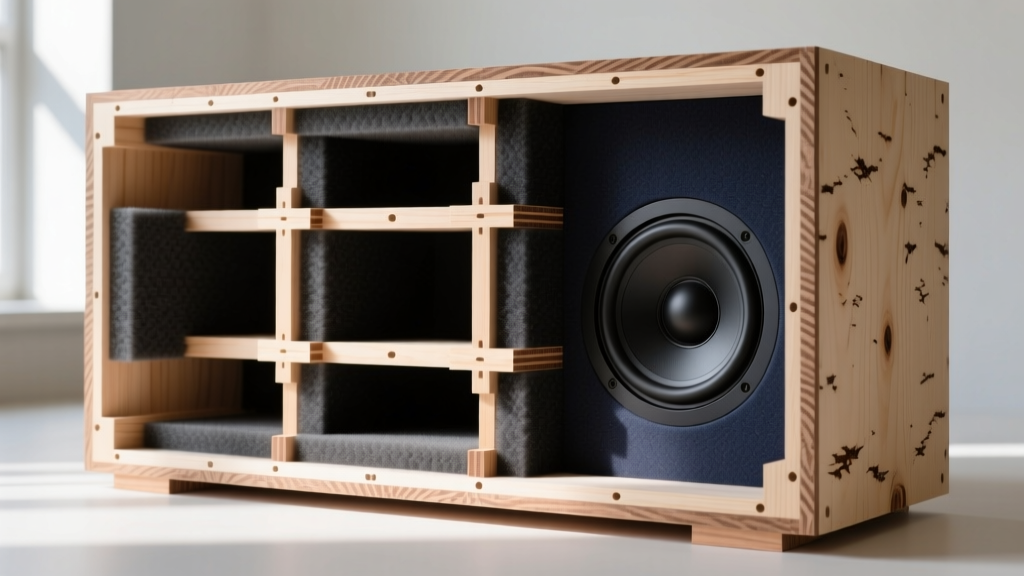
Internal bracing should not merely consist of corner blocks. The most effective topology is the windowpane brace—a grid of interlocking internal panels that touch all four interior walls and the front/rear baffles. By cutting precise rectangular slots into the bracing panels, they interlock at the center, distributing acoustic loads evenly across the entire enclosure volume and preventing localized stress fractures.
2026 Sourcing and Cost Analysis
As of 2026, global supply chains for wood composites have stabilized, but premium acoustic materials command a distinct premium. Standard 3/4-inch MDF remains highly accessible at big-box retailers for roughly $75 per sheet. However, genuine 13-ply Baltic Birch has seen price consolidation around $160 per sheet, driven by FSC (Forest Stewardship Council) sustainable harvesting mandates and import logistics. For high-end audiophile builds where transient response and cabinet inertness are the primary metrics, the 2x cost multiplier for Baltic Birch is universally justified by the measurable reduction in cabinet resonance and the superior screw retention for heavy neodymium drivers.
Written by
Priya KapoorPriya Kapoor is a real estate market analyst and construction economics researcher with expertise in housing affordability, development feasibility, and infrastructure investment. She holds a Master of Regional Planning from Cornell University and previously worked as a senior analyst at CBRE's Investment Properties group, where she modeled returns for $4B in mixed-use development pipelines. Priya now runs an independent research practice advising developers, municipalities, and REITs on construction cost forecasting and market timing. She publishes the quarterly "BuildMat Market Pulse" report tracking material price indices across 12 commodity categories. Based in Austin, TX, Priya serves on the board of Habitat for Humanity Austin and is a marathon runner.
More from Priya Kapoor
View all
Construction Cost
Cost to Build a 1600 Sq Ft Home in 2026: Full Breakdown
Accurate 2026 cost to build a 1600 sq ft home—material, labor, and regional pricing breakdowns included. Plan your budget with real-time estimates.
Aug 11, 2026

Wood & Lumber
Name the Types of Wood for Pressure Treatment and Preservation
Learn how to name the types of wood best suited for pressure treatment. Compare species treatability, chemical retention levels, and 2026 preservation costs.
Aug 4, 2026

Stone & Masonry
Stone Veneer Suppliers Lindenhurst: 2026 Cost Analysis
Analyze 2026 stone veneer costs in Lindenhurst, NY. Compare local supplier pricing, delivery fees, and Suffolk County installation labor rates.
Aug 4, 2026