Valheim Build Materials: Structural Integrity & Tier Guide
Master Valheim build materials with our structural integrity guide. Learn wood, stone, and Mistlands tier limits to prevent base collapses.

The Physics Engine: Structural Integrity Decoded
Building in Valheim is not merely an aesthetic exercise; it is a strict physics simulation governed by cumulative weight and load-bearing limits. Unlike traditional survival games where structures float indefinitely, Valheim utilizes a structural integrity system that calculates the distance and weight of every connected piece from a grounded foundation. Understanding these mechanics is mandatory before selecting your Valheim build materials for large-scale fortresses or multi-tier longhouses.
When using the Hammer tool, the game color-codes every building piece to indicate its current structural stability. According to the Valheim Official Wiki, the color spectrum dictates the load threshold:
- Blue: Directly grounded or resting on a fully supported foundation. Zero structural degradation.
- Green: Strong support. Minimal weight penalty applied.
- Yellow: Moderate support. Approaching the material's weight threshold.
- Orange: Weak support. Nearing the collapse point.
- Red: Critical failure. The piece cannot support additional weight and will instantly collapse if struck or if another piece is attached.
Comprehensive Valheim Build Materials Matrix
Each material tier introduces new durability thresholds and support capacities. While early-game wood is abundant, it lacks the load-bearing capacity for massive horizontal spans. The following matrix outlines the exact specifications for core structural components.
| Material Tier | Component | Durability (HP) | Max Support Weight | Primary Architectural Use |
|---|---|---|---|---|
| Basic Wood | Wood Beam (2m) | 100 | 1000 units | Early walls, basic roofing, scaffolding |
| Core Wood | Core Wood Beam | 200 | 1000 units | Reinforced walls, Black Forest watchtowers |
| Stone | Stone Pillar (2m) | 300 | 1500 units | Vertical load-bearing columns, foundation piers |
| Iron | Iron Beam (2m) | 500 | 1500 units | Massive horizontal spans, bridge supports |
| Dark Wood | Dark Wood Beam | 400 | 1000 units | Swamp bases, aesthetic timber framing |
| Marble (Mistlands) | Marble Beam (2m) | 1000 | 2000+ units | High-tier citadels, extreme vertical builds |
As noted in PC Gamer's Building Guide, players often mistake higher HP for higher structural support. Core Wood and Dark Wood possess significantly more health against enemy siege attacks than Basic Wood, but their structural weight limits remain identical at 1000 units. To increase horizontal reach, you must upgrade the material class, not just the wood type.
Vertical vs. Horizontal Load Management
The most common cause of catastrophic base collapses in Valheim is misunderstanding how the physics engine treats vertical versus horizontal vectors. Stone is the ultimate vertical material. A single stone pillar can support a massive stack of additional stone or wood pieces directly above it. However, stone cannot be built horizontally without underlying support; attempting to build a stone ceiling will result in immediate collapse.
The Cross-Bracing Technique
To maximize the horizontal reach of wood and iron beams, builders must utilize 45-degree cross-bracing. Diagonal beams transfer weight back to vertical pillars much more efficiently than flat horizontal beams. When constructing a large mead hall ceiling:
- Erect stone pillars every 6 to 8 meters to serve as primary load-bearing columns.
- Run iron beams horizontally between the stone pillars.
- Attach 45-degree wood or iron struts from the pillars to the horizontal beams to redistribute the roof's weight downward.
Any wooden structural piece exposed to direct rainfall will suffer continuous durability damage. The wood will turn black and its HP will permanently cap at 50% of its maximum value until covered. This 'Roof Rot' does not cause structural collapse on its own, but it makes your base highly vulnerable to troll attacks and Fulings raids. Always ensure wood beams are covered by thatch, wood roofing, or crystal roofing, even during the construction phase.
Environmental Engineering: Smoke and Ventilation
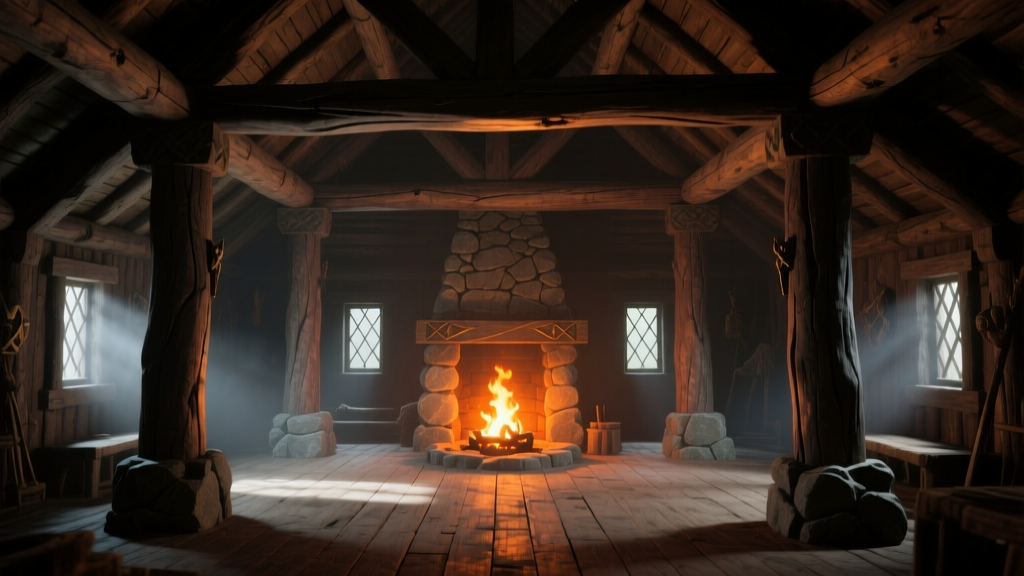
Material selection also dictates environmental survival. Placing a Hearth or Campfire inside a sealed stone or wood bunker will quickly fill the room with smoke, applying a 'Smoked' debuff that halts health and stamina regeneration. Smoke in Valheim travels upward and requires a clear 2x2 vertical shaft to vent properly. When designing your great hall, integrate a stone chimney directly above the central hearth. Stone is immune to fire damage, whereas wood roofing will eventually ignite if placed too close to the smoke path or flame source.
Mistlands and Ashlands: Late-Game Material Integration
Reaching the Mistlands biome unlocks Marble, a game-changing material for structural engineers. Marble beams and arches possess a vastly superior support weight threshold compared to iron, allowing for the construction of soaring, cathedral-like interiors without the need for cluttered interior pillars. Furthermore, the introduction of Flametal in the Ashlands biome provides specialized, high-durability roofing and exterior plating that resists the extreme environmental hazards of the late game.
When integrating these late-game materials into existing bases, be aware that the structural integrity calculator treats mixed-material joints with strict penalties. Connecting a heavy marble roof to a basic wood frame will instantly overload the wood, turning it red and collapsing the structure. Always ensure the foundational pillars match or exceed the weight class of the roofing materials.
Base Engineering FAQ
Why did my roof collapse when I added a single decorative beam?
Valheim calculates cumulative weight. If your horizontal wooden beam is already supporting 999 units of weight (orange), adding a decorative roof piece that weighs 50 units will push the total to 1049, exceeding the 1000-unit limit and triggering a red collapse. Always leave a 10% weight buffer on horizontal spans.
Can I use stone walls to support a wood roof?
Yes. Stone walls provide excellent vertical support. However, you cannot attach wood beams directly to the side of a stone wall without a stone corbel or pillar acting as the anchor point. The wood must rest on top of the stone or connect to a grounded wooden frame adjacent to the stone.
Does terrain affect structural integrity?
Absolutely. Pieces placed directly on natural, unmodified terrain register as 'Blue' (grounded). If you use the Hoe to flatten or pave the ground, the terrain remains valid. However, building on steep, unmodified slopes can cause pieces to register as unsupported if the collision mesh fails to detect the ground beneath the foundation.
Written by
James ThorntonJames Thornton is a construction industry veteran with 25 years of hands-on experience in wood framing, lumber grading, and residential building codes. He started as a framing carpenter in rural Oregon, earned his ICC Residential Building Inspector certification, and eventually became a senior plan reviewer for the City of Portland Bureau of Development Services. James holds a B.S. in Wood Science & Technology from Oregon State University and is a certified lumber grader through the West Coast Lumber Inspection Bureau (WCLIB). He has inspected over 3,000 residential construction sites and authored the city's internal guide on advanced framing techniques (2x6 at 24" O.C.). James lives in Bend, OR, where he builds custom timber-frame cabins and competes in lumberjack sports.
More from James Thornton
View all
Insulation
Best Home Insulation Materials: Complete 2026 Guide
Compare top home insulation materials for 2026. Find R-values, installed costs per square foot, and best uses for fiberglass, spray foam, and mineral wool.
Aug 4, 2026

Sustainable Building
Certify Your Green Building Material for LEED and WELL
Step-by-step guide to certifying a green building material for LEED v5 and WELL v2. Master EPDs, HPDs, and VOC limits for 2026 project specifications.
Aug 4, 2026

Stone & Masonry
Veneer Stacked Stone Panels: Interior Design & Style Showcase
Discover how veneer stacked stone panels transform interiors. Explore modern design profiles, material pairings, and technical installation specs.
Aug 4, 2026