Best Materials for Custom Rugs: A Builder's Application Guide
Specify the best materials for custom rugs in commercial and luxury fit-outs. Compare wool, nylon, and PET for durability, fire codes, and acoustics.

The Architectural Shift: Custom Rugs as Integrated Building Elements
In commercial construction and high-end residential fit-outs, custom rugs are no longer viewed merely as decorative floor coverings. They are highly engineered architectural finishes that directly impact a building’s acoustic performance, indoor air quality, fire egress safety, and ADA compliance. Specifying the best materials for custom rugs requires general contractors, interior architects, and facility managers to evaluate fibers not just on aesthetics, but on rigorous performance metrics including face weight, denier thickness, critical radiant flux, and moisture resistance.
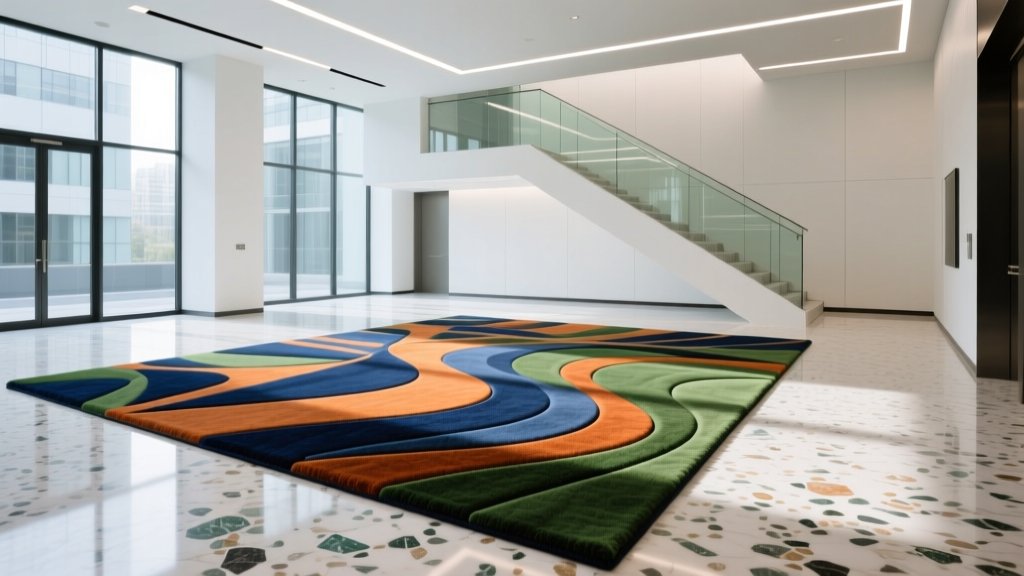
When integrating custom area rugs into hard-surface transitions (such as LVT, terrazzo, or polished concrete), the material selection dictates the necessary transition profiles, subfloor preparation, and adhesive systems. A failure to specify the correct rug material for a specific environmental zone can lead to premature delamination, failed fire inspections, or severe acoustic reverberation issues in large-volume spaces.
For commercial egress paths, corridors, and stairwells, NFPA 101 Life Safety Code mandates that flooring must meet ASTM E648 Class I (Critical Radiant Flux ≥ 0.45 W/cm²). Untreated natural fibers like pure silk, jute, or low-grade cotton will inherently fail this test. When specifying custom rugs for these zones, you must require factory-applied, permanent fire-retardant treatments or default to inherently flame-resistant fibers like 100% wool or specialized modacrylic blends.
Fiber Performance Matrix: Specifying by Traffic and Environment
The foundation of any custom rug specification is the fiber composition. Below is a technical comparison matrix detailing how the primary rug materials perform under commercial and luxury residential conditions. Data aligns with current 2026 manufacturing standards and GSA Facilities Standards (PBS-P100) guidelines for federal and commercial flooring.
| Material / Fiber | Face Weight (oz/yd²) | Commercial Traffic Rating | ASTM E648 Class | Avg. Cost (per sq. ft.) |
|---|---|---|---|---|
| Solution-Dyed Nylon 6,6 | 28 - 36 | Extra Heavy | Class I (0.45+) | $8.00 - $14.00 |
| 100% New Zealand Wool | 40 - 60 | Heavy | Class I (Natural) | $18.00 - $35.00 |
| Recycled PET (Polyester) | 24 - 32 | Moderate | Class II (w/ treatment) | $6.00 - $10.00 |
| Sisal/Wool Blend (80/20) | 35 - 45 | Moderate/Heavy | Class II | $12.00 - $22.00 |
| Bamboo Silk / Viscose | 50 - 70 | Light (Residential Only) | Class II (w/ treatment) | $25.00 - $45.00 |
Application Scenarios: Material Selection Framework
Selecting the optimal fiber requires mapping the material's physical properties to the specific environmental stressors of the room. Use the following framework to guide your specifications.
Scenario A: High-Traffic Hospitality Corridors and Lobbies
Specified Material: Solution-Dyed Nylon 6,6 with a high-density, low-pile loop construction.
Why it Works: In hospitality environments, rugs face rolling luggage, heavy foot traffic, and aggressive chemical cleaning. Solution-dyed nylon (where color is added to the liquid polymer before extrusion) is impervious to bleach-based spot cleaners. Unlike piece-dyed fibers, the color will not strip when facility maintenance teams use hydrogen peroxide-based extraction chemicals to remove bio-stains. Specify a minimum face weight of 32 oz/yd² and a dense, low-pile loop (1/8 inch or less) to prevent heel-catch and luggage wheel drag.
Scenario B: Executive Boardrooms and Acoustic Control
Specified Material: 100% New Zealand Wool with a high-pile cut construction and dense felt backing.
Why it Works: Boardrooms require strict acoustic management to prevent speech reverberation and ensure privacy. Wool fibers possess a natural crimp and high mass that excel at absorbing high-frequency airborne noise. When paired with a 40 oz/yd² face weight and a 1/4-inch acoustic felt underpad, a custom wool rug can achieve a Noise Reduction Coefficient (NRC) of 0.35 to 0.50 and significantly boost the floor assembly's Impact Insulation Class (IIC). Furthermore, wool is naturally flame-resistant, meeting strict commercial fire codes without toxic chemical treatments.
Scenario C: Healthcare Waiting Areas and Cleanroom Adjacent Zones
Specified Material: Bio-based or Recycled PET (Polyester) with antimicrobial backing.
Why it Works: Healthcare facilities demand materials that do not harbor pathogens and can withstand frequent moisture exposure. PET is inherently hydrophobic—it absorbs less than 0.4% of its weight in moisture, preventing the wicking effect that causes mold and mildew in natural fibers. For custom rugs in these zones, specify a direct-glue-down installation using a moisture-cured urethane adhesive with an integrated antimicrobial agent, eliminating the need for a separate cushion pad where bacteria could proliferate.
Installation Mechanics and ADA Compliance
The best materials for custom rugs will fail prematurely if the installation methodology ignores the building's operational requirements. When integrating custom rugs into commercial fit-outs, contractors must address edge transitions and accessibility.
- ADA Rolling Resistance: The Americans with Disabilities Act (ADA) requires floor surfaces to be firm, stable, and slip-resistant. Custom rugs with a pile height exceeding 1/2 inch create severe rolling resistance for wheelchairs. For accessible routes, specify low-pile rugs (under 1/4 inch) with a firm, high-density backing, and ensure the rug is fully adhered to the subfloor rather than loosely laid.
- Transition Profiles: When a custom rug meets hard surface flooring (like 5mm LVT or poured terrazzo), the height differential must not exceed 1/4 inch vertically, or 1/2 inch if beveled. Use specialized aluminum or Schluter-style transition profiles designed for carpet-to-hard-surface ramps to prevent trip hazards and protect the rug's bound edges from fraying.
- Waterjet Inlay Integration: For high-end lobbies, custom rugs are often waterjet-cut and inlaid directly into the surrounding hard flooring. This requires precise subfloor leveling (within 1/8 inch over 10 feet) and the use of color-matched, flexible epoxy grouts at the seam to accommodate the differing expansion and contraction rates between the textile and the stone/terrazzo.
Lifecycle, Maintenance, and Indoor Air Quality
Total Cost of Ownership (TCO) for custom rugs extends far beyond the initial material and installation costs. Facility managers must factor in extraction cleaning cycles, fiber replacement rates, and indoor environmental quality.
"A cheaper, piece-dyed nylon rug may save $4.00 per square foot upfront, but if it requires replacement in 4 years due to irreversible UV fading and chemical stripping during maintenance, its lifecycle cost triples compared to a solution-dyed alternative that easily survives 12 years of commercial extraction cleaning."
From an indoor air quality (IAQ) perspective, custom rugs and their associated adhesives and pads are significant sources of Volatile Organic Compounds (VOCs). To meet LEED v4.1 and WELL Building Standard requirements, always specify materials that carry the Carpet and Rug Institute (CRI) Green Label Plus certification. This ensures the rug, backing, and adhesive system emit VOCs below the strict limits established by the California Office of Environmental Health Hazard Assessment (OEHHA), safeguarding the building's HVAC load and occupant health.
Frequently Asked Specification Questions
Can custom silk or viscose rugs be used in commercial dining areas?
No. Viscose (often marketed as bamboo silk or rayon) is a regenerated cellulose fiber that loses up to 50% of its tensile strength when wet. In dining areas where beverage spills and aggressive enzymatic cleaning are guaranteed, viscose fibers will permanently distort, shed, and develop severe water-marking. Restrict viscose to low-traffic, dry executive spaces or residential applications.
How do I prevent moth damage in 100% wool custom rugs?
If specifying wool for a ground-floor commercial space or a humid residential climate, require the manufacturer to apply a permanent, EPA-registered moth-proofing treatment (such as a permethrin-based or borax-based finish) during the yarn extrusion or dyeing phase. Topical sprays applied post-installation are insufficient and will wash out during the first hot-water extraction cleaning.
What backing system is best for custom rugs on concrete slabs with high MVER?
If the concrete subfloor has a Moisture Vapor Emission Rate (MVER) exceeding 5 lbs per 1,000 sq. ft. per 24 hours (tested via ASTM F1869), standard latex or synthetic backings will degrade and delaminate. Specify a custom rug with a high-performance urethane backing (such as StrataWorx or similar proprietary polyurethane systems) which is completely impervious to alkaline moisture and can tolerate MVER levels up to 15 lbs without adhesive breakdown.
Written by
Priya KapoorPriya Kapoor is a real estate market analyst and construction economics researcher with expertise in housing affordability, development feasibility, and infrastructure investment. She holds a Master of Regional Planning from Cornell University and previously worked as a senior analyst at CBRE's Investment Properties group, where she modeled returns for $4B in mixed-use development pipelines. Priya now runs an independent research practice advising developers, municipalities, and REITs on construction cost forecasting and market timing. She publishes the quarterly "BuildMat Market Pulse" report tracking material price indices across 12 commodity categories. Based in Austin, TX, Priya serves on the board of Habitat for Humanity Austin and is a marathon runner.
More from Priya Kapoor
View all
Construction Cost
Cost to Build a 1600 Sq Ft Home in 2026: Full Breakdown
Accurate 2026 cost to build a 1600 sq ft home—material, labor, and regional pricing breakdowns included. Plan your budget with real-time estimates.
Aug 11, 2026

Wood & Lumber
Name the Types of Wood for Pressure Treatment and Preservation
Learn how to name the types of wood best suited for pressure treatment. Compare species treatability, chemical retention levels, and 2026 preservation costs.
Aug 4, 2026

Stone & Masonry
Stone Veneer Suppliers Lindenhurst: 2026 Cost Analysis
Analyze 2026 stone veneer costs in Lindenhurst, NY. Compare local supplier pricing, delivery fees, and Suffolk County installation labor rates.
Aug 4, 2026