What Is the Best Screening Material for Porch Enclosures?
Discover what is the best screening material for porch enclosures. Compare fiberglass, bronze, and pet screens with exact specs and costs.

The Physics of Porch Screening: Airflow, Optics, and Tensile Strength
When evaluating exterior mesh, the fundamental trade-off is always between optical clarity (visibility) and structural durability. Mesh count dictates both. A standard 18x16 mesh features 18 threads per inch vertically and 16 horizontally. The diameter of those individual threads determines the "open area" percentage, which directly correlates to airflow and outward visibility. Standard fiberglass utilizes a 0.011-inch yarn, yielding roughly 60% open area. Conversely, heavy-duty pet screens use a 0.024-inch vinyl-coated polyester yarn, dropping the open area to 45% but increasing lateral tear resistance by over 400%. Understanding these micro-measurements is critical when determining what is the best screening material for porch applications, as the wrong choice leads to premature sagging, frame warping, or inadequate pest exclusion.
Comprehensive Material Matrix (2026 Market Pricing)
The following matrix breaks down the primary architectural screen materials by their physical properties and current material-only costs. Labor for professional installation typically adds $2.50 to $4.50 per square foot depending on framing complexity.
| Material Type | Mesh Count | Thread/Wire Diameter | Open Area (Airflow) | Cost per Sq Ft | Primary Vulnerability |
|---|---|---|---|---|---|
| Standard Fiberglass | 18x16 | 0.011" | 60% | $0.35 - $0.50 | UV degradation, sagging |
| Charcoal Aluminum | 18x16 | 0.009" | 65% | $0.55 - $0.75 | Denting, coastal oxidation |
| Bronze Wire | 18x16 | 0.010" | 60% | $2.80 - $3.50 | Initial cost, requires clear-coating if patina is unwanted |
| No-See-Um (Fiberglass) | 20x20 | 0.011" | 45% | $0.65 - $0.85 | Reduced airflow, pollen accumulation |
| Pet Screen (Polyester) | 16x16 | 0.024" | 45% | $1.20 - $1.80 | Frame bowing if splined incorrectly |
| Stainless Steel (Marine) | 17x14 | 0.015" | 55% | $3.50 - $4.50 | Difficult to cut, requires heavy-duty spline |
Application Guide: Selecting for Specific Environments
Coastal and High-Salt Environments
Aluminum screen mesh is highly susceptible to galvanic corrosion and salt-air oxidation. Within 18 to 24 months in coastal zones, aluminum mesh will develop a white, powdery oxide that streaks down the porch framing and permanently stains white paint. For any project within five miles of a saltwater coastline, bronze or 304-grade stainless steel are the only viable options. Bronze naturally oxidizes to a dark, stable patina that blends seamlessly with wood and dark aluminum framing, while stainless steel remains impervious to salt spray.
High-Insect and Wetland Zones
Standard 18x16 mesh is entirely ineffective against biting midges (no-see-ums) and certain species of small mosquitoes. According to entomological data from the Centers for Disease Control and Prevention (CDC), biting midges can be as small as 1 to 3 millimeters and easily pass through standard window screening. For wetland-adjacent porches, you must specify a 20x20 mesh. Be aware that the tighter weave reduces airflow by approximately 15% to 20% and requires more frequent cleaning, as the smaller apertures trap windblown pollen and dust more readily.
High-Traffic and Pet Enclosures
Standard fiberglass tears at roughly 15 pounds of lateral force. If the porch will house large dogs or experience high foot traffic from children, specify a vinyl-coated polyester pet screen (often branded as Super Screen or TuffScreen). According to manufacturing specifications from Phifer Inc., these heavy-duty meshes can withstand over 100 pounds of blunt force without tearing. However, the application requires specialized hardware, detailed in the spline section below.
Never install aluminum screen mesh using steel staples or untreated steel nails on a wooden porch frame. Moisture will trigger a galvanic reaction between the dissimilar metals, causing the aluminum to corrode rapidly at the contact points and the steel to rust, resulting in structural failure of the screen edge within a single season. Always use aluminum or stainless steel fasteners and spline.
The Spline and Groove Tolerance Framework
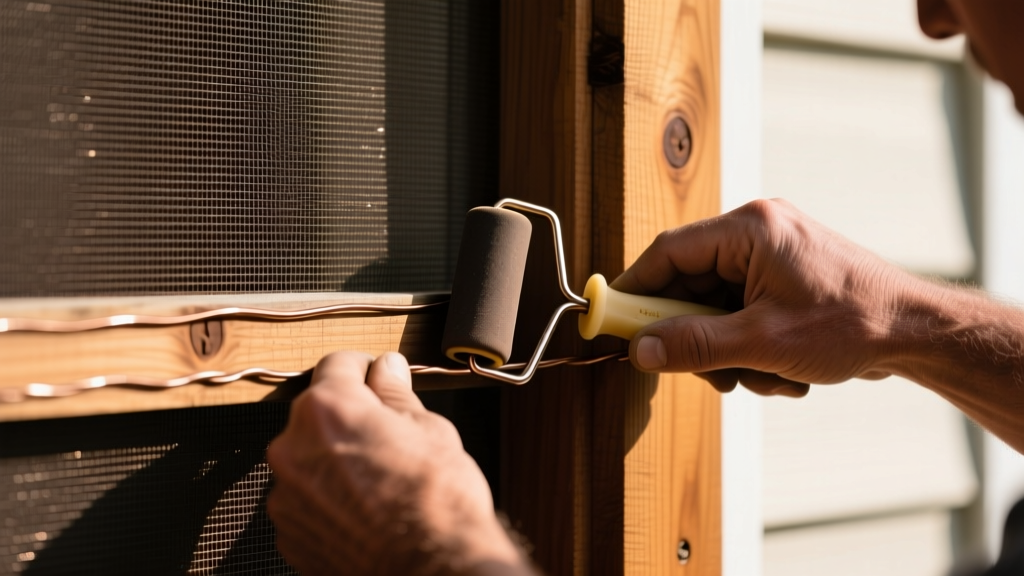
The most common point of failure in porch screening is not the mesh tearing, but the spline (the rubber cord that holds the mesh in the frame) popping out under wind load. This is almost always due to incorrect spline sizing relative to the frame groove and the mesh thickness.
- For Flexible Meshes (Fiberglass, No-See-Um): The spline must be 0.015 inches larger than the frame groove width. If your aluminum frame has a 0.125-inch groove, use a 0.140-inch spline. The compression of the rubber against the flexible yarn creates the necessary friction lock.
- For Rigid Meshes (Pet Screen, Bronze, Stainless): The spline must be 0.005 inches smaller than the groove width. If you attempt to force a 0.140-inch spline and a 0.024-inch pet screen into a 0.125-inch groove, the extreme radial pressure will permanently bow and warp the aluminum frame, ruining the panel.
Structural Framing and Wind Load Management
Screened porches act as massive wind sails. A standard 4-foot by 8-foot screen panel encompasses 32 square feet. In a moderate 30 mph wind, the aerodynamic pressure exerts roughly 2.5 pounds per square foot, translating to 80 pounds of sheer outward force distributed across the spline channel. If the mesh stretches or the spline shrinks due to UV exposure, the wind will pull the screen entirely out of the frame.
To mitigate this, never exceed an unsupported span of 4 feet in any direction. For large porch bays, install structural mullions (such as 1x4 cedar battens or extruded aluminum H-bars) to divide the space into smaller, manageable 4x4 or 4x3 foot panels. This not only reduces the wind load per panel but also allows for easier replacement of individual sections if damage occurs.
Step-by-Step Tensioning Protocol for Large Panels
Proper tensioning prevents the "trampoline effect" and ensures optical clarity. Follow this sequence for panels wider than 36 inches:
- Cut Oversized: Cut the mesh 2 inches wider than the frame on all sides. Do not attempt to cut it flush before installation.
- Seat the Top Edge: Using a convex-wheel spline roller, press the spline into the top channel only. Start from the center and roll outward to the corners.
- Apply Bottom Tension: Pull the mesh taut across the bottom of the frame. Use a specialized screen tensioning jig or apply firm, even downward pressure with your non-dominant hand while rolling the spline into the bottom channel with your dominant hand.
- Seat the Sides: Roll the side splines from the top corner down to the bottom corner, maintaining outward tension to eliminate horizontal wrinkles.
- Trim with Convex Cutters: Never use a standard utility knife or razor blade to trim the excess mesh. A razor blade will inevitably slip and nick the primary screen fibers, creating a weak point that will "unzip" under tension. Use a specialized convex-wheel trimming tool or heavy-duty diagonal flush cutters.
Selecting the correct mesh, pairing it with the mathematically precise spline diameter, and respecting wind-load span limits will result in a porch enclosure that remains taut, optically clear, and structurally sound for a decade or more.
Written by
Sarah WhitfieldSarah Whitfield is a chartered quantity surveyor (MRICS) and construction cost analyst with 15 years of experience in material pricing, procurement strategy, and project budgeting. She earned her degree in Construction Management from the University of Reading (UK) and has worked on projects ranging from $2M custom homes to $180M mixed-use developments across North America and Europe. Sarah currently leads cost estimating for BuildMat Insight, maintaining a proprietary database of 4,000+ material price points updated quarterly. She is a frequent contributor to RSMeans cost data panels and has presented at the International Cost Engineering Council (ICEC) congress. Based in Denver, CO, Sarah is an avid trail runner and volunteer mentor for Women in Construction.
More from Sarah Whitfield
View all
Wood & Lumber
What Are the Different Types of Wood? A Builder's Guide
Compare structural softwoods, finish hardwoods, and engineered lumber. Analyze Janka ratings, MOE values, and 2026 pricing for construction.
Aug 4, 2026

Walls & Panels
Steel Framing vs Wood Framing: Corrosion and Moisture Defense
Compare steel framing vs wood framing for moisture resistance. Learn about galvanized coatings, condensation risks, and corrosion protection strategies.
Jul 21, 2026

Stone & Masonry
How to Cut Stone Veneer: Wet Saw vs Grinder Comparison
Compare the best tools for cutting stone veneer. We review wet saws, angle grinders, and chop saws to help you achieve clean, chip-free cuts.
Jul 21, 2026