How Materials Used to Build the Central Pacific Railroad Were Shipped
Discover the extreme 19th-century logistics of how materials used to build the Central Pacific Railroad were shipped via Cape Horn and Panama.

The Ultimate 19th-Century Supply Chain Challenge
Constructing the western half of the First Transcontinental Railroad required moving thousands of tons of heavy industrial materials across vast, unforgiving distances before a single mile of track could be laid in the mountains. Understanding exactly how the materials used to build the Central Pacific Railroad were shipped provides modern construction managers with a masterclass in extreme logistics, risk mitigation, and modular prefabrication. Because the industrial base of the United States in the 1860s was concentrated on the East Coast and in Europe, the Central Pacific Railroad (CPRR) faced a geographic nightmare: building eastward from Sacramento meant crossing the Sierra Nevada before reaching local iron and coal resources.
According to the National Park Service, the CPRR was responsible for laying 690 miles of track, much of it through solid granite. To achieve this, the company had to establish a global supply chain that rivaled modern international freight networks, relying on a fragile combination of clipper ships, steamers, and the newly completed Panama Canal Railway.
- Total Iron Required: Over 40,000 tons of rails, spikes, and fasteners.
- Standard Rail Weight: 56 pounds per yard (early iron T-rails).
- Cape Horn Transit Time: 100 to 180 days depending on wind and hull design.
- Locomotive Kits: 12-ton engines disassembled into 50+ individual wooden crates.
Routing the Heavy Materials: Cape Horn vs. Panama vs. Overland
The decision of how to route freight was dictated by a strict matrix of weight, urgency, and capital. The CPRR utilized three primary logistical arteries to move materials from Eastern foundries and European ports to the Sacramento staging yards.
| Route | Transit Time | Cost per Ton (Approx.) | Best Suited For | Primary Risks |
|---|---|---|---|---|
| Cape Horn (Sea) | 3 - 6 Months | $15 - $25 | Heavy iron rails, spikes, bulk timber, coal | Shipwreck, spoilage, severe scheduling delays |
| Panama Isthmus | 4 - 6 Weeks | $50 - $100+ | Locomotive parts, precision tools, urgent hardware | Port bottlenecks, high transfer fees, jungle rot |
| Overland (Stage/Wagon) | 2 - 4 Months | $200 - $500 | Emergency replacement parts, mail, specialized engineers | Theft, weather, extreme weight limitations |
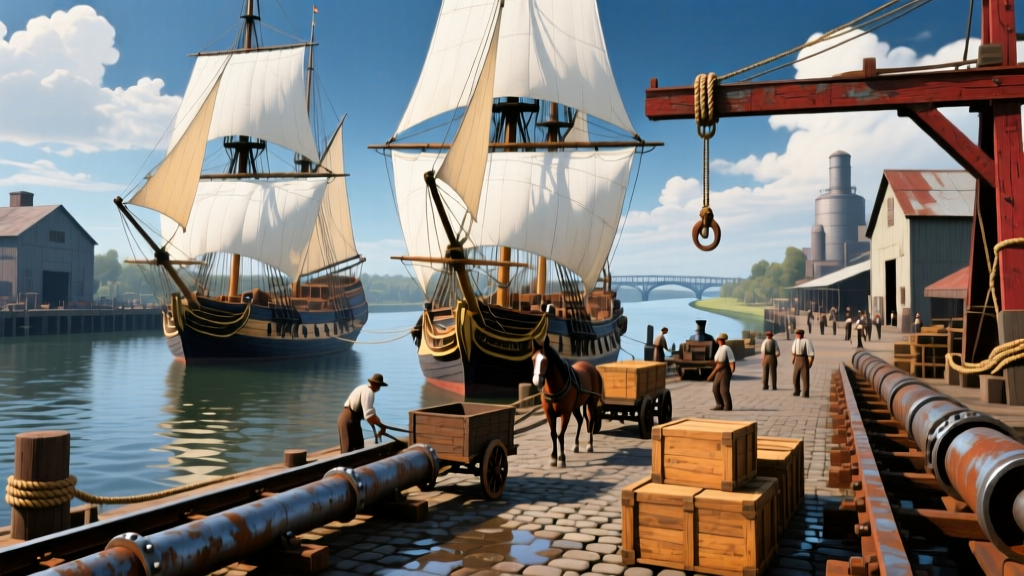
The vast majority of the tonnage—specifically the pig iron, rails, and heavy machinery—was loaded onto clipper ships and sent around Cape Horn. While slow, the sheer cargo capacity of a 19th-century sailing vessel made it the only economically viable method for moving bulk steel and iron. The National Archives notes that the financial pressure to finish the railroad meant that delayed ships could halt grading crews in the mountains, costing the company thousands of dollars a day in idle labor.
Breakdown of Shipped Materials and Their Origins
Iron Rails, Spikes, and Fasteners
The CPRR relied heavily on 56-pound-per-yard iron T-rails. Because California lacked the blast furnaces required to produce this volume of milled iron, rails were sourced primarily from foundries in Pennsylvania, New Jersey, and Wales. These rails were bundled, hoisted into the holds of freight ships, and sent around South America. A single mile of track required roughly 100 tons of iron rails and spikes. The sheer volume meant that the Sacramento docks were perpetually stacked with thousands of tons of rusting iron waiting to be loaded onto flatcars and pushed up the Sierra Nevada grade.
Locomotives and Rolling Stock: The Original Modular Prefab
Perhaps the most impressive logistical feat was the shipping of locomotives. A standard 4-4-0 steam locomotive of the era weighed between 12 and 20 tons and could not be transported whole. Instead, manufacturers like the Schenectady Locomotive Works completely disassembled the engines. The boiler, cowcatcher, drive wheels, and cab were packed into dozens of numbered wooden crates. These crates were shipped via the faster Panama route to ensure that as soon as the track was laid, an engine was waiting to be reassembled in the Sacramento railyards. The CPRR's first locomotive, the Gov. Stanford, was shipped in pieces via Cape Horn and reassembled in Sacramento in 1863.
Explosives: The Shift from Black Powder to On-Site Manufacturing
Blasting through the Summit Tunnel (Tunnel 6) required massive quantities of explosives. Initially, black powder was shipped in 25-keg lots from Eastern mills. However, as the granite of the Sierras proved too hard for standard black powder, the CPRR attempted to ship nitroglycerin. Due to its extreme volatility and the high rate of accidental detonations on ships and wagons, shipping liquid nitroglycerin was quickly banned by freight carriers. In a brilliant pivot of construction management, the CPRR hired chemist James Strobridge to manufacture nitroglycerin directly on-site at the tunnel face, eliminating the shipping bottleneck entirely and accelerating the blasting rate by 50%.
The Sacramento Assembly Hubs and River Logistics
Sacramento served as the ultimate chokepoint for all shipped materials. Situated on the Sacramento River, the city allowed deep-water ships coming from San Francisco Bay to offload heavy freight directly onto the CPRR's wharves. From there, materials were transferred to construction trains. As the track pushed higher into the mountains, the logistics shifted from maritime shipping to a brutal overland supply chain. Snowsheds had to be built not just to protect the tracks from avalanches, but to create sheltered staging areas where shipped materials could be stockpiled during the harsh winter months without being buried under 40-foot snowdrifts.
'The success of the Central Pacific was not merely a triumph of civil engineering, but of maritime and logistical coordination. Every spike driven into the Sierra granite represented a journey of over 17,000 miles by sea.' — Historical analysis from the Stanford University Chinese Railroad Workers Project.
Modern Mega-Project Lessons from CPRR Logistics
Modern construction project managers overseeing mega-projects (such as high-speed rail networks, offshore wind farms, or remote mining facilities) can extract highly actionable frameworks from the CPRR's historical supply chain.
The CPRR Framework for Remote Construction Logistics
- Design for Disassembly (DfD): Just as 19th-century locomotives were shipped in numbered crates, modern remote projects should specify modular, prefab components that fit within standard TEU (Twenty-foot Equivalent Unit) shipping containers, avoiding the need for specialized heavy-lift transport.
- Decentralize Volatile Material Production: The CPRR's shift from shipping nitroglycerin to manufacturing it on-site mirrors modern decisions to use mobile concrete batch plants or on-site 3D printing rather than shipping volatile or time-sensitive materials over degraded access roads.
- Dual-Route Risk Hedging: The CPRR used Cape Horn for bulk and Panama for speed. Modern PMs should split critical path materials between low-cost ocean freight and high-cost air freight, triggered by specific schedule-variance thresholds.
Frequently Asked Questions
Did the Central Pacific Railroad source any materials locally?
Yes. While iron and machinery were shipped globally, the CPRR sourced millions of board-feet of timber locally from the Sierra Nevada forests for trestles, snowsheds, and railroad ties. Local granite was also quarried directly from the tunnel excavations and repurposed for retaining walls and bridge abutments, significantly reducing the need to ship masonry.
How did the completion of the Panama Canal Railway impact CPRR shipping?
Completed in 1855, the Panama Canal Railway allowed the CPRR to bypass the six-month Cape Horn voyage for urgent, high-value, or low-weight shipments. However, the Panama route was notorious for exorbitant freight rates and frequent bottlenecks at the transfer points, meaning it was used strictly for critical-path items like locomotive parts and specialized surveying equipment.
What happened to the ships that delivered the materials?
Many of the clipper ships and freighters that delivered materials to San Francisco and Sacramento during the 1860s were part of a massive global maritime fleet. Once the transcontinental railroad was completed in 1869, the need for maritime shipping of heavy goods to California plummeted, leading to a massive surplus of freight vessels and a subsequent crash in Pacific maritime shipping rates.
Written by
Marcus ChenMarcus Chen is a licensed structural engineer (PE) and building materials analyst with over 12 years of experience across residential, commercial, and industrial construction. He holds a Master of Science in Civil Engineering from UC Berkeley and spent six years at Thornton Tomasetti before transitioning to independent consulting and technical writing. Marcus specializes in material selection for seismic-prone regions, concrete reinforcement strategies, and lifecycle cost analysis. His work has been cited by the American Concrete Institute (ACI) and the Structural Engineers Association of California (SEAOC). When he is not on a job site or at his desk, you will find him hiking the Sierra Nevada or restoring a 1920s craftsman bungalow in Oakland, CA.
More from Marcus Chen
View all
Construction Cost
How Much Did the Eiffel Tower Cost to Build?
How much did the Eiffel Tower cost to build in 1889? We adjust for inflation and compare its budget to modern skyscraper construction.
Aug 4, 2026

Fire Resistance
What Is a Fire Resistant Material? Testing & Certification Guide
Discover what is a fire resistant material through ASTM and UL testing. Learn how fire ratings, certifications, and assemblies work in construction.
Aug 4, 2026

Construction Cost
How Much Did the Burj Khalifa Cost to Build?
How much did the Burj Khalifa cost to build? We break down the $1.5B project and extract 5 money-saving strategies for your next build.
Jul 30, 2026