What Materials Were Used to Build the Colosseum: Technical Specs
Analyze the technical specifications of the materials used to build the Colosseum, including travertine, tuff, and self-healing Roman concrete.

When analyzing what materials were used to build the Colosseum, modern structural engineers look beyond historical timelines to examine the precise material science that allowed the Flavian Amphitheatre to survive for nearly two millennia. The structure is not a monolith of a single stone, but a highly engineered, graded composite system. Roman builders strategically deployed materials based on their specific compressive strengths, densities, and tensile behaviors to manage the immense dead loads and lateral seismic forces of a 50,000-seat stadium.
Primary Load-Bearing Skeleton: Travertine Limestone
The ground-floor piers and the primary load-bearing skeleton of the Colosseum were constructed from lapis tiburtinus (travertine), a dense limestone quarried in Tivoli, approximately 20 miles east of Rome. The selection of travertine was dictated by its exceptional compressive strength and structural anisotropy.
Engineering Specifications of Travertine
- Compressive Strength: 100–150 MPa (when loaded parallel to its natural geological bedding plane).
- Density: ~2,710 kg/m³.
- Porosity: 10-15%, characterized by distinct horizontal voids formed by ancient spring deposits.
Roman engineers understood the anisotropic nature of sedimentary travertine. If the stone blocks were laid "on edge" (vertically), the compressive strength would drop by nearly 50%, leading to delamination under the immense weight of the upper tiers. Every travertine block in the Colosseum's piers was meticulously laid in its natural horizontal bed. The ground-floor piers, measuring roughly 3.4 meters in width, were designed to distribute the estimated 100,000-ton dead load of the superstructure into the underlying alluvial soil without exceeding the soil's bearing capacity.
Unlike modern masonry, the travertine blocks were laid completely dry, without mortar. The structural integrity relied entirely on gravity, friction, and precise ashlar dressing. This dry-joint technique actually enhanced the structure's seismic resilience, allowing the masonry to shift and dissipate kinetic energy during earthquakes without the brittle failure associated with rigid mortar joints.
Secondary Radial Walls: Tuff (Tufo Lionato)
As the structure rises, the dead load must be minimized to prevent catastrophic settlement. For the secondary radial walls and the upper-tier piers, engineers transitioned to Tufo Lionato, a volcanic tuff sourced from the Aniene river valley.
Material Properties of Tufo Lionato
- Compressive Strength: 20–40 MPa (significantly lower than travertine).
- Density: 1,500–1,800 kg/m³ (roughly 40% lighter than travertine).
- Thermal Insulation: High porosity provides excellent thermal mass and insulation for the interior corridors.
The use of tuff was a calculated weight-reduction strategy. By substituting heavy travertine with lighter tuff in the non-primary load paths (the interior radial walls that supported the seating tiers), the Romans effectively lowered the building's center of gravity. This reduction in mass directly decreased the lateral inertial forces generated during seismic events.
The Vaulting System: Opus Caementicium (Roman Concrete)
The most critical material innovation answering what materials were used to build the Colosseum is opus caementicium. The vast barrel vaults and radial arches spanning the corridors were cast in Roman concrete. This material differs fundamentally from modern Portland cement in both its chemical composition and its mixing methodology.
The Pozzolanic Reaction and Hot Mixing
Roman concrete utilized a binder composed of slaked lime and pozzolana (volcanic ash from the Bay of Naples). When mixed with water, the reactive silica and alumina in the ash react with the calcium hydroxide to form calcium-aluminum-silicate-hydrate (C-A-S-H), a binder that is significantly more resistant to chemical degradation than modern C-S-H gels.
Recent research published in Science Advances revealed that Roman concrete was "hot mixed." Instead of using pre-slaked lime, the Romans mixed quicklime (calcium oxide) directly with the pozzolanic ash and water. This exothermic reaction reached temperatures exceeding 100°C, creating millimeter-scale "lime clasts." According to MIT researchers, these lime clasts act as a self-healing mechanism: when micro-cracks form in the concrete vaults and water enters, the lime clasts dissolve and recrystallize as calcium carbonate, effectively sealing the cracks and preventing structural spalling.
| Property | Roman Concrete (Opus Caementicium) | Modern Portland Cement (OPC) |
|---|---|---|
| Primary Binder | C-A-S-H (Calcium-Aluminum-Silicate-Hydrate) | C-S-H (Calcium-Silicate-Hydrate) |
| Mixing Temperature | Exothermic (>100°C via quicklime) | Ambient (requires cooling for mass pours) |
| Self-Healing Capability | High (via undissolved lime clasts) | Low (requires specific crystalline admixtures) |
| Aggregate Grading | Stratified (heavy basalt base, light pumice crown) | Uniformly graded crushed stone/gravel |
Formwork and Facing: Opus Testaceum (Brick-Faced Concrete)
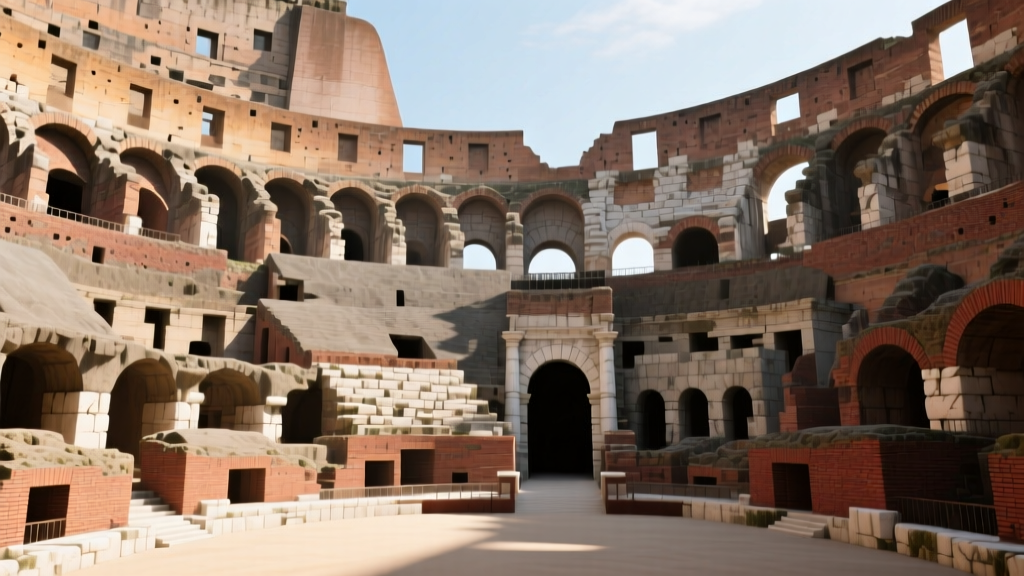
The visible brickwork on the Colosseum's interior and exterior arches is not merely decorative; it is an integral structural component known as opus testaceum. The Romans utilized bipedales—large, flat bricks measuring approximately 60cm square and 4cm thick. These were cut diagonally into triangles and laid with the flat face outward and the pointed end embedded deep into the wet concrete core.
The Structural Function of Thick Mortar Joints
Modern bricklaying demands thin, uniform mortar joints (typically 10mm). In contrast, the mortar joints in the Colosseum's opus testaceum are remarkably thick, often ranging from 15mm to 25mm. This was a deliberate engineering specification. The thick beds of pozzolanic mortar acted as a capillary network, drawing moisture evenly from the concrete core to ensure uniform curing. Furthermore, the brick facing served as permanent, structural formwork, eliminating the need to build and dismantle massive timber scaffolding for the vaulted ceilings.
Metallurgical Fastening: Iron Clamps and Lead Encasement
To secure the massive dry-laid travertine blocks against lateral shear forces, the builders used an estimated 300 tons of forged iron clamps. These C-shaped and dovetail clamps were inserted into precisely carved recesses across the stone joints.
In modern construction, exposed steel rebar or iron ties embedded in masonry are prone to oxidation. When iron rusts, the resulting iron oxide expands up to six times its original volume, causing "rust jacking" that violently spalls and cracks the surrounding stone. To prevent this catastrophic failure mode, Roman metallurgists poured molten lead into the recesses after the iron clamps were set. The lead encasement completely sealed the iron from oxygen and moisture, preserving the tensile connections for nearly 2,000 years. Sadly, during the Middle Ages, much of this lead was mined out and melted down for ammunition, leading to the localized collapse of some travertine piers.
Seismic Performance and Material Flexibility
The survival of the Colosseum through numerous severe earthquakes (notably in 443, 847, and 1349 AD) is a testament to its composite material design. According to structural assessments by the Parco Archeologico del Colosseo, the combination of heavy, rigid travertine piers, lighter tuff walls, and flexible dry-joints created a structure with a low fundamental frequency. This allowed the building to sway and dissipate seismic energy rather than resist it rigidly and shatter. The 1349 earthquake did cause the collapse of the southern outer ring, but this was due to a localized geological fault (an alluvial soil liquefaction zone on the south side) rather than a material failure of the stone itself.
Modern Conservation Engineering
Today, the primary threat to the Colosseum's materials is not structural loading, but environmental chemistry. Modern urban pollution introduces sulfur dioxide (SO2) into the atmosphere, which reacts with rainwater to form sulfuric acid. This acid reacts with the calcium carbonate in the travertine to form gypsum (calcium sulfate), which is highly soluble and washes away, causing severe surface erosion. Current conservation efforts utilize nanoparticle lime consolidants (calcium hydroxide nanoparticles suspended in alcohol) that penetrate deep into the stone's pore network, converting back to calcium carbonate and restoring the stone's original tensile skin without altering its vapor permeability.
Written by
James ThorntonJames Thornton is a construction industry veteran with 25 years of hands-on experience in wood framing, lumber grading, and residential building codes. He started as a framing carpenter in rural Oregon, earned his ICC Residential Building Inspector certification, and eventually became a senior plan reviewer for the City of Portland Bureau of Development Services. James holds a B.S. in Wood Science & Technology from Oregon State University and is a certified lumber grader through the West Coast Lumber Inspection Bureau (WCLIB). He has inspected over 3,000 residential construction sites and authored the city's internal guide on advanced framing techniques (2x6 at 24" O.C.). James lives in Bend, OR, where he builds custom timber-frame cabins and competes in lumberjack sports.
More from James Thornton
View all
Insulation
Best Home Insulation Materials: Complete 2026 Guide
Compare top home insulation materials for 2026. Find R-values, installed costs per square foot, and best uses for fiberglass, spray foam, and mineral wool.
Aug 4, 2026

Sustainable Building
Certify Your Green Building Material for LEED and WELL
Step-by-step guide to certifying a green building material for LEED v5 and WELL v2. Master EPDs, HPDs, and VOC limits for 2026 project specifications.
Aug 4, 2026

Stone & Masonry
Veneer Stacked Stone Panels: Interior Design & Style Showcase
Discover how veneer stacked stone panels transform interiors. Explore modern design profiles, material pairings, and technical installation specs.
Aug 4, 2026