Best Materials for Vintage Lamp Durability in Heritage Restorations
Discover the best materials for vintage lamp durability in heritage restorations. Compare brass, bronze, and glass for lasting architectural lighting.

The Material Science of Architectural Lighting Longevity
When integrating heritage lighting into modern commercial renovations or high-end residential builds, contractors and preservationists face a unique metallurgical challenge. Determining the best materials for vintage lamp durability requires an understanding of early 20th-century manufacturing processes, alloy degradation, and modern electrical safety codes. Architectural salvage fixtures are not merely decorative; they are structural components that must withstand thermal cycling, mechanical stress, and environmental humidity without compromising the building's electrical integrity.
Original fixtures from the Art Deco (1920s-1930s) and Mid-Century (1950s-1960s) eras were constructed using a wide variance of metal grades. While some alloys have survived a century in pristine condition, others suffer from catastrophic crystalline breakdown. According to the Secretary of the Interior's Standards for the Treatment of Historic Properties, preserving original materials is paramount, but only when those materials do not pose a safety or structural hazard. This guide breaks down the exact alloys, glass types, and internal components required to restore vintage lamps for permanent architectural integration.
Evaluating Base and Stem Alloys
The structural foundation of any vintage floor or table lamp dictates its lifespan. Modern replicas often use thin, electroplated zinc or aluminum, which lack the mass and thermal dissipation properties of period-correct metals. For genuine durability, restorers must identify and prioritize specific copper-based alloys.
| Material | Alloy Designation | Tensile Strength | Primary Failure Mode | Restoration Viability |
|---|---|---|---|---|
| Cartridge Brass | C26000 | 46,000 psi | Dezincification in high humidity | Excellent (Industry Standard) |
| Silicon Bronze | C87600 | 60,000 psi | Stress corrosion cracking | Superior (Marine/Exterior) |
| Cast Iron | Gray Iron (Class 30) | 30,000 psi | Oxidation / Rust jacking | Good (Requires sealing) |
| Pot Metal (Zinc) | Zamak 3 | 41,000 psi | Zinc Pest (Intergranular corrosion) | Poor (Requires replacement) |
Why C26000 Cartridge Brass Dominates
The Copper Development Association's Architectural Handbook notes that C26000 brass offers the optimal balance of malleability for intricate casting and rigidity for structural stems. When sourcing replacement stems or base weights, specify solid C26000 brass rather than brass-plated steel. Plated steel will eventually succumb to galvanic corrosion where the plating chips, leading to rust jacking that cracks the fixture's base.
⚠️ Critical Warning: The Pot Metal Degradation Trap
Lamps manufactured between 1925 and 1945 frequently utilized 'pot metal' (zinc die-cast alloys) for decorative bases and harps. Over time, impurities like lead and tin in the early Zamak alloys trigger 'zinc pest'—an intergranular corrosion that causes the metal to swell, crack, and eventually crumble into dust. If a vintage lamp base exhibits hairline fractures or a warped geometry, the pot metal is actively decaying. There is no chemical treatment to halt zinc pest; the component must be recast in silicon bronze or solid brass.
Shade and Reflector Materials: Thermal Shock Resistance
The shade material must endure the thermal output of modern LED retrofits as well as the heat generated by period-accurate incandescent or halogen bulbs. While original shades are prized, their material composition dictates their survival rate in commercial environments.
- Vitrolite and Opal Glass: Pigmented structural glass popular in the 1930s. While aesthetically unmatched, early Vitrolite is highly susceptible to thermal shock. When specifying these for architectural sconces, ensure the socket is positioned at least 4 inches from the glass surface to prevent heat-induced micro-fracturing.
- Slag Glass: Often set in cast metal frames, the primary failure point is not the glass, but the lead solder joints holding the panels together. Restoration requires re-flowing all joints with 60/40 tin-lead solder and applying a micro-crystalline wax sealant to prevent oxidation.
- Enameled Steel (Industrial Pendants): Common in mid-century factory builds. The porcelain enamel coating is essentially fused glass, making it impervious to UV degradation and moisture. However, chipped enamel exposes the steel substrate to rapid oxidation. Touch-ups must be performed using two-part epoxy ceramic coatings, not standard acrylic paints, to maintain the dielectric barrier.
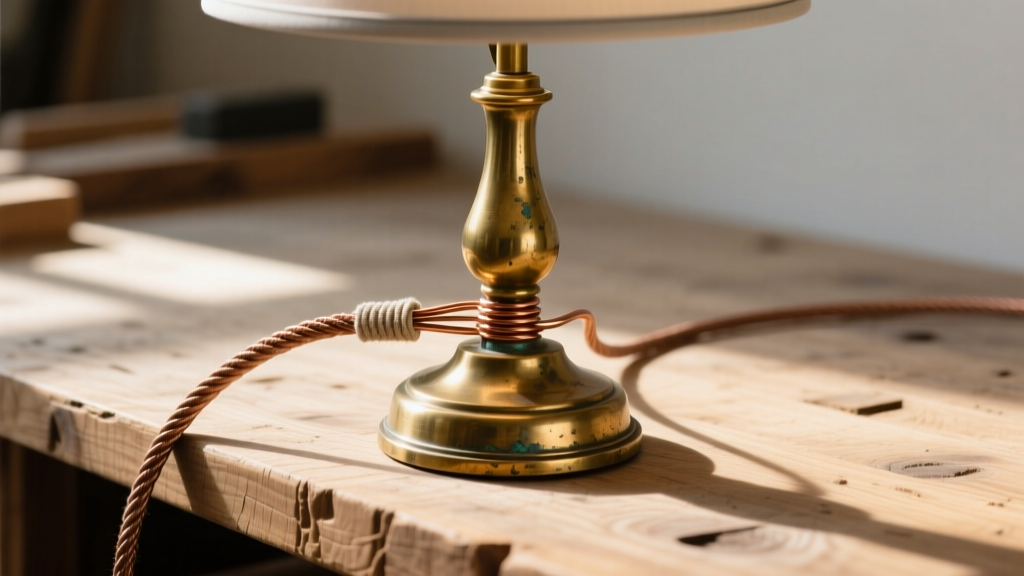
Internal Components: Upgrading for 2026 Safety Standards
External restoration is meaningless if the internal wiring poses a fire hazard. Original rubber-insulated wiring from the early 20th century becomes brittle and cracks, exposing live copper. Upgrading internal components to meet current UL 153 (Portable Electric Luminaires) standards is non-negotiable for building code compliance and insurance underwriting.
Wiring and Socket Specifications
Do not use standard modern thermoplastic wire (like Romex or standard SPT-1) inside narrow vintage brass stems, as the plasticizers can react with the copper and brass over decades. Instead, utilize the following specifications:
- Conductor: 18 AWG stranded copper. For narrow stems, use 18 AWG SPT-1 (105°C rated). For high-heat environments (like enclosed slag glass bowls), specify 18 AWG fiberglass-braided copper wire rated for 200°C.
- Sockets: Discard original brass-shell, cardboard-lined sockets. The cardboard liners absorb ambient moisture and become conductive, creating a severe shock hazard. Replace them with UL-recognized porcelain medium base (E26) or mogul base (E39) sockets. Porcelain provides superior thermal resistance and dielectric isolation.
- Strain Relief: Vintage lamps rarely featured modern strain relief. Install a UL-listed, ribbed rubber grommet and an underwriter's knot (UL knot) at the base exit point to prevent mechanical tension from pulling the live connections apart inside the metal stem.
Step-by-Step Material Assessment Framework
When evaluating an architectural salvage fixture on a job site, contractors should follow this diagnostic sequence to determine material viability:
Field Diagnostic Protocol
Step 1: The Magnet Test. Apply a neodymium magnet to the base and stem. If it adheres strongly, the fixture is steel or cast iron, not solid brass or bronze. Steel requires immediate inspection for internal rust jacking.
Step 2: The Scratch Test. In an inconspicuous area (under the base pad), use a brass pick to scratch the surface. A bright yellow scratch indicates solid brass. A silvery scratch indicates zinc pot metal or aluminum. A copper-colored scratch beneath a silver surface indicates brass-plating over copper or steel.
Step 3: The Weight and Resonance Check. Tap the stem with a knuckle. Solid bronze and thick-walled brass produce a high-pitched, sustained ring. Thin, spun brass or plated base metals produce a dull, short thud.
Step 4: Socket Inspection. Look inside the socket shell. If the lining is black, charred, or made of compressed paper/cardboard, the entire socket assembly must be discarded and replaced with porcelain.
Sourcing and Cost Expectations for 2026
Procuring historically accurate, code-compliant materials requires specialized suppliers. Standard hardware store components will compromise both the aesthetic and the structural integrity of a heritage restoration. Below are current market expectations for restoration-grade materials:
| Component | Material / Specification | Estimated Cost (2026) | Primary Sourcing Channel |
|---|---|---|---|
| Replacement Socket | Porcelain E26, Brass Shell, UL-Listed | $28 - $45 | Specialty Lighting Restorers |
| Stem Tubing | 3/8" OD Solid C26000 Brass, 0.035" wall | $12 - $18 per foot | Metallurgical Suppliers |
| Wiring | 18 AWG Fiberglass Braided (200°C) | $1.50 - $2.20 per foot | Industrial Wire Distributors |
| Base Weight | Cast Lead-Free Bronze Puck (2.5 lbs) | $35 - $60 | Custom Foundries |
'The longevity of a restored vintage fixture is entirely dependent on respecting the original metallurgical intent while silently upgrading the internal electrical pathways. You cannot cheat the alloy, and you cannot compromise the socket.' — Master Restorer, Architectural Heritage Lighting Guild.
By prioritizing C26000 brass, eliminating degrading zinc alloys, and integrating high-temperature porcelain and fiberglass components, construction professionals can ensure that vintage architectural lamps remain both a stunning focal point and a code-compliant, durable asset for the next century of the building's lifecycle.
Written by
Sarah WhitfieldSarah Whitfield is a chartered quantity surveyor (MRICS) and construction cost analyst with 15 years of experience in material pricing, procurement strategy, and project budgeting. She earned her degree in Construction Management from the University of Reading (UK) and has worked on projects ranging from $2M custom homes to $180M mixed-use developments across North America and Europe. Sarah currently leads cost estimating for BuildMat Insight, maintaining a proprietary database of 4,000+ material price points updated quarterly. She is a frequent contributor to RSMeans cost data panels and has presented at the International Cost Engineering Council (ICEC) congress. Based in Denver, CO, Sarah is an avid trail runner and volunteer mentor for Women in Construction.
More from Sarah Whitfield
View all
Wood & Lumber
What Are the Different Types of Wood? A Builder's Guide
Compare structural softwoods, finish hardwoods, and engineered lumber. Analyze Janka ratings, MOE values, and 2026 pricing for construction.
Aug 4, 2026

Walls & Panels
Steel Framing vs Wood Framing: Corrosion and Moisture Defense
Compare steel framing vs wood framing for moisture resistance. Learn about galvanized coatings, condensation risks, and corrosion protection strategies.
Jul 21, 2026

Stone & Masonry
How to Cut Stone Veneer: Wet Saw vs Grinder Comparison
Compare the best tools for cutting stone veneer. We review wet saws, angle grinders, and chop saws to help you achieve clean, chip-free cuts.
Jul 21, 2026