Metallurgy Guide: Finding the Best Material for a Sword Blade
Discover the best material for a sword through metallurgical analysis. Compare high-carbon steels, spring steels, and modern alloys for blade fabrication.
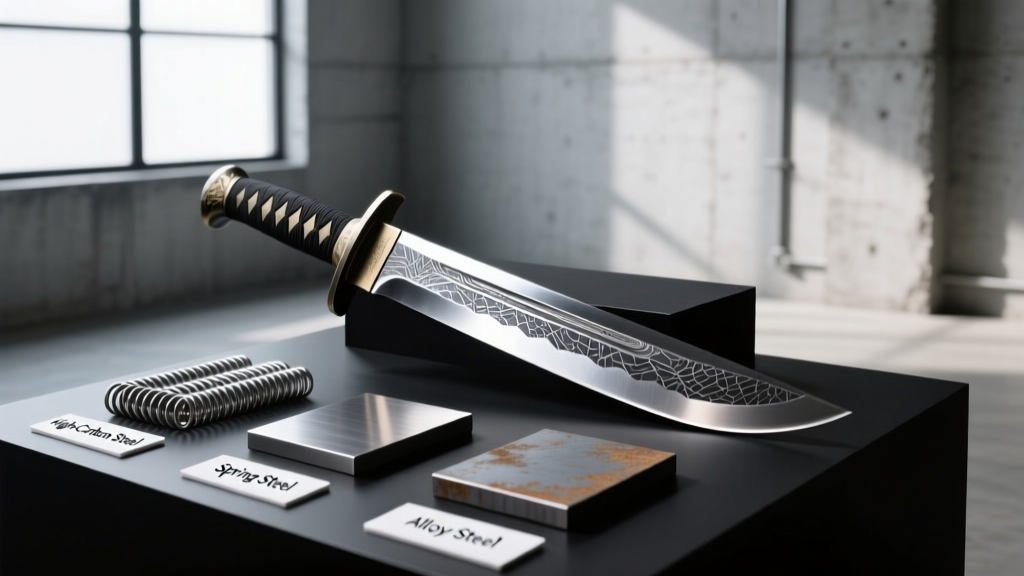
The Metallurgical Fallacy: Why "Super Steels" Fail in Long Blades
While structural engineers select ASTM A992 steel for high-rise I-beams based on predictable yield strength and ductility, custom metalworkers and bladesmiths face a more volatile mechanical challenge. When determining the best material for a sword, the common misconception is that the most expensive, high-wear "super steels" used in modern pocket knives are automatically superior. From a materials science perspective, this is fundamentally incorrect.
Knife blades prioritize edge retention (wear resistance) because they cut via compressive slicing. Swords, particularly those exceeding 24 inches in length, prioritize toughness and lateral shock absorption. A sword striking a dense target experiences massive torsional stress and bending moments. High-carbide powder metallurgy steels (like CPM-S90V or Maxamet) possess extreme compressive hardness but lack the ductility required to absorb lateral impact, leading to catastrophic brittle fracture. Therefore, the optimal alloy for a sword depends entirely on the blade's geometry, length, and intended mechanical load.
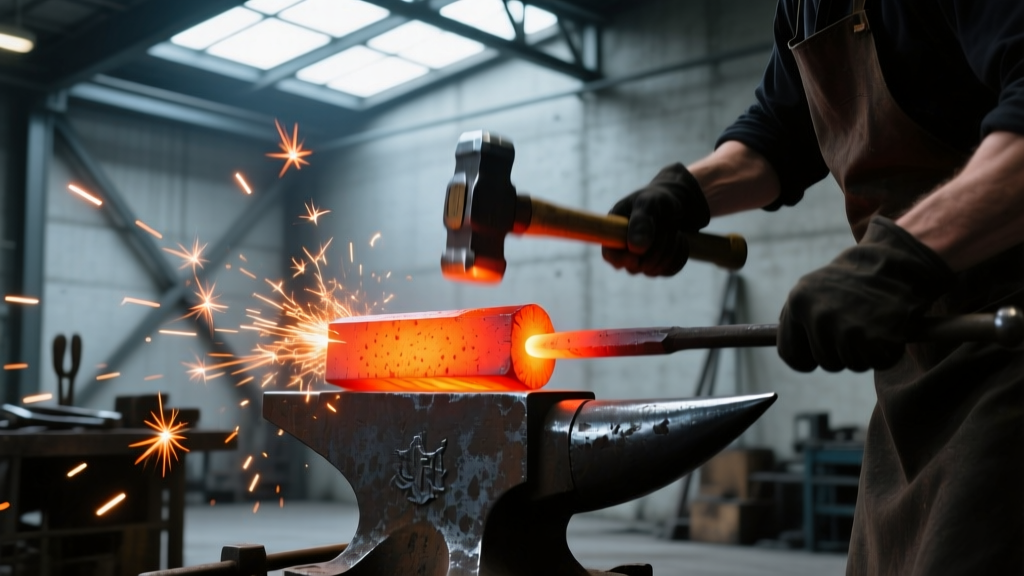
The Iron-Carbon Baseline: Hardness vs. Toughness
The foundation of any ferrous blade alloy is the iron-carbon phase diagram. To achieve a martensitic structure capable of holding an edge, the steel must contain between 0.50% and 1.20% carbon. However, as carbon content increases, the steel's ability to deform plastically (toughness) decreases.
Evaluating Yield Strength and Torsion
In structural building materials, we measure a material's ability to return to its original shape after bending via its yield point. For a functional sword, the steel must possess a high elastic limit. Spring steels, which incorporate silicon or chromium, excel here. They allow the blade to flex up to 15 degrees off-center and return to true without permanent plastic deformation.
Comparative Matrix: Top Alloys for Blade Fabrication
The following matrix evaluates the most reliable alloys for sword fabrication, balancing metallurgical data with practical forging characteristics. Data regarding tensile strength and carbide volume is sourced from industry-standard material property databases and independent metallurgical analysis.
| Alloy Designation | Carbon % | Target HRC | Toughness (Impact Resistance) | Wear Resistance | Best Application |
|---|---|---|---|---|---|
| AISI 5160 | 0.56 - 0.64% | 55 - 57 | Exceptional | Moderate | Longswords, Broadswords, Katanas |
| AISI 1095 | 0.90 - 1.03% | 56 - 58 | Good | High | Short swords, Machetes, Seaxes |
| 80CrV2 | 0.75 - 0.85% | 56 - 58 | Excellent | High | Heavy choppers, Falchions, Axes |
| CPM-S35VN | 1.40% | 59 - 61 | Moderate | Exceptional | Daggers, Dirks, Architectural display |
| CPM MagnaCut | 1.15% | 60 - 62 | High (for stainless) | Exceptional | Marine-environment short blades |
The Powder Metallurgy Revolution
For short blades (under 18 inches) where edge retention is prioritized over extreme lateral flex, Crucible Particle Metallurgy (CPM) represents the pinnacle of modern alloy design. Traditional ingot metallurgy results in large, uneven carbide clusters that act as micro-stress risers. CPM uses gas atomization to create a uniform micro-powder, which is then subjected to Hot Isostatic Pressing (HIP).
According to metallurgical research on CPM MagnaCut stainless steel, eliminating chromium carbides and relying solely on vanadium and niobium carbides yields a stainless alloy with toughness rivaling high-carbon tool steels. While MagnaCut is a breakthrough for daggers and tactical blades, its high cost and extreme difficulty in grinding make it impractical for traditional 36-inch longsword fabrication.
Heat Treatment Best Practices for Functional Swords
Selecting the best material for a sword is irrelevant if the thermal processing is flawed. The ASM International guidelines for heat treating tool and spring steels dictate strict adherence to time-temperature transformation (TTT) curves. Below is the standard protocol for AISI 5160 spring steel, the gold standard for European longsword replicas.
- Normalization (Stress Relieving): Heat the forged blade to 1550°F (843°C) and allow it to cool in still air. Repeat three times. This refines the grain structure and eliminates internal stresses from hammer forging.
- Austenitizing: Heat to exactly 1550°F (843°C) and hold for 10 minutes. This dissolves the carbon into the iron matrix, preparing it for the martensitic transformation.
- Quenching: Submerge vertically into pre-heated (130°F) fast quenching oil (e.g., Parks 50). Agitate briskly to break the vapor jacket. The steel is now fully martensitic and glass-brittle.
- Tempering (Crucial Step): Immediately place in a tempering oven at 400°F (204°C) for two hours. Cool to room temperature, then repeat for a second two-hour cycle. This precipitates fine epsilon carbides, reducing hardness slightly to HRC 56 but exponentially increasing impact toughness.
Decision Framework: Matching Alloy to Fabrication Goal
Use this practical framework to specify the correct material for your next custom metalwork or historical reproduction commission:
- If fabricating a 30"+ Longsword or Katana: Specify AISI 5160 or 9260 Spring Steel. The addition of silicon in 9260 provides superior elastic memory, allowing the blade to withstand severe bending without taking a permanent set.
- If fabricating a heavy chopping Falchion or Messer: Specify 80CrV2. The combination of 0.80% carbon, chromium, and vanadium provides a harder edge than 5160 while maintaining enough ductility to prevent chipping against bone or hardwood.
- If fabricating a 12" Dagger or Stiletto: Specify CPM-S35VN or A2 Tool Steel. Short blades do not experience the same lever-arm torsion as long swords, allowing you to safely utilize higher HRC (60+) alloys for maximum piercing durability and edge retention.
- If fabricating Architectural/Decorative Wall Displays: Specify 304 or 316L Austenitic Stainless Steel. While mechanically unsuitable for impact (HRC ~20, non-martensitic), these alloys offer the corrosion resistance required for humid environments or exterior architectural accents without the need for constant oiling.
Material Science Takeaway: The "best" material is never a single superlative alloy; it is the precise metallurgical match between carbon content, carbide morphology, and the physical geometry of the tool being fabricated. Treat blade steel selection with the same rigorous load-bearing analysis applied to structural construction materials.
Written by
David NakamuraDavid Nakamura is a licensed architect (AIA) and construction technology writer focused on sustainable building methods, mass timber engineering, and high-performance building envelopes. He holds a Master of Architecture from the University of Washington and is a certified Passive House Consultant (CPHC). David spent eight years at the Seattle firm Mithun, where he led the design of three LEED Platinum projects, before founding his own practice specializing in net-zero residential design. He serves on the editorial advisory board of GreenBuilder Magazine and has authored peer-reviewed papers on cross-laminated timber (CLT) connections for the Journal of Structural Engineering. In his spare time, David teaches woodworking at Pratt Fine Arts Center and kayaks the Puget Sound.
More from David Nakamura
View all
Construction Cost
Labor Cost to Build a Deck Per Sq Ft: 2026 Installation Guide
Discover the exact labor cost to build a deck per sq ft in 2026. This installation guide breaks down contractor rates, complexity factors, and hidden fees.
Aug 4, 2026

Construction Cost
How Much Does It Cost to Build a 3 Bedroom House? Financing Guide
Learn exactly how much it costs to build a 3 bedroom house and explore 2026 financing options, construction loan types, and budget frameworks for your build.
Aug 4, 2026

Construction Cost
Cost to Build a Tennis Court: 2026 Guide
How much does it cost to build a tennis court in 2026? Breakdowns for asphalt, concrete, and synthetic surfaces plus fencing and lighting.
Jul 30, 2026