What Materials Were Used to Build the Golden Gate Bridge?
Discover what materials were used to build the Golden Gate Bridge and how its 1930s engineering informs modern coastal material selection guides.

The Masterclass in Marine Material Selection
When structural engineers and procurement specialists ask what materials were used to build the Golden Gate Bridge, the historical answer is straightforward: 83,000 tons of custom silicon steel, 1.2 million hot-driven rivets, and specialized Portland cement. However, viewing this iconic structure merely as a historical artifact misses its immense value as a living laboratory for extreme-environment material selection. Completed in 1937, the bridge was designed to withstand 60 mph winds, powerful tidal currents, and a highly corrosive salt-fog environment. Today, analyzing the original bill of materials provides a critical framework for selecting modern equivalents for coastal infrastructure, suspension bridges, and marine-grade architectural projects in 2026.
Original vs. Modern Material Equivalents
The Golden Gate Bridge Highway and Transportation District has continuously upgraded the bridge's materials over the decades. Below is a selection guide comparing the original 1930s specifications with the modern ASTM standards used for contemporary marine construction.
| Component | Original 1937 Material | Modern 2026 Selection Equivalent | Key Selection Metric |
|---|---|---|---|
| Main Towers & Deck | Custom Silicon Steel (50 ksi yield) | ASTM A709 Grade 50W (Weathering Steel) | Atmospheric corrosion resistance |
| Main Cable Wire | Hot-Dipped Galvanized Steel | ZnAl (Zinc-Aluminum) Mischmetal Coated Wire | 3x lifespan in high-chloride fog |
| Structural Fasteners | Carbon Steel Hot-Driven Rivets | ASTM F3125 Grade A325/F1852 Bolts | High-strength friction-grip tension |
| Anchorages | Standard Portland Cement Concrete | High-Performance Concrete (HPC) w/ Silica Fume | Chloride ion penetrability < 1000 coulombs |
| Protective Coating | Red Lead Primer & Alkyd Topcoat | Zinc Silicate Primer & Polysiloxane Topcoat | Zero-VOC compliance & 30-year lifecycle |
Deep Dive: Structural Steel for High-Salinity Environments
The primary material used in the bridge's towers and deck trusses was a specialized silicon-alloy steel rolled by Bethlehem Steel. The addition of silicon increased the steel's yield strength to 50,000 psi, allowing for lighter, more aerodynamic structural members that reduced dead load on the suspension cables.
Modern Selection Framework for Marine Steel
For modern coastal projects, standard carbon steel (ASTM A36) is unacceptable due to rapid chloride-induced oxidation. When specifying steel for marine splash zones or high-salinity fog environments, engineers must select based on the following hierarchy:
- Weathering Steel (ASTM A709 Grade 50W): Ideal for atmospheric exposure where the structure can dry periodically. It forms a dense, protective patina. Limitation: Not suitable for continuous saltwater immersion or heavy fog zones where the patina cannot stabilize.
- Duplex Stainless Steel (ASTM A240 UNS S31803): The premium choice for critical load-bearing nodes in splash zones. It offers double the yield strength of standard austenitic stainless and exceptional resistance to pitting.
- Thermomechanical Controlled Processing (TMCP) Steels: Used for thick-plate weldments in seismic zones, offering high toughness without the carbon equivalent penalties of traditional quenched and tempered steels.
When selecting austenitic stainless steels (like 304 or 316) for tensioned cable components in marine environments, beware of CISCC. Even 316L can fail catastrophically under sustained tensile stress in the presence of chlorides and temperatures above 120°F. Always specify duplex or super-duplex grades for tensioned marine hardware.
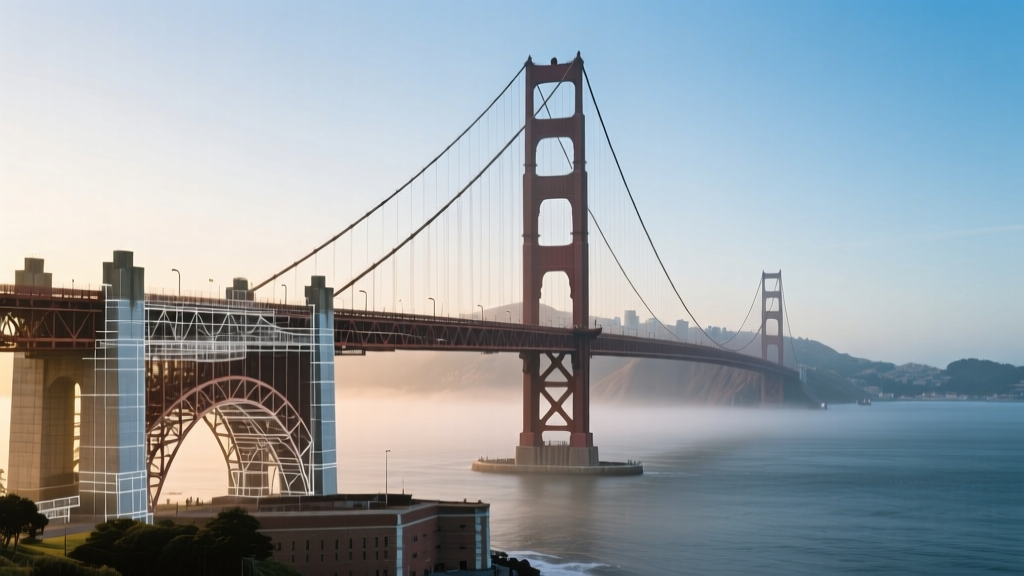
Suspension Cables: The Evolution of Wire Galvanization
The bridge's two main cables contain 27,572 individual strands of galvanized steel wire. In the 1930s, hot-dip galvanizing (pure zinc) was the absolute cutting edge of cathodic protection. However, pure zinc sacrifices itself relatively quickly in the aggressive microclimate of the San Francisco Bay.
According to the Golden Gate Bridge Highway and Transportation District, ongoing maintenance requires continuous dehumidification of the main cables to prevent internal corrosion. If you are specifying materials for a new suspension or cable-stayed bridge today, pure zinc is obsolete.
The 2026 Standard: ZnAl Mischmetal Alloys
Modern material selection dictates the use of Zinc-Aluminum (ZnAl) alloy coatings, typically 95% zinc and 5% aluminum (ASTM A475). The aluminum component creates a barrier layer of aluminum oxide that drastically slows the consumption of the zinc anode. Field data from the Federal Highway Administration (FHWA) indicates that ZnAl-coated wire provides up to three times the corrosion resistance of pure galvanized wire in equivalent marine environments, significantly extending the time between costly cable dehumidification retrofits.
Concrete & Foundation Specifications
The bridge's south pier was an unprecedented engineering feat, built 1,100 feet offshore in open ocean waters. Divers blasted the bedrock, and massive tremie pipes poured standard Portland cement concrete to form the foundation. While revolutionary for its time, modern concrete technology offers vastly superior durability against sulfate attack and rebar corrosion.
Specifying Marine-Grade Concrete
When designing anchorages or piers in tidal zones, the Portland Cement Association (PCA) recommends strict adherence to High-Performance Concrete (HPC) parameters:
- Water-to-Cementitious Ratio (w/c): Must not exceed 0.40 to minimize capillary porosity.
- Supplementary Cementitious Materials (SCMs): Incorporate 8-10% silica fume by weight of cement. Silica fume consumes calcium hydroxide and physically blocks chloride ion ingress.
- Reinforcement: Standard black rebar is prohibited. Specify solid stainless steel rebar (ASTM A955) or high-strength low-carbon chromium steel for the splash zone, and epoxy-coated rebar (ASTM A775) for the substructure.
The Coating Matrix: Protecting the Asset
Perhaps the most famous material used on the bridge is its 'International Orange' paint. Originally, the steel was primed with red lead (lead tetroxide), which provided incredible corrosion inhibition but is now banned due to severe toxicity. The original topcoat was an alkyd enamel, which chalks and degrades under high UV exposure.
Modern coating selection for marine steel requires a multi-component system designed for a 25-to-30-year service life before major rehabilitation.
| Coating Layer | Modern Material Specification | Function & Mil Thickness |
|---|---|---|
| Primer | Moisture-Cured Zinc Silicate (SSPC Paint 20) | Cathodic protection; 3.0 - 5.0 mils DFT |
| Intermediate | High-Build Epoxy Mastic (SSPC Paint 25) | Barrier coat & surface tolerance; 6.0 - 8.0 mils DFT |
| Topcoat | Polysiloxane or Fluorourethane | UV resistance & color retention; 2.0 - 3.0 mils DFT |
Procurement Note: When specifying polysiloxane topcoats for landmark structures, ensure the pigment load is engineered for high UV reflectance. Standard acrylics will require recoating every 10-15 years, whereas advanced polysiloxanes maintain gloss and film integrity for 25+ years in marine atmospheres.
Decision Framework for Coastal Infrastructure
Selecting materials for projects mirroring the scale and environmental hostility of the Golden Gate Bridge requires a systematic approach. Use this decision matrix during the preliminary design phase:
- Define the Microclimate Zone: Categorize structural elements into Atmospheric, Splash, Tidal, or Submerged zones. Material selection must change at each boundary.
- Calculate Lifecycle Cost (LCCA): Do not select materials based on initial capital expenditure. Duplex stainless steel may cost 4x more than coated carbon steel initially, but its 100-year zero-maintenance profile in the splash zone yields a lower net present value.
- Design for Inspectability: Specify hollow structural sections (HSS) with integrated dehumidification ports for main cables, mirroring the retrofits applied to the Golden Gate Bridge in the 2000s.
- Mandate Mock-Ups: Require accelerated cyclic corrosion testing (ASTM G85 Annex A5) on all specified coating systems before final procurement approval.
Understanding what materials were used to build the Golden Gate Bridge is not just an exercise in historical trivia; it is the foundational baseline for modern marine engineering. By upgrading 1930s silicon steel and red lead to modern ZnAl alloys, duplex stainless steels, and polysiloxane coatings, today's engineers can ensure that the next generation of coastal infrastructure survives the next century with minimal intervention.
Written by
James ThorntonJames Thornton is a construction industry veteran with 25 years of hands-on experience in wood framing, lumber grading, and residential building codes. He started as a framing carpenter in rural Oregon, earned his ICC Residential Building Inspector certification, and eventually became a senior plan reviewer for the City of Portland Bureau of Development Services. James holds a B.S. in Wood Science & Technology from Oregon State University and is a certified lumber grader through the West Coast Lumber Inspection Bureau (WCLIB). He has inspected over 3,000 residential construction sites and authored the city's internal guide on advanced framing techniques (2x6 at 24" O.C.). James lives in Bend, OR, where he builds custom timber-frame cabins and competes in lumberjack sports.
More from James Thornton
View all
Insulation
Best Home Insulation Materials: Complete 2026 Guide
Compare top home insulation materials for 2026. Find R-values, installed costs per square foot, and best uses for fiberglass, spray foam, and mineral wool.
Aug 4, 2026

Sustainable Building
Certify Your Green Building Material for LEED and WELL
Step-by-step guide to certifying a green building material for LEED v5 and WELL v2. Master EPDs, HPDs, and VOC limits for 2026 project specifications.
Aug 4, 2026

Stone & Masonry
Veneer Stacked Stone Panels: Interior Design & Style Showcase
Discover how veneer stacked stone panels transform interiors. Explore modern design profiles, material pairings, and technical installation specs.
Aug 4, 2026