Building Wrap Material Costs: 2026 Price & ROI Analysis
Compare 2026 building wrap material costs, from Tyvek to ZIP System. Analyze material pricing, labor savings, and long-term energy ROI.

The True Cost of Weather-Resistive Barriers in 2026
Selecting the right building wrap material is no longer just about keeping bulk water out of the wall cavity; it is a critical calculation in air-sealing, vapor management, and overall energy efficiency. As building codes tighten toward the 2024 and 2027 IECC standards, the weather-resistive barrier (WRB) has evolved from a cheap, secondary defense line into a primary building enclosure system. For contractors and developers in 2026, the initial material cost of a building wrap is only a fraction of the total economic impact. Labor efficiency, accessory costs, and long-term HVAC load reductions drastically alter the true return on investment (ROI).
This cost analysis breaks down the three dominant categories of building wrap materials—traditional non-woven membranes, integrated sheathing panels, and fluid-applied membranes—providing exact pricing, labor variables, and performance metrics to help you allocate your enclosure budget effectively.
Material vs. Installed Cost Breakdown
The table below outlines the baseline material and fully installed costs per square foot for the most common building wrap material categories in the 2026 market. Installed costs include standard framing labor rates (averaging $55 to $65 per hour) and basic accessories like cap staples or seam tapes.
| Material Category | Representative Product | Material Cost / Sq Ft | Installed Cost / Sq Ft | Permeability (Perms) |
|---|---|---|---|---|
| #15 Asphalt Felt | Generic 15lb Felt | $0.05 - $0.08 | $0.45 - $0.65 | 10 - 15 (Variable) |
| Non-Woven Wrap | DuPont Tyvek HomeWrap | $0.15 - $0.22 | $0.60 - $0.95 | 58 |
| Integrated Sheathing | Huber ZIP System | $1.15 - $1.45 (Premium) | $1.40 - $2.10 (Net) | 12 - 16 |
| Fluid-Applied | Prosoco R-Guard FastFlash | $0.85 - $1.50 | $2.20 - $3.50 | 18 |
Category Analysis: Which Building Wrap Material Fits Your Budget?
1. Traditional Non-Woven Wraps (e.g., DuPont Tyvek)
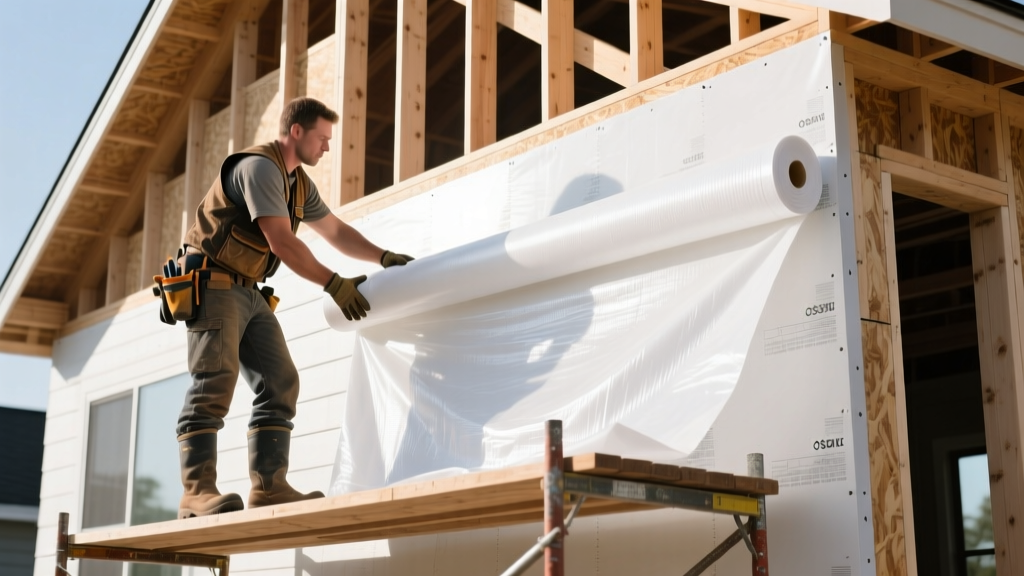
Spunbonded polyolefin wraps like DuPont Tyvek HomeWrap remain the industry baseline. At $0.15 to $0.22 per square foot for the membrane alone, it is highly cost-effective for material purchasing. However, the true cost of traditional wraps lies in the labor and accessories. Installing Tyvek requires a secondary trade step after the sheathing is nailed off. A two-person crew will typically take 4 to 6 hours to wrap a 2,500-square-foot single-story home, adding $440 to $780 in direct labor costs.
Furthermore, traditional wraps are highly susceptible to installation errors. Reverse shingling, inadequate overlapping (minimum 6 inches required), and tearing around window bucks compromise the air barrier. According to the U.S. Department of Energy, unsealed WRB seams and penetrations can account for up to 25% of a home's total air leakage, negating the energy savings of high-R-value cavity insulation.
2. Integrated Sheathing Systems (e.g., Huber ZIP System)
Integrated sheathing eliminates the separate wrap installation step by applying a weather-resistant coating directly to the OSB panel at the factory. While the material carries a premium of $1.15 to $1.45 per square foot over standard OSB, the labor savings are substantial. Because the framing crew tapes the seams as they install the panels, you eliminate the need for a separate wrap crew, scaffolding repositioning, and secondary cap-nailing.
For a 3,000-square-foot exterior wall area, the material premium is roughly $1,500 to $2,000. However, eliminating 1.5 days of wrap labor and scaffolding rentals easily saves $1,200 to $1,800, making the net installed cost highly competitive with premium traditional wraps. The primary failure mode for this building wrap material is improper tape adhesion. ZIP System Tape requires a specialized roller tool and a clean, dry substrate; applying it in freezing temperatures or over dusty OSB leads to seam failure and costly warranty voids.
3. Fluid-Applied Membranes (e.g., Prosoco R-Guard)
Fluid-applied building wrap materials are roller- or spray-applied liquid membranes that cure into a seamless, monolithic rubberized coating. Priced at $0.85 to $1.50 per square foot for the liquid alone, this is the most expensive material option. It is rarely used as a full-wall WRB in standard residential construction due to the high cost and the labor-intensive nature of rolling it onto large, flat OSB expanses.
However, fluid-applied membranes offer unmatched ROI on complex geometries. For curved walls, intricate window bucks, and deep cantilevers where cutting and folding traditional wrap creates vulnerable seams, fluid-applied products provide a guaranteed air and water seal. As noted by Building Science Corporation, managing water at complex transitions is where the majority of building enclosure failures occur, making fluid-applied membranes a cost-effective insurance policy for high-risk detailing.
Warning: The Accessory Cost Trap
When budgeting for building wrap materials, contractors frequently underestimate accessory costs. A $250 roll of premium house wrap covering 500 square feet requires:
- Cap Nails/Staples: 2 boxes ($90 total) to prevent wind-tear before siding installation.
- Seam Tape: 4 to 6 rolls of compatible acrylic tape ($200 - $300) to achieve code-mandated air-barrier continuity.
- Flashing Tapes: Butyl or acrylic flashing tapes for windows and doors ($150+).
Always calculate your WRB budget by adding a minimum of 60% to the raw membrane cost to account for tapes, fasteners, and flashing.
Labor Savings and ROI: The Hidden Economics
The financial justification for upgrading your building wrap material relies heavily on the blower door test. Modern energy codes (and certification programs like ENERGY STAR and Passive House) require strict Air Changes per Hour at 50 Pascals (ACH50). A standard home wrapped in felt or poorly taped Tyvek typically tests between 5.0 and 8.0 ACH50. A home utilizing meticulously taped integrated sheathing or fluid-applied membranes routinely tests below 2.0 ACH50.
Reducing air leakage from 5.0 to 2.0 ACH50 allows HVAC contractors to downsize heating and cooling equipment by 10% to 15%. On a custom home with a $25,000 HVAC budget, this yields $2,500 to $3,750 in immediate equipment savings, effectively paying for the premium building wrap material before the house is even finished.
Additionally, tighter enclosures reduce the long-term energy burden on the homeowner. By eliminating convective loops that pull conditioned air through the wall cavity, premium WRBs protect the R-value of fiberglass and mineral wool batts, which can lose up to 40% of their stated thermal resistance when subjected to steady air movement.
Climate Zone Decision Matrix
Choosing a building wrap material is not just about budget; it is about hygrothermal performance. Vapor permeability dictates whether a wall can dry to the exterior. Use this matrix to align your material choice with your 2026 project's climate zone:
- Climate Zones 1-3 (Hot/Humid): Prioritize high-permeability wraps (Tyvek at 58 perms or fluid-applied vapor-open membranes). Air conditioning cools the interior drywall, making it a condensing surface. The WRB must allow outward drying to prevent mold growth inside the cavity.
- Climate Zones 4-5 (Mixed): Integrated sheathing (ZIP System) or standard non-woven wraps perform exceptionally well here. The drying potential is balanced, and the primary focus should be on liquid water management and air-sealing to handle both heating and cooling seasons.
- Climate Zones 6-8 (Cold): Focus heavily on interior vapor retarders (Class I or II) and use a standard WRB on the exterior. Avoid using low-perm fluid-applied membranes or foil-faced wraps on the exterior of cold-climate walls, as they will trap interior moisture trying to dry outward during the winter months.
For comprehensive guidance on enclosure drying potential and vapor drive, refer to the Building Science Digest on Energy Efficient Enclosures. Ultimately, the most cost-effective building wrap material is the one that your specific framing crew can install flawlessly, ensuring continuous air and water control without compromising the wall's ability to dry.
Written by
Priya KapoorPriya Kapoor is a real estate market analyst and construction economics researcher with expertise in housing affordability, development feasibility, and infrastructure investment. She holds a Master of Regional Planning from Cornell University and previously worked as a senior analyst at CBRE's Investment Properties group, where she modeled returns for $4B in mixed-use development pipelines. Priya now runs an independent research practice advising developers, municipalities, and REITs on construction cost forecasting and market timing. She publishes the quarterly "BuildMat Market Pulse" report tracking material price indices across 12 commodity categories. Based in Austin, TX, Priya serves on the board of Habitat for Humanity Austin and is a marathon runner.
More from Priya Kapoor
View all
Construction Cost
Cost to Build a 1600 Sq Ft Home in 2026: Full Breakdown
Accurate 2026 cost to build a 1600 sq ft home—material, labor, and regional pricing breakdowns included. Plan your budget with real-time estimates.
Aug 11, 2026

Wood & Lumber
Name the Types of Wood for Pressure Treatment and Preservation
Learn how to name the types of wood best suited for pressure treatment. Compare species treatability, chemical retention levels, and 2026 preservation costs.
Aug 4, 2026

Stone & Masonry
Stone Veneer Suppliers Lindenhurst: 2026 Cost Analysis
Analyze 2026 stone veneer costs in Lindenhurst, NY. Compare local supplier pricing, delivery fees, and Suffolk County installation labor rates.
Aug 4, 2026