Specifying the Best Cutting Board Material for Knives in Kitchens
Discover the best cutting board material for knives in commercial millwork. Compare HDPE, end-grain maple, and synthetic rubber for kitchen builds.
The Intersection of Blade Metallurgy and Architectural Millwork
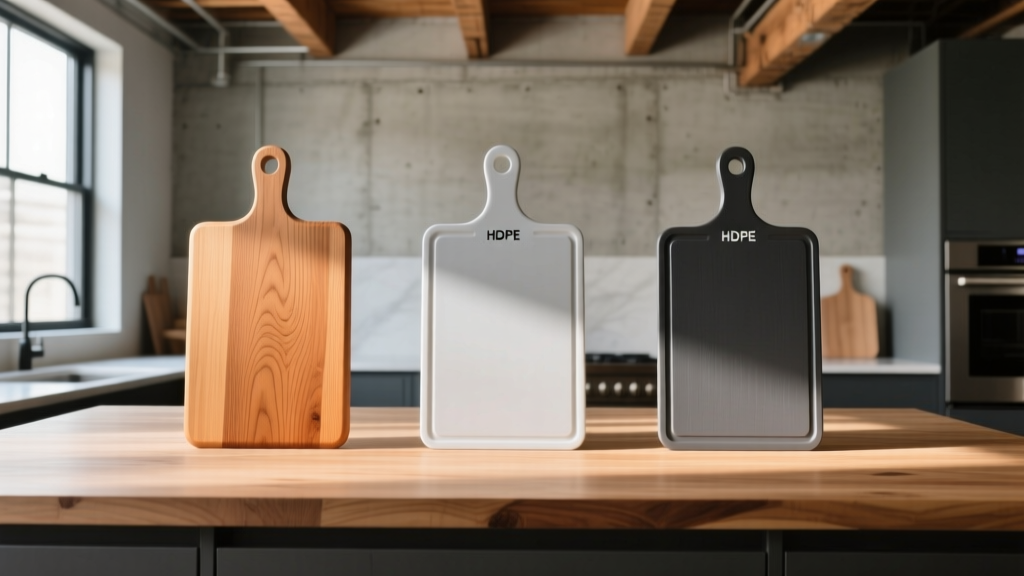
When architectural millworkers and commercial kitchen contractors specify food preparation surfaces, they must balance strict health code compliance with the physical preservation of expensive cutlery. The quest to identify the best cutting board material for knives is not merely a culinary preference; it is a materials science challenge. Professional kitchen knives are typically forged from high-carbon or stainless steels hardened to a Rockwell C scale (HRC) between 56 and 62. When a hardened steel edge strikes a surface that is too dense, abrasive, or unyielding, the microscopic carbides in the steel fracture or roll, leading to rapid edge degradation.
For custom residential builds and commercial food service layouts, integrating the correct cutting surface directly into cabinetry and stainless steel prep tables requires a deep understanding of material hardness, porosity, and dimensional stability. Specifying the wrong material results in increased equipment replacement costs, compromised food safety, and failed health inspections.
Material Matrix: Hardness, Porosity, and Compliance
To evaluate surfacing options, fabricators must cross-reference the Janka hardness scale (which measures the force required to embed a steel ball into wood) with the FDA Food Code requirements for non-absorbent, easily cleanable surfaces in commercial zones. According to the FDA Food Code, cutting surfaces must be smooth, non-absorbent, and easily cleanable, though exceptions exist for specific hardwoods used in specialized prep areas.
| Material | Hardness / Density | Silica Content | Knife Edge Impact | Commercial NSF Status |
|---|---|---|---|---|
| End-Grain Hard Maple | 1,450 lbf (Janka) | Negligible | Minimal wear; fibers part cleanly | Approved for specific dry/bakery prep |
| High-Density Polyethylene (HDPE) | Shore D 65 | Zero | Low wear; absorbs impact shock | Fully compliant for all raw proteins |
| Synthetic Rubber (Elastomer) | Shore A 85 | Zero | Zero micro-chipping; high shock absorption | Compliant with proper sanitation |
| Bamboo (Grass Composite) | 1,380 lbf (Janka) | High (Phytoliths) | Severe dulling; abrasive silica strips edges | Not recommended for heavy commercial |
| Quartz / Glass / Stone | >7,000 lbf equiv. | Very High | Catastrophic edge failure; micro-chipping | Banned as primary cutting surfaces |
Deep Dive: Top 3 Materials Specified by Kitchen Fabricators
1. End-Grain Hard Maple (Acer saccharum)
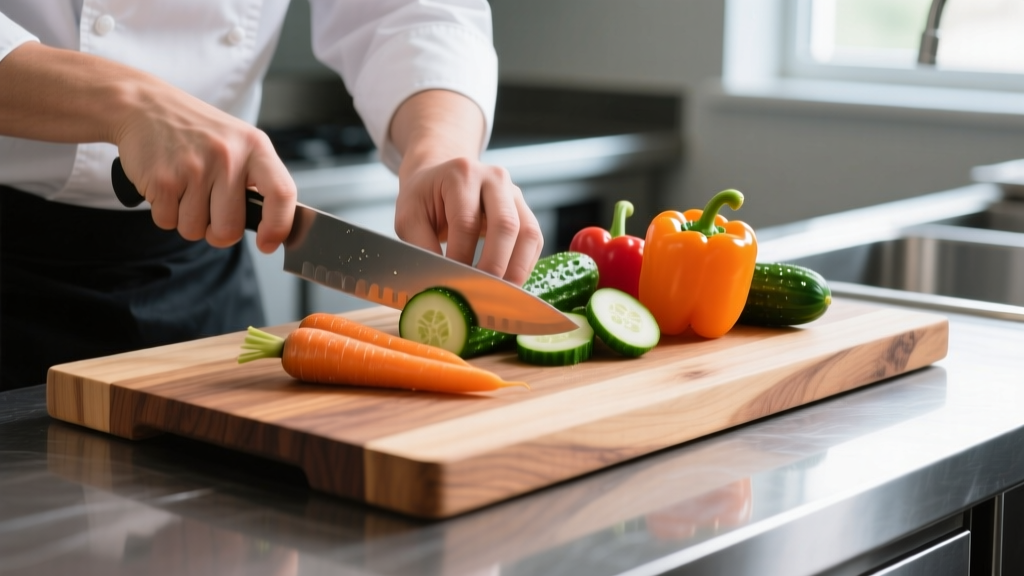
For high-end residential kitchens and artisanal bakery millwork, end-grain hard maple remains the gold standard. According to data compiled by The Wood Database, hard maple sits at an optimal 1,450 lbf on the Janka scale. This hardness is sufficient to resist deep gouging but soft enough to yield to a 60 HRC knife edge.
The critical advantage of end-grain construction lies in its cellular orientation. When a knife strikes end-grain wood, it slides between the vertical wood fibers rather than severing them. The fibers naturally close back up after the blade passes, creating a self-healing surface that dramatically extends knife sharpness. Fabricators must specify kiln-dried maple with a moisture content of 6-8% and utilize FDA-compliant, waterproof adhesives like Titebond III for the glue-up process to prevent delamination in humid kitchen environments.
2. High-Density Polyethylene (HDPE)
In high-volume commercial environments where raw proteins are processed, HDPE (often specified under brand names like King StarBoard or PolyHi Solidur) is the mandatory choice. HDPE is entirely non-porous, impervious to moisture, and can withstand aggressive chemical sanitizers and high-temperature commercial dishwashers.
From a knife-preservation standpoint, HDPE provides a slight cushioning effect that prevents edge rolling. However, it is prone to developing deep score marks over time. To mitigate cross-contamination and manage wear, millworkers should specify color-coded HDPE drop-in boards (e.g., red for raw meat, green for produce, white for dairy) routed directly into stainless steel prep tables with replaceable fasteners.
3. Synthetic Rubber (Hasegawa / Asahi Profiles)
For specialized prep stations focusing on precision slicing (such as sushi bars or charcuterie stations utilizing fragile, high-carbon Japanese blades), synthetic rubber boards are the superior specification. Brands like Hasegawa utilize a solid wood core encased in a thick, high-density elastomer. This material offers the highest shock absorption of any commercial surface, virtually eliminating micro-chipping on ultra-hard, brittle steel edges like VG-10 or SG2 powdered steels. While not typically built-in as permanent millwork, fabricators often design custom recessed docks in countertops to hold these specialized boards flush with the primary work surface.
Millwork Fabrication and Drop-In Installation Best Practices
Integrating thick hardwood or HDPE cutting surfaces into surrounding cabinetry or stainless steel counters requires precise tolerances to account for thermal expansion and moisture ingress.
- Expansion Gaps: Hard maple expands and contracts tangentially with seasonal humidity shifts. Fabricators must route a minimum 1/8-inch expansion gap around the entire perimeter of a drop-in wooden board. HDPE requires a similar gap due to its high coefficient of thermal expansion when exposed to hot commercial dishwashing cycles.
- Sealant Specification: Do not use standard hardware-grade silicone. Specify an NSF/ANSI Standard 51 certified silicone sealant (such as Dow Corning 795 or equivalent food-safe variants) to fill the expansion gap. This prevents organic debris and moisture from accumulating in the seam while allowing the material to move.
- Substrate Support: Heavy end-grain maple boards (often 2 to 3 inches thick) require robust structural support. Install a marine-grade plywood or aluminum honeycomb sub-base beneath the board, ensuring the cutting surface sits perfectly flush with the adjacent stainless steel or quartz perimeter. A recessed lip route (rabbet joint) on the underside of the board prevents it from pushing through the counter plane.
- Edge Profiling: Route a slight 1/16-inch chamfer or bullnose on the top perimeter edge of the integrated board. Sharp 90-degree corners on hardwood will splinter over time from impact and trap bacteria, violating health code smooth-surface requirements.
Maintenance Protocols for Built-In Surfaces
The longevity of an integrated cutting surface depends heavily on the chemical treatments applied post-installation. For end-grain maple millwork, fabricators should pre-finish the board before installation using a polymerizing oil, such as pure tung oil or specialized board creams containing beeswax and mineral oil. These oils penetrate the end-grain capillaries and cure, creating a hydrophobic barrier that repels meat juices and prevents the wood fibers from swelling and warping.
HDPE surfaces require no oiling but demand rigorous mechanical maintenance. Once deep score marks exceed 1/16-inch in depth, the board must be removed from the drop-in housing and run through a commercial planer or sanded with an orbital sander (using 80-grit followed by 120-grit pads) to expose fresh, un-scored material. Designing the millwork with removable, screw-secured retention brackets rather than permanent silicone adhesion allows kitchen staff to rotate and resurface the boards without calling in a contractor.
Final Specification Recommendations
Selecting the best cutting board material for knives in a built environment requires matching the material to the specific culinary application of that zone. Specify flush-mounted end-grain hard maple for dry prep, baking, and residential chef kitchens where edge retention is paramount and raw protein cross-contamination is less centralized. Mandate color-coded, drop-in HDPE modules for all commercial raw meat and seafood processing zones to satisfy health inspectors while providing adequate shock absorption for heavy cleavers and boning knives. By treating cutting surfaces as precision architectural components rather than mere accessories, contractors deliver kitchens that protect both the culinary investment and the end-user's safety.
Written by
James ThorntonJames Thornton is a construction industry veteran with 25 years of hands-on experience in wood framing, lumber grading, and residential building codes. He started as a framing carpenter in rural Oregon, earned his ICC Residential Building Inspector certification, and eventually became a senior plan reviewer for the City of Portland Bureau of Development Services. James holds a B.S. in Wood Science & Technology from Oregon State University and is a certified lumber grader through the West Coast Lumber Inspection Bureau (WCLIB). He has inspected over 3,000 residential construction sites and authored the city's internal guide on advanced framing techniques (2x6 at 24" O.C.). James lives in Bend, OR, where he builds custom timber-frame cabins and competes in lumberjack sports.
More from James Thornton
View all
Insulation
Best Home Insulation Materials: Complete 2026 Guide
Compare top home insulation materials for 2026. Find R-values, installed costs per square foot, and best uses for fiberglass, spray foam, and mineral wool.
Aug 4, 2026

Sustainable Building
Certify Your Green Building Material for LEED and WELL
Step-by-step guide to certifying a green building material for LEED v5 and WELL v2. Master EPDs, HPDs, and VOC limits for 2026 project specifications.
Aug 4, 2026

Stone & Masonry
Veneer Stacked Stone Panels: Interior Design & Style Showcase
Discover how veneer stacked stone panels transform interiors. Explore modern design profiles, material pairings, and technical installation specs.
Aug 4, 2026