Kitchen FF&E Specs: Identifying the Best Material for Cookware Health
Technical specifications for kitchen FF&E procurement, analyzing metallurgical data and NSF standards to select the best material for cookware health.

The Intersection of Kitchen Design and Culinary Metallurgy
When architects, interior designers, and general contractors execute high-end residential kitchen remodels or commercial wellness-focused culinary build-outs, the procurement of Furniture, Fixtures, and Equipment (FF&E) extends beyond aesthetics. In 2026, with stringent indoor air quality (IAQ) standards and heightened awareness regarding per- and polyfluoroalkyl substances (PFAS), specifying the best material for cookware health has become a critical technical requirement. Wellness-centric clients and farm-to-table commercial operators demand culinary surfaces that do not off-gas volatile organic compounds (VOCs) or leach heavy metals into acidic food matrices.
Selecting the appropriate metallurgical composition for kitchen FF&E requires an understanding of thermal diffusivity, magnetic permeability for induction compatibility, and compliance with food-safe contact regulations. This technical guide breaks down the material science behind health-safe cookware to inform architectural specification schedules and commercial kitchen procurement.
Technical Breakdown: Evaluating the Best Material for Cookware Health
To determine the optimal materials for health-conscious kitchen builds, we must analyze the crystalline structure and chemical stability of the primary alloys and ceramics used in premium culinary manufacturing.
1. Surgical-Grade Austenitic Stainless Steel (SAE 304 / 18/10)
SAE 304 stainless steel, commonly marketed as 18/10 (18% chromium, 10% nickel), remains the benchmark for commercial and high-end residential kitchens. The chromium forms a passive, self-healing layer of chromium oxide that prevents corrosion and rust. From a health perspective, high-quality 18/10 stainless steel is highly inert. According to toxicological studies published in the National Institutes of Health (NIH), while trace amounts of nickel and chromium can leach when cooking highly acidic foods (like tomato sauce) for extended durations, the levels remain well below established toxicological thresholds for the general population.
Specification Note for Induction Cooktops: Austenitic 304 stainless steel is non-magnetic, meaning it will not work on the induction ranges standard in 2026 energy-efficient kitchen builds. Procurement specs must mandate encapsulated tri-ply or multi-ply constructions featuring a ferritic stainless steel (SAE 430) or carbon steel base plate to ensure magnetic permeability without compromising the 18/10 interior cooking surface.
2. Vitreous Enameled Cast Iron
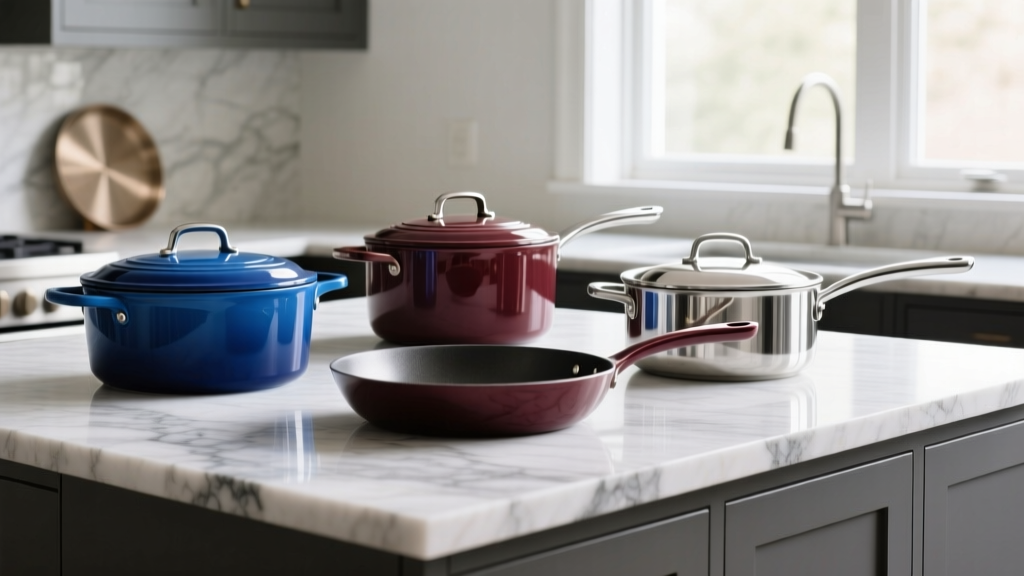
For slow-braising and high-heat searing, enameled cast iron provides a completely non-reactive cooking surface. The manufacturing process involves fusing a frit (powdered glass) to a gray iron core at temperatures exceeding 1,400°F (760°C). This creates a vitreous enamel coating that is chemically inert, impervious to acidic foods, and entirely free of synthetic polymers. When sourcing for commercial or residential FF&E, ensure the enamel pigments comply with FDA 21 CFR 175.300 regarding resinous and polymeric coatings, specifically verifying that the exterior colorants are free of lead and cadmium, which were historically used in bright red and orange ceramic glazes.
3. Low-Carbon Steel (Uncoated)
Composed of 99% iron and 1% carbon, carbon steel is the traditional choice for high-heat commercial wok stations and skillets. It contains no synthetic coatings, relying instead on a polymerized layer of oil (seasoning) for its non-stick properties. While exceptionally durable and highly responsive to temperature changes, carbon steel requires rigorous maintenance. It is unsuitable for cooking highly acidic ingredients, which will strip the polymerized seasoning and expose the bare iron to rapid oxidation.
Traditional PTFE (polytetrafluoroethylene) non-stick coatings begin to degrade and release toxic fluoropolymer fumes when surface temperatures exceed 500°F (260°C). While modern PTFE is PFOA-free, the microplastic and PFAS concerns surrounding its lifecycle disposal have led many wellness-focused clients to reject it. Alternatively, 'ceramic' non-stick coatings (sol-gel silicon dioxide) avoid PFAS entirely but suffer from severe mechanical degradation. The hydrophobic siloxane bonds break down after 300 to 500 thermal cycles or when exposed to alkaline commercial dishwashing detergents, resulting in a high FF&E replacement rate that disrupts lifecycle cost analyses.
Thermal Conductivity & Compliance Matrix
When specifying equipment for commercial kitchen layouts or high-performance residential culinary zones, thermal conductivity (measured in Watts per meter-Kelvin, W/m·K) dictates energy efficiency and cooking precision. The matrix below compares the primary health-safe materials against critical engineering and compliance metrics.
| Material Specification | Thermal Conductivity (W/m·K) | Induction Compatible | NSF/ANSI 51 Status | Acid Reactivity |
|---|---|---|---|---|
| SAE 304 Stainless (18/10) | 16.2 (Core) | No (Requires 430 Base) | Certified | Non-Reactive |
| Enameled Cast Iron | 55.0 (Core) | Yes | Certified | Non-Reactive |
| Carbon Steel (1% C) | 54.0 | Yes | Certified (Seasoned) | Highly Reactive |
| Sol-Gel Ceramic (SiO2) | Variable (Substrate) | Substrate Dependent | Varies by Mfr. | Non-Reactive |
Note: Commercial food equipment materials must comply with NSF/ANSI 51 standards, which dictate the minimum material requirements for safety, sanitation, and cleanability in food zones.
Procurement & Lifecycle Cost Analysis for Commercial Builds
For commercial contractors and FF&E purchasing agents, the initial unit cost of health-safe cookware must be weighed against its mean time between failures (MTBF) and replacement frequency. Wellness retreats and high-volume health-focused restaurants often attempt to cut costs by procuring sol-gel ceramic non-stick pans, averaging $35 to $60 per unit. However, the mechanical degradation of the siloxane layer in commercial environments necessitates replacement every 3 to 6 months.
Conversely, specifying 5-ply SAE 304 stainless steel skillets ($90 to $140 per unit) or enameled cast iron Dutch ovens ($180 to $320 per unit) represents a higher initial capital expenditure. Yet, these materials possess an operational lifecycle measured in decades, not months. The 18/10 stainless steel can be aggressively scoured with commercial abrasives and run through high-temperature sanitation dishwashers without compromising its structural integrity or food safety profile. From a lifecycle cost analysis (LCCA) perspective, inert metallurgical options yield a 40% to 60% reduction in 5-year FF&E replacement costs compared to coated alternatives.
Specification Guidelines for Architects and Kitchen Designers
When drafting the FF&E schedule for a wellness-certified residential build (such as LEED or WELL Building Standard projects) or a commercial culinary space, incorporate the following technical parameters into your procurement documents:
- Mandate Core Alloy Disclosures: Require manufacturers to specify the exact SAE grade of stainless steel used on the food-contact surface. Reject specifications that simply state 'premium stainless' without verifying it is 18/10 or 304-grade.
- Specify Encapsulated Base Plates: To ensure compatibility with induction ranges (which reduce ambient kitchen heat loads and improve HVAC efficiency), specify tri-ply or 5-ply constructions with a magnetic SAE 430 exterior base plate.
- Prohibit PFAS and Sol-Gel in High-Heat Zones: Explicitly exclude PTFE, PFOA, GenX, and sol-gel ceramic coatings from FF&E schedules for any equipment designated for high-heat searing, broiling, or commercial wok stations where surface temperatures routinely exceed 450°F.
- Verify Enamel Firing Standards: For enameled cast iron procurement, require documentation that the vitreous enamel is fired at a minimum of 1,400°F to ensure proper glass-to-metal adhesion, preventing thermal shock spalling during commercial deglazing operations.
- Require NSF/ANSI 51 Certification: For all commercial projects, the FF&E schedule must mandate that all food-contact surfaces carry current NSF/ANSI 51 certification, ensuring the materials meet strict sanitation and toxicity thresholds.
"In modern culinary architecture, the kitchen is not just a visual centerpiece but a highly engineered environmental system. Specifying inert, metallurgically stable cookware is as critical as specifying low-VOC cabinetry adhesives or HEPA-integrated ventilation hoods. The health of the end-user relies on the microscopic stability of the materials we procure."
By prioritizing metallurgical integrity and verifiable compliance standards over marketing-driven non-stick claims, construction professionals and designers can deliver kitchen spaces that align with the highest standards of environmental and human health. Ensuring that the FF&E schedule reflects the best material for cookware health guarantees that the culinary environment remains safe, durable, and highly functional for decades.
Written by
Priya KapoorPriya Kapoor is a real estate market analyst and construction economics researcher with expertise in housing affordability, development feasibility, and infrastructure investment. She holds a Master of Regional Planning from Cornell University and previously worked as a senior analyst at CBRE's Investment Properties group, where she modeled returns for $4B in mixed-use development pipelines. Priya now runs an independent research practice advising developers, municipalities, and REITs on construction cost forecasting and market timing. She publishes the quarterly "BuildMat Market Pulse" report tracking material price indices across 12 commodity categories. Based in Austin, TX, Priya serves on the board of Habitat for Humanity Austin and is a marathon runner.
More from Priya Kapoor
View all
Construction Cost
Cost to Build a 1600 Sq Ft Home in 2026: Full Breakdown
Accurate 2026 cost to build a 1600 sq ft home—material, labor, and regional pricing breakdowns included. Plan your budget with real-time estimates.
Aug 11, 2026

Wood & Lumber
Name the Types of Wood for Pressure Treatment and Preservation
Learn how to name the types of wood best suited for pressure treatment. Compare species treatability, chemical retention levels, and 2026 preservation costs.
Aug 4, 2026

Stone & Masonry
Stone Veneer Suppliers Lindenhurst: 2026 Cost Analysis
Analyze 2026 stone veneer costs in Lindenhurst, NY. Compare local supplier pricing, delivery fees, and Suffolk County installation labor rates.
Aug 4, 2026