What Material Is Best for Underwear for Construction Workers?
Discover what material is best for underwear on the construction site. Compare Merino wool, synthetics, and FR blends for laborer comfort and safety.
The Hidden PPE: Why Base Layer Materials Matter on the Job Site
When evaluating site safety, most contractors focus on hard hats, steel-toe boots, and fall arrest systems. However, the foundation of a laborer's comfort, endurance, and thermal regulation starts at the skin level. When site managers and tradespeople ask what material is best for underwear, the context is vastly different from everyday apparel. Construction professionals require base layers that manage extreme moisture, prevent severe friction burns from heavy outerwear, and in some cases, provide critical flame resistance.
The wrong base layer can lead to debilitating chafing, accelerated heat exhaustion, or catastrophic burn injuries in flash-fire scenarios. According to the NIOSH guidelines on heat stress, improper clothing that traps sweat is a primary contributing factor to heat-related illnesses in outdoor laborers. This comparison review breaks down the exact fabric compositions, GSM (grams per square meter) weights, and safety ratings you need to specify when outfitting your crew or upgrading your own workwear.
Material Comparison Matrix: Synthetics vs. Wool vs. FR Blends
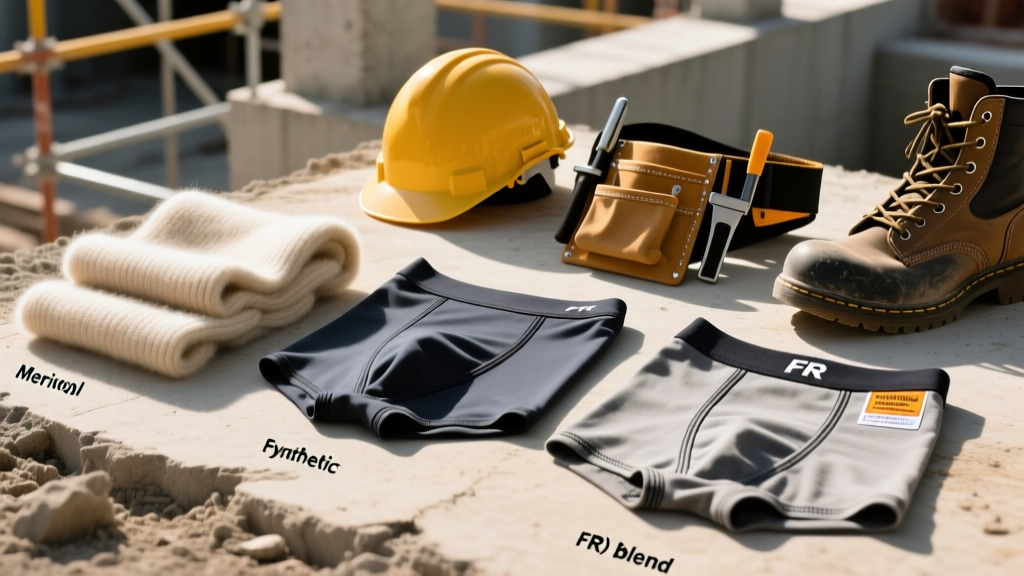
Before diving into specific use cases, here is a direct comparison of the four primary material categories used in construction base layers and work underwear.
| Material Type | Moisture Wicking | Durability | FR Compliance | Avg. Cost (Per Pair) |
|---|---|---|---|---|
| Merino Wool (150-250 GSM) | Excellent | Moderate | No (Naturally flame-resistant but melts) | $45 - $65 |
| Synthetic Blends (Poly/Nylon/Spandex) | Superior | High | No (Melts to skin in high heat) | $15 - $30 |
| FR Modacrylic Blends | Good | High | Yes (ASTM F1506 / NFPA 70E) | $50 - $85 |
| 100% Cotton | Poor (Traps moisture) | Moderate | No (Highly flammable) | $10 - $20 |
Merino Wool: The Premium Temperature Regulator
For general contractors, framers, and heavy equipment operators working in fluctuating climates, Merino wool is widely considered the gold standard. Unlike traditional wool, Merino fibers are incredibly fine (typically 17-19 microns), eliminating the itch factor while providing unmatched thermoregulation. The fiber's hydrophilic core can absorb up to 30% of its weight in moisture vapor while the hydrophobic exterior repels liquid water, keeping the skin dry during high-exertion tasks.
Pros and Cons of Merino Wool
- Pros: Naturally odor-resistant due to keratin protein structures that trap odor-causing bacteria; regulates temperature in both freezing and 90°F+ heat; retains insulating properties even when damp.
- Pros: Available in specific weights: 150-175 GSM for summer framing, and 200-250 GSM for winter concrete pours.
- Cons: High initial cost; requires careful laundering (no high-heat drying); less abrasion-resistant than nylon when rubbing against rough tool belts or harnesses.
Expert Recommendation: Look for brands that blend Merino with 10-15% nylon or spandex (like Minus33 or Smartwool work lines) in high-friction zones like the gusset and waistband to increase lifespan without sacrificing the wool's core benefits.
Synthetic Blends (Polyester/Nylon/Spandex): The High-Output Workhorse
If your primary concern is high-volume sweat management and budget, synthetic blends are the most practical choice. Modern workwear synthetics utilize capillary action—engineering the cross-section of the polyester fibers to pull liquid sweat away from the skin and spread it across the fabric's surface area for rapid evaporation. Brands like Carhartt (Force line) and Duluth Trading (Buck Naked) dominate this space by integrating anti-microbial treatments and strategic mesh ventilation.
Pros and Cons of Synthetic Blends
- Pros: Extremely fast drying; highly durable against abrasion from tool harnesses; affordable; excellent stretch recovery (spandex blends prevent sagging during overhead work).
- Cons: Prone to retaining body odor over time as synthetic fibers attract oleophilic (oil-loving) bacteria; provides zero thermal insulation when wet; highly dangerous in welding or electrical environments as polyester will melt directly into the skin upon contact with sparks or arc flashes.
FR Modacrylic Blends: Mandatory for Electrical and Welding Crews
For electricians, welders, pipefitters, and anyone working near arc flash hazards or open flames, standard underwear is a severe safety liability. The NFPA 70E standard for electrical safety explicitly requires that base layers worn under FR (Flame-Resistant) outerwear must either be FR-rated themselves or be made of non-melting natural fibers. Modacrylic blends (often mixed with cotton, aramid, or viscose) are the industry standard for FR underwear.
Pros and Cons of FR Modacrylic
- Pros: Self-extinguishing; will not melt or drip; inherently compliant with OSHA and NFPA safety mandates; excellent durability and colorfastness.
- Cons: Expensive; heavier and less breathable than Merino or standard synthetics; can feel slightly stiff until broken in.
The Cotton Trap: Why 100% Cotton is a Site Hazard
While 100% cotton is acceptable for light, indoor, climate-controlled tasks, it is fundamentally unsuited for active construction work. Cotton is highly hydrophilic, absorbing up to 25 times its weight in water. Once saturated with sweat, a cotton base layer loses all insulating properties, leading to rapid hypothermia in winter conditions. In summer, wet cotton causes severe chafing and inhibits the body's natural cooling mechanism. The Center for Construction Research and Training (CPWR) consistently advises against heavy, moisture-trapping cotton garments for outdoor summer labor.
Decision Framework: Choosing Your Base Layer by Trade
Match Your Material to Your Trade
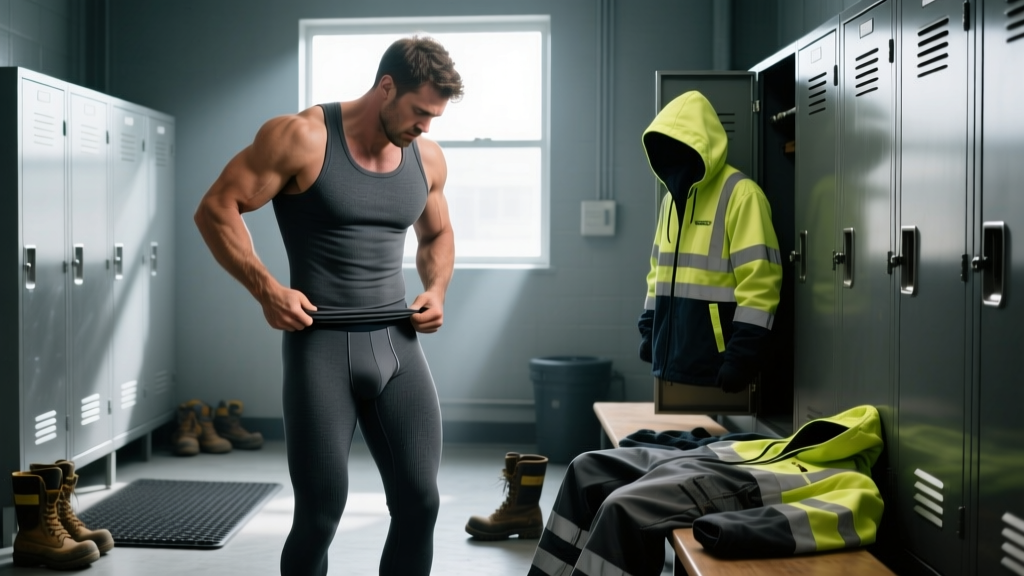
- General Labor, Framing, Roofing (High Sweat, High Mobility): Choose Synthetic Blends (Poly/Spandex) in the summer for maximum wicking and stretch. Switch to 150 GSM Merino Wool if odor control and multi-day wear are priorities.
- Heavy Equipment, Concrete, Outdoor Winter Work: Choose 200-250 GSM Merino Wool. The thermal regulation prevents freezing when sitting still in a cab, and prevents overheating during active shoveling.
- Electricians, Welders, Industrial Pipefitters: Choose FR Modacrylic Blends. Non-negotiable for arc flash and spark hazards. Ensure the garment carries an ASTM F1506 label.
- Drywallers, Painters, Indoor Finishers: Choose Lightweight Synthetics or Cotton-Synthetic Blends. Breathability and low cost are key in climate-controlled environments.
FAQ: Workwear Underwear Maintenance and Longevity
How should I wash FR underwear to maintain its safety rating?
FR modacrylic blends must be washed separately from standard workwear to avoid contamination with flammable substances like grease, oil, or paint thinners. Never use chlorine bleach, hydrogen peroxide, or fabric softeners, as these chemicals coat the fibers and compromise the garment's self-extinguishing properties. Wash in warm water and tumble dry on low.
Why do my synthetic base layers smell bad after just one shift?
Synthetic fibers like polyester are oleophilic, meaning they absorb body oils and sebum, which bacteria feed on to produce odor. To combat this, look for synthetics treated with silver-ion or zinc-oxide anti-microbial technologies. Alternatively, switch to Merino wool, which naturally resists bacterial growth at the molecular level.
What is the best seam construction to prevent chafing from a tool belt?
Look for base layers with flatlock seams or bonded (seamless) edges. Traditional overlock seams create raised ridges that act like sandpaper against the skin when compressed by a heavy leather tool belt, fall-arrest harness, or knee pads. A gusseted crotch is also mandatory for trades requiring deep squatting or climbing ladders.
Written by
Marcus ChenMarcus Chen is a licensed structural engineer (PE) and building materials analyst with over 12 years of experience across residential, commercial, and industrial construction. He holds a Master of Science in Civil Engineering from UC Berkeley and spent six years at Thornton Tomasetti before transitioning to independent consulting and technical writing. Marcus specializes in material selection for seismic-prone regions, concrete reinforcement strategies, and lifecycle cost analysis. His work has been cited by the American Concrete Institute (ACI) and the Structural Engineers Association of California (SEAOC). When he is not on a job site or at his desk, you will find him hiking the Sierra Nevada or restoring a 1920s craftsman bungalow in Oakland, CA.
More from Marcus Chen
View all
Construction Cost
How Much Did the Eiffel Tower Cost to Build?
How much did the Eiffel Tower cost to build in 1889? We adjust for inflation and compare its budget to modern skyscraper construction.
Aug 4, 2026

Fire Resistance
What Is a Fire Resistant Material? Testing & Certification Guide
Discover what is a fire resistant material through ASTM and UL testing. Learn how fire ratings, certifications, and assemblies work in construction.
Aug 4, 2026

Construction Cost
How Much Did the Burj Khalifa Cost to Build?
How much did the Burj Khalifa cost to build? We break down the $1.5B project and extract 5 money-saving strategies for your next build.
Jul 30, 2026