Best Material for Gua Sha: A Stone Fabricator's Guide to Hardness and Thermal Properties
Analyzing the best material for gua sha through material science. Compare Mohs hardness, thermal effusivity, and CNC specs for jade, quartz, and bian stone.

While traditionally evaluated through the lens of dermatology and holistic wellness, selecting the best material for gua sha is fundamentally an exercise in applied mineralogy and precision stone fabrication. For architectural stone suppliers, lapidaries, and CNC fabrication shops, the physical properties of these micro-tools dictate manufacturing viability, tooling wear, and end-user thermodynamic performance. This guide deconstructs the primary geological materials used in gua sha production, analyzing their structural integrity, thermal effusivity, and 5-axis machining parameters from a materials science perspective.
Mineralogical Composition and Fracture Toughness
The structural viability of any stone tool relies on its crystalline matrix. When evaluating the best material for gua sha, fabricators must distinguish between hardness (scratch resistance) and toughness (resistance to fracture and chipping).
Nephrite vs. Jadeite: Amphibole vs. Pyroxene
The term 'jade' encompasses two distinct minerals. Nephrite is a calcium magnesium iron silicate belonging to the amphibole group. Its microscopic structure consists of densely interlocking fibrous crystals (tremolite-actinolite). This felt-like matrix grants nephrite an exceptional fracture toughness—often exceeding 120 MPa·m^1/2—making it virtually immune to edge chipping during CNC profiling or accidental drops on tile flooring.
Conversely, Jadeite is a pyroxene mineral with a granular, interlocking crystal structure. While slightly harder on the Mohs scale (6.5–7.0 compared to nephrite's 6.0–6.5), its granular matrix makes it significantly more brittle. Under tensile stress, jadeite is prone to catastrophic cleavage, requiring more conservative feed rates during edge-routing.
Rose Quartz and Macrocrystalline Silica
Rose quartz is a macrocrystalline variety of silicon dioxide. With a Mohs hardness of 7.0, it offers excellent scratch resistance but suffers from a conchoidal fracture pattern and low tensile strength. Fabricators must account for its brittleness; thin edges (under 2mm) are highly susceptible to micro-chipping during the final polishing stages.
Bian Stone: Microcrystalline Siltstone
Bian stone is not a single crystal but a microcrystalline siltstone rich in trace elements like strontium and titanium. Geologically, it is softer (Mohs 5.5–6.0) and easier to machine, but its primary value lies in its acoustic and thermal properties. Material science analyses have shown that high-grade Bian stone exhibits specific far-infrared (FIR) emission bands (8–15 microns) and generates low-frequency ultrasonic pulses when subjected to friction, properties not found in quartz or jade.
Thermal Effusivity and Surface Thermodynamics
The characteristic 'cooling' sensation of a gua sha tool is frequently misunderstood as a function of the stone's ambient temperature. In reality, it is governed by thermal effusivity—the material's ability to exchange thermal energy with the skin. Effusivity ($e$) is calculated as the square root of the product of thermal conductivity ($k$), density ($\rho$), and specific heat capacity ($c_p$).
| Material | Density (g/cm³) | Thermal Conductivity (W/m·K) | Specific Heat (J/kg·K) | Relative Effusivity |
|---|---|---|---|---|
| Nephrite Jade | 2.95 | 2.8 | 880 | High |
| Rose Quartz | 2.65 | 8.5 | 740 | Very High |
| Bian Stone | 2.70 | 1.5 | 820 | Moderate |
| Obsidian | 2.45 | 1.2 | 800 | Low |
Rose quartz feels significantly 'colder' to the touch than Bian stone because its higher thermal conductivity rapidly draws heat away from the epidermis. For product developers targeting specific thermodynamic feedback, quartz is the superior choice for rapid heat dissipation, while Bian stone retains ambient temperature longer, providing a neutral thermal profile.
CNC Machining and Fabrication Parameters
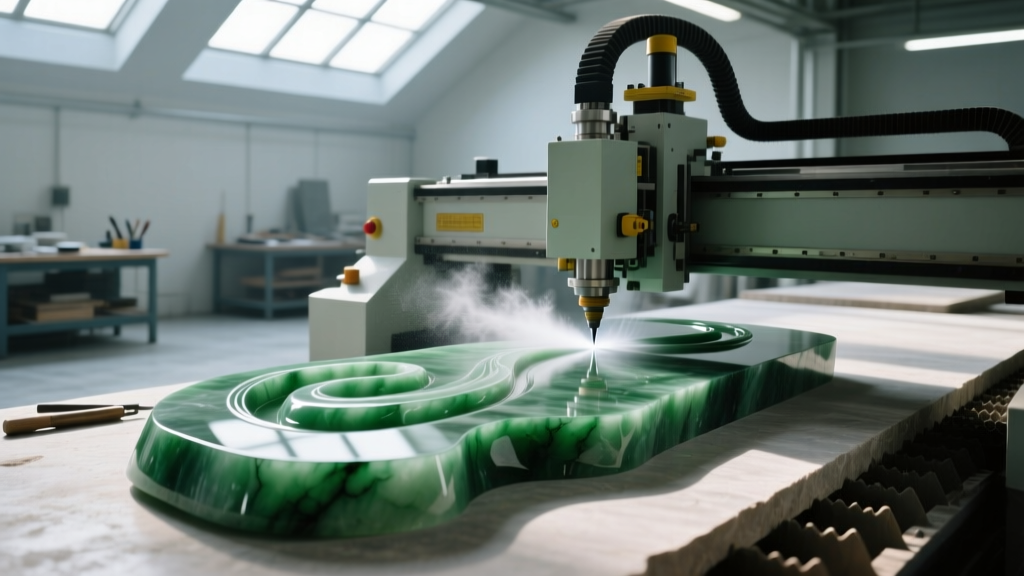
Transitioning from raw slab to contoured micro-tool requires precise 5-axis CNC routing and abrasive waterjet cutting. As of 2026, modern fabrication shops utilize specialized toolpaths to mitigate the unique failure modes of each mineral.
Waterjet Profiling
For initial roughing and complex perimeter cuts, abrasive waterjets operating at 60,000 PSI with 120-mesh garnet are industry standard. However, cutting Obsidian requires a reduction in traverse speed by 30% to prevent edge spalling, as its amorphous volcanic glass structure lacks crystalline boundaries to arrest micro-fractures.
Edge Profiling and Rounding
The ergonomic edges of a gua sha tool require a multi-step profiling process. For Nephrite, a 1/4-inch ball-nose diamond bit can safely execute a 0.5mm depth of cut per pass at 18,000 RPM. For Rose Quartz, the depth of cut must be reduced to 0.2mm per pass to prevent conchoidal chipping along the tool's perimeter.
Polishing and Surface Finishing Protocols
Achieving a zero-friction surface finish is critical for dermatological applications. The polishing protocol varies strictly by mineral hardness.
- Nephrite & Bian Stone: Can be polished using traditional cerium oxide slurries on felt wheels. The fibrous and microcrystalline structures respond well to chemical-mechanical planarization, yielding a glass-like finish at 3,000 grit.
- Rose Quartz & Jadeite: Cerium oxide is largely ineffective on Mohs 7.0 materials. Fabricators must use progressive diamond suspensions (400, 800, 1500, 3000, and finally 14,000 grit) applied via polyurethane polishing pads to achieve optical clarity.
- Obsidian: Requires careful handling. Because it is an amorphous glass, it can be polished to an atomic-level finish using tin oxide and water, but excessive downward pressure during buffing will cause localized thermal fracturing.
Troubleshooting Fabrication Defects
Even with optimized parameters, stone fabricators encounter specific defects when producing high volumes of contoured wellness tools. Below is a diagnostic framework for common manufacturing failures.
Defect: Edge Chipping in Quartz
Cause: Tensile failure during the final CNC profiling pass, typically caused by tool deflection or excessive feed rates.
Solution: Implement a 'finish pass' with a maximum radial engagement of 0.1mm. Ensure the workpiece is secured using a sacrificial MDF spoil board with a vacuum chuck to eliminate harmonic vibration.
Defect: Orange Peel Effect on Nephrite
Cause: Overheating during the cerium oxide polishing phase, causing the polishing pad to glaze and skip across the fibrous surface.
Solution: Increase coolant flow rate and reduce spindle RPM during the final polish. Switch to a softer, open-cell foam polishing pad to distribute pressure evenly across the contoured topography.
Defect: Thermal Cracking in Obsidian
Cause: Localized heat buildup during dry routing or aggressive sanding, leading to rapid expansion and stress fractures.
Solution: Obsidian must only be shaped using wet-grinding techniques. Never use pneumatic orbital sanders without continuous water misting.
Material Selection Matrix for Buyers and Fabricators
Choosing the best material for gua sha depends entirely on the manufacturing capabilities of the shop and the desired end-user experience.
| Application Priority | Recommended Material | Fabrication Complexity |
|---|---|---|
| Maximum Drop Resistance & Durability | Nephrite Jade | Moderate (High tool wear, low breakage) |
| Rapid Thermal Dissipation (Cooling) | Rose Quartz | High (Requires diamond tooling, prone to chipping) |
| FIR Emission & Acoustic Resonance | Bian Stone | Low (Easy to machine, standard abrasives) |
| Ultra-Low Cost / High Volume | Obsidian / Aventurine | Moderate (Fast cutting, high waste/spalling) |
By treating the production of these tools as a precise materials science challenge rather than a simple lapidary craft, fabricators can drastically reduce scrap rates, optimize CNC toolpaths, and deliver structurally superior products that meet exact thermodynamic specifications.
Written by
Sarah WhitfieldSarah Whitfield is a chartered quantity surveyor (MRICS) and construction cost analyst with 15 years of experience in material pricing, procurement strategy, and project budgeting. She earned her degree in Construction Management from the University of Reading (UK) and has worked on projects ranging from $2M custom homes to $180M mixed-use developments across North America and Europe. Sarah currently leads cost estimating for BuildMat Insight, maintaining a proprietary database of 4,000+ material price points updated quarterly. She is a frequent contributor to RSMeans cost data panels and has presented at the International Cost Engineering Council (ICEC) congress. Based in Denver, CO, Sarah is an avid trail runner and volunteer mentor for Women in Construction.
More from Sarah Whitfield
View all
Wood & Lumber
What Are the Different Types of Wood? A Builder's Guide
Compare structural softwoods, finish hardwoods, and engineered lumber. Analyze Janka ratings, MOE values, and 2026 pricing for construction.
Aug 4, 2026

Walls & Panels
Steel Framing vs Wood Framing: Corrosion and Moisture Defense
Compare steel framing vs wood framing for moisture resistance. Learn about galvanized coatings, condensation risks, and corrosion protection strategies.
Jul 21, 2026

Stone & Masonry
How to Cut Stone Veneer: Wet Saw vs Grinder Comparison
Compare the best tools for cutting stone veneer. We review wet saws, angle grinders, and chop saws to help you achieve clean, chip-free cuts.
Jul 21, 2026